
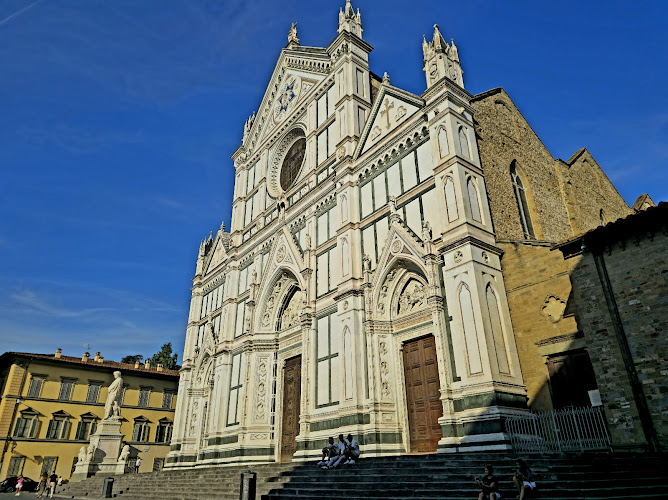
Basilica of Santa Croce in Florence
About Basilica of Santa Croce in Florence
Description
The Basilica of Santa Croce in Florence is one of those places that quietly messes with your sense of time. You walk in expecting another big, beautiful church (Florence has plenty, let’s be honest), and then you realize you’re standing among the tombs of people who basically rewired Western thought. Michelangelo. Galileo. Machiavelli. And you’re just… there, wearing sneakers, trying not to trip over history.
Santa Croce is a Neo-Gothic Franciscan basilica, though parts of it feel older in spirit than the label suggests. Construction started in the late 1200s, and you can feel that medieval ambition in the sheer scale of the place. The interior is wide and luminous, less dark and mysterious than some churches. Light spills in, especially on sunny afternoons, bouncing off stone floors and frescoed walls. It feels open, thoughtful, and oddly approachable for something so monumental.
The Franciscan roots matter here. This was never meant to be a flashy power-church dripping in gold. It was meant to teach, to inspire, and to keep faith connected to everyday life. And that comes through. The Giotto frescoes, tucked into chapels along the sides, tell stories with emotion and clarity. Faces actually look human, not stiff icons. I remember standing there longer than planned, because one scene just hit differently. Maybe jet lag helped, who knows.
What travelers often don’t expect is how Santa Croce functions as a kind of national pantheon. Italians sometimes call it the Temple of the Italian Glories, and yeah, that sounds dramatic, but once you see the names carved into marble, it clicks. These aren’t symbolic burials either. Many of them are actually here. The mood isn’t gloomy though. It’s respectful, proud, and oddly energizing.
Outside, the marble façade is a 19th-century addition, all crisp lines and patterns. Some purists grumble that it’s not original. Personally? I like the contrast. It’s Florence admitting that history is layered, sometimes patched together, and still worth admiring. Plus, the square out front has its own rhythm, street musicians, locals passing through, kids kicking balls. Life continuing, as it should.
Key Features
- The tomb of Michelangelo, complete with allegorical statues representing Painting, Sculpture, and Architecture
- Galileo Galilei’s monumental tomb, a quiet victory after his complicated relationship with the Church
- Giotto frescoes in the Bardi and Peruzzi Chapels, essential for understanding early Renaissance art
- The Pazzi Chapel, a masterpiece of Renaissance harmony and geometry (and a nice breather from crowds)
- Wide nave and uncluttered interior that feels calmer than many Florentine churches
- Accessible entrances and restrooms, which honestly matters more than guidebooks admit
- A functioning Franciscan complex, not just a museum in disguise
Best Time to Visit
If you can swing it, go early in the morning on a weekday. That’s when Santa Croce feels most like itself. Fewer tour groups, more quiet footsteps, and a kind of soft echo that makes you lower your voice without being told. Late afternoon is also nice, especially when sunlight angles in and warms the stone. But midday? That’s when it gets busy, a bit rushed, and the atmosphere shifts toward checklist tourism.
Season matters too. Spring and fall are ideal, not shocking news, but Santa Croce specifically benefits from moderate weather. In summer, Florence can feel like a brick oven, and the basilica becomes a refuge. Cool inside, calm, and honestly a sanity saver. In winter, it’s quieter, though a bit chilly. Bring a layer. I once underestimated that and spent the visit half-distracted by cold toes.
Religious holidays can change the vibe. Sometimes parts are closed, sometimes there are services that add depth if you’re respectful and patient. But if you’re purely sightseeing, check timing so you don’t arrive mid-mass and feel awkward hovering near a tomb.
How to Get There
Santa Croce is in the eastern part of Florence’s historic center, and walking is usually the best option. Florence is compact, and half the joy is wandering streets that suddenly open into a square you didn’t plan on seeing. From the Duomo area, it’s an easy stroll, maybe 10 to 15 minutes depending on how distracted you get by gelato stops (very distracted, in my case).
Buses run nearby and are useful if you’re coming from farther out, but they can be crowded and slightly confusing if you’re new to the city. Taxis work too, though honestly they feel unnecessary unless mobility is an issue. And if you’re already near the Arno, walking along the river and cutting inland is a pleasant approach. You sort of ease into the experience instead of being dropped at the door.
Tips for Visiting
First tip, and I say this with love: slow down. Santa Croce is not a quick in-and-out spot unless you want it to be. Give it at least an hour. Two, if you’re into art or history. Sit on a bench. Watch how people move through the space. I once overheard a kid asking why there were so many dead famous people in one place, and honestly, fair question.
Dress respectfully. This is still a working church. Shoulders covered, shorts not too short. They do enforce it, and nothing kills the mood like being turned away because it’s 35°C and you dressed accordingly.
Consider an audio guide if you’re not deeply familiar with Italian history. The stories behind the tombs and chapels add layers you’d otherwise miss. That said, don’t feel glued to it. Wander off-script when something catches your eye.
If accessibility matters for you or someone you’re traveling with, Santa Croce does a decent job. Wheelchair-accessible entrances and restrooms are available, which sadly isn’t a given in historic sites. Just note that some areas still have uneven flooring, because medieval builders weren’t thinking about modern wheels.
And one last thing: step outside after your visit and hang around the square for a bit. Grab a coffee nearby, watch Florentine life roll on, and let what you saw sink in. Santa Croce isn’t just about checking off Michelangelo’s tomb. It’s about feeling the long, messy, brilliant stretch of human creativity. And if that sounds heavy, don’t worry. It lands lighter than you’d think.
Key Features
- The tomb of Michelangelo, complete with allegorical statues representing Painting, Sculpture, and Architecture
- Galileo Galilei’s monumental tomb, a quiet victory after his complicated relationship with the Church
- Giotto frescoes in the Bardi and Peruzzi Chapels, essential for understanding early Renaissance art
- The Pazzi Chapel, a masterpiece of Renaissance harmony and geometry (and a nice breather from crowds)
- Wide nave and uncluttered interior that feels calmer than many Florentine churches
- Accessible entrances and restrooms, which honestly matters more than guidebooks admit
- A functioning Franciscan complex, not just a museum in disguise
More Details
Updated December 31, 2025
Table of Contents
- Description
- Key Features
- Best Time to Visit
- How to Get There
- Tips for Visiting
- Key Highlights
- Location
- Places to Stay Near Basilica of Santa Croce in Florence
- Find and Book a Tour
- Explore More Travel Guides
- Nearby Places You Might Like
- Traveler Reviews for Basilica of Santa Croce in Florence
- Share Your Experience
Description
The Basilica of Santa Croce in Florence is one of those places that quietly messes with your sense of time. You walk in expecting another big, beautiful church (Florence has plenty, let’s be honest), and then you realize you’re standing among the tombs of people who basically rewired Western thought. Michelangelo. Galileo. Machiavelli. And you’re just… there, wearing sneakers, trying not to trip over history.
Santa Croce is a Neo-Gothic Franciscan basilica, though parts of it feel older in spirit than the label suggests. Construction started in the late 1200s, and you can feel that medieval ambition in the sheer scale of the place. The interior is wide and luminous, less dark and mysterious than some churches. Light spills in, especially on sunny afternoons, bouncing off stone floors and frescoed walls. It feels open, thoughtful, and oddly approachable for something so monumental.
The Franciscan roots matter here. This was never meant to be a flashy power-church dripping in gold. It was meant to teach, to inspire, and to keep faith connected to everyday life. And that comes through. The Giotto frescoes, tucked into chapels along the sides, tell stories with emotion and clarity. Faces actually look human, not stiff icons. I remember standing there longer than planned, because one scene just hit differently. Maybe jet lag helped, who knows.
What travelers often don’t expect is how Santa Croce functions as a kind of national pantheon. Italians sometimes call it the Temple of the Italian Glories, and yeah, that sounds dramatic, but once you see the names carved into marble, it clicks. These aren’t symbolic burials either. Many of them are actually here. The mood isn’t gloomy though. It’s respectful, proud, and oddly energizing.
Outside, the marble façade is a 19th-century addition, all crisp lines and patterns. Some purists grumble that it’s not original. Personally? I like the contrast. It’s Florence admitting that history is layered, sometimes patched together, and still worth admiring. Plus, the square out front has its own rhythm, street musicians, locals passing through, kids kicking balls. Life continuing, as it should.
Key Features
- The tomb of Michelangelo, complete with allegorical statues representing Painting, Sculpture, and Architecture
- Galileo Galilei’s monumental tomb, a quiet victory after his complicated relationship with the Church
- Giotto frescoes in the Bardi and Peruzzi Chapels, essential for understanding early Renaissance art
- The Pazzi Chapel, a masterpiece of Renaissance harmony and geometry (and a nice breather from crowds)
- Wide nave and uncluttered interior that feels calmer than many Florentine churches
- Accessible entrances and restrooms, which honestly matters more than guidebooks admit
- A functioning Franciscan complex, not just a museum in disguise
Best Time to Visit
If you can swing it, go early in the morning on a weekday. That’s when Santa Croce feels most like itself. Fewer tour groups, more quiet footsteps, and a kind of soft echo that makes you lower your voice without being told. Late afternoon is also nice, especially when sunlight angles in and warms the stone. But midday? That’s when it gets busy, a bit rushed, and the atmosphere shifts toward checklist tourism.
Season matters too. Spring and fall are ideal, not shocking news, but Santa Croce specifically benefits from moderate weather. In summer, Florence can feel like a brick oven, and the basilica becomes a refuge. Cool inside, calm, and honestly a sanity saver. In winter, it’s quieter, though a bit chilly. Bring a layer. I once underestimated that and spent the visit half-distracted by cold toes.
Religious holidays can change the vibe. Sometimes parts are closed, sometimes there are services that add depth if you’re respectful and patient. But if you’re purely sightseeing, check timing so you don’t arrive mid-mass and feel awkward hovering near a tomb.
How to Get There
Santa Croce is in the eastern part of Florence’s historic center, and walking is usually the best option. Florence is compact, and half the joy is wandering streets that suddenly open into a square you didn’t plan on seeing. From the Duomo area, it’s an easy stroll, maybe 10 to 15 minutes depending on how distracted you get by gelato stops (very distracted, in my case).
Buses run nearby and are useful if you’re coming from farther out, but they can be crowded and slightly confusing if you’re new to the city. Taxis work too, though honestly they feel unnecessary unless mobility is an issue. And if you’re already near the Arno, walking along the river and cutting inland is a pleasant approach. You sort of ease into the experience instead of being dropped at the door.
Tips for Visiting
First tip, and I say this with love: slow down. Santa Croce is not a quick in-and-out spot unless you want it to be. Give it at least an hour. Two, if you’re into art or history. Sit on a bench. Watch how people move through the space. I once overheard a kid asking why there were so many dead famous people in one place, and honestly, fair question.
Dress respectfully. This is still a working church. Shoulders covered, shorts not too short. They do enforce it, and nothing kills the mood like being turned away because it’s 35°C and you dressed accordingly.
Consider an audio guide if you’re not deeply familiar with Italian history. The stories behind the tombs and chapels add layers you’d otherwise miss. That said, don’t feel glued to it. Wander off-script when something catches your eye.
If accessibility matters for you or someone you’re traveling with, Santa Croce does a decent job. Wheelchair-accessible entrances and restrooms are available, which sadly isn’t a given in historic sites. Just note that some areas still have uneven flooring, because medieval builders weren’t thinking about modern wheels.
And one last thing: step outside after your visit and hang around the square for a bit. Grab a coffee nearby, watch Florentine life roll on, and let what you saw sink in. Santa Croce isn’t just about checking off Michelangelo’s tomb. It’s about feeling the long, messy, brilliant stretch of human creativity. And if that sounds heavy, don’t worry. It lands lighter than you’d think.
Key Highlights
- The tomb of Michelangelo, complete with allegorical statues representing Painting, Sculpture, and Architecture
- Galileo Galilei’s monumental tomb, a quiet victory after his complicated relationship with the Church
- Giotto frescoes in the Bardi and Peruzzi Chapels, essential for understanding early Renaissance art
- The Pazzi Chapel, a masterpiece of Renaissance harmony and geometry (and a nice breather from crowds)
- Wide nave and uncluttered interior that feels calmer than many Florentine churches
- Accessible entrances and restrooms, which honestly matters more than guidebooks admit
- A functioning Franciscan complex, not just a museum in disguise
Location
Places to Stay Near Basilica of Santa Croce in Florence
Find and Book a Tour
Explore More Travel Guides
No reviews found! Be the first to review!
Traveler Reviews for Basilica of Santa Croce in Florence
There are no reviews yet. Be the first one to write one.
Have you visited Basilica of Santa Croce in Florence? Help other travelers by sharing your review.
You Might Also Like

Piazza della Signoria

Basilica di San Miniato

Piazzale Michelangelo
Find Accommodations Nearby
Recommended Tours & Activities
Visitor Reviews
There are no reviews yet. Be the first one to write one.
Share Your Experience
Have you visited Basilica of Santa Croce in Florence? Help other travelers by leaving a review.