
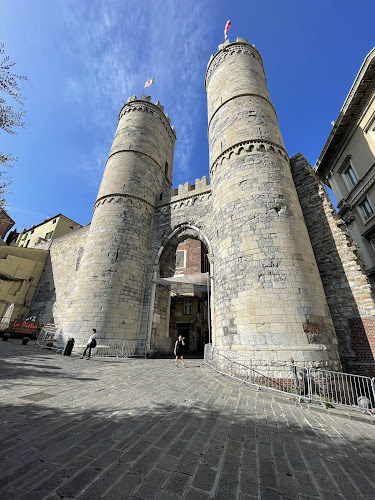
Porta Soprana
About Porta Soprana
Description
The Porta Soprana stands as one of Genoa’s most impressive medieval gateways, serving as a powerful reminder of the city’s rich maritime past and strategic importance during the Middle Ages. Built in the 12th century as part of Genoa’s defensive walls, this towering structure features two massive cylindrical towers that still command attention from anyone walking through the historic center. The gate was constructed during a period when Genoa was establishing itself as one of the Mediterranean’s most powerful maritime republics, competing with Venice and Pisa for control of lucrative trade routes.
Walking up to the Porta Soprana for the first time can be quite striking—these aren’t delicate decorative towers but serious defensive structures that meant business. The stonework tells stories of centuries past, and you can almost imagine armored guards stationed at the top, keeping watch over who entered and left the city. The restoration work done in the 19th and 20th centuries has helped preserve this monument, though it maintains that authentic medieval character that makes it so compelling.
What many visitors don’t immediately realize is that the Porta Soprana isn’t just a single gate—it’s part of a larger defensive system that once encircled the entire city. The towers rise approximately 20 meters high, and the thickness of the walls reflects the military engineering knowledge of the era. When you stand beneath the archway, you’re literally walking through the same passage that merchants, soldiers, sailors, and ordinary citizens used for hundreds of years.
The area around Porta Soprana has its own distinct atmosphere. It’s located in what’s still a living, breathing neighborhood rather than being completely touristified, which I personally find refreshing. You’ll see locals going about their daily business, which adds to the authentic feel of experiencing this medieval structure in its original context.
Key Features
The Porta Soprana offers visitors several distinctive elements that make it worth including on any Genoa itinerary:
• Two imposing cylindrical towers that rise dramatically above the surrounding neighborhood, providing excellent photo opportunities from multiple angles
• Original 12th-century stonework and architectural details that showcase medieval construction techniques and defensive design principles
• The massive archway passage that allows visitors to walk directly through the gate, experiencing the structure as it was originally intended
• Proximity to the alleged house of Christopher Columbus, creating a concentrated area of historical interest within easy walking distance
• Remnants of the ancient city walls extending from the gate, giving context to Genoa’s medieval urban planning and defensive strategies
• Architectural features including arrow slits, defensive positions, and fortification elements that illustrate medieval military engineering
• The contrast between the rough medieval stonework and the surrounding neighborhood, showing how the city has evolved over centuries
• Viewing platforms and areas where the scale and construction methods become apparent up close
• Kid-friendly accessibility that makes it easy for families to explore without difficult climbs or restricted areas
• The gate’s position as a natural transition point between different historical areas of Genoa’s old town
Best Time to Visit
Timing your visit to Porta Soprana can really affect your experience, and I’ve learned this applies to most historical monuments—not all hours are created equal. The best time to visit is during the morning hours, particularly between 9 AM and 11 AM when the lighting is excellent for photography and the area hasn’t yet filled with afternoon tour groups. The morning sun hits the towers at an angle that really brings out the texture of the stone and creates dramatic shadows that emphasize the structure’s imposing nature.
Seasonally speaking, spring and autumn offer ideal conditions for exploring Genoa’s outdoor monuments. The temperatures are comfortable for walking around the old town, usually ranging between 15-22 degrees Celsius, and you won’t be dealing with the intense summer heat that can make extended outdoor exploration less pleasant. But here’s the thing—summer isn’t necessarily bad if you plan around it. Early summer mornings before 10 AM can be absolutely lovely, with that Mediterranean light that photographers dream about.
Winter visits have their own appeal, honestly. The crowds thin out considerably, and there’s something atmospheric about seeing these medieval towers against grey winter skies. Sure, it might be chillier, but you’ll often have the space more to yourself, which allows for a more contemplative experience. Plus, the nearby cafes feel more inviting when there’s a bit of chill in the air.
Avoid visiting during the middle of the day in peak summer months—roughly July and August between noon and 3 PM. The combination of heat, harsh overhead lighting, and maximum tourist traffic can diminish the experience. And if you’re visiting on weekends, especially during cruise ship season, expect more crowds regardless of the hour.
One more consideration: if you’re interested in photography, late afternoon about an hour before sunset provides beautiful golden light, though the orientation of the towers means you’ll want to experiment with different angles to avoid backlighting issues.
How to Get There
Getting to Porta Soprana is relatively straightforward, and the gate’s location in the historic center means you have several transportation options. If you’re arriving by train at Genova Piazza Principe or Genova Brignole stations, the easiest approach is using the metro. Take Line 1 to San Giorgio station, and from there it’s about a 10-minute walk through the old town. The walk itself is pleasant and gives you a sense of the city’s layout before you reach the gate.
For those staying in the central area, walking is probably your best option. Genoa’s historic center is quite compact, and the Porta Soprana is within walking distance of most hotels in the old town. From the Porto Antico waterfront area, it’s roughly a 15-minute walk inland. The route takes you through some interesting streets, though be prepared for a few uphill sections—Genoa isn’t called a vertical city for nothing.
Bus services also connect to the area, with several lines stopping near Via Dante or Piazza De Ferrari, both within easy walking distance. The bus system in Genoa can be a bit confusing for first-timers, so I’d recommend getting a transit map from your hotel or downloading one of the local transit apps.
If you’re driving, well, here’s where things get tricky. The historic center has limited vehicle access, and parking can be challenging. There is paid parking available in the vicinity, but you’ll likely need to use one of the multi-story car parks on the edges of the old town and then walk in. The walk from these parking areas to Porta Soprana typically takes 10-15 minutes.
Taxis and ride-sharing services can drop you nearby, though they may not be able to get right up to the monument depending on traffic restrictions. The closest they’ll usually get is along Via Dante or one of the main thoroughfares.
Tips for Visiting
Making the most of your visit to Porta Soprana requires a bit of planning and some insider knowledge that guidebooks don’t always share. First off, wear comfortable walking shoes—and I can’t stress this enough. The streets around the gate are paved with those traditional stone blocks that look charming but can be uneven and slippery when wet. Your Instagram-worthy sandals can wait for another day.
The monument itself is best appreciated from multiple angles, so don’t just snap a photo from one spot and move on. Walk around the structure, approach it from different streets, and take time to examine the details in the stonework. There are spots where you can see how the walls were constructed and how they’ve been repaired over the centuries, which is genuinely interesting if you’re into that kind of thing.
Since the area is good for kids, families should know that while the monument is accessible, young children need supervision. There aren’t dangerous drops or anything like that, but the uneven terrain and the occasional traffic nearby mean you’ll want to keep an eye on energetic youngsters. The towers themselves spark imagination, and I’ve seen kids really engage with the medieval history in a way that museum displays don’t always achieve.
Combine your visit with the nearby House of Columbus (or at least the building claimed to be his childhood home) to make efficient use of your time. The two sites are practically adjacent, and seeing them together gives you a richer sense of medieval Genoa. There are also several cafes and small restaurants in the surrounding streets where you can grab an espresso or a focaccia—the local specialty that you absolutely need to try while in Genoa.
Photography enthusiasts should bring a wide-angle lens if you have one, as the towers are tall and the surrounding streets are narrow, making it challenging to capture the full structure otherwise. Early morning or late afternoon light works best, as mentioned earlier, but even midday shots can work if you expose for the shadows and don’t mind doing some post-processing.
Don’t expect extensive signage or information boards at the monument itself. This isn’t a highly curated museum experience—it’s an authentic medieval structure that’s part of the living city. Consider downloading some background information before you visit or hiring a local guide if you want detailed historical context. Some visitors find this lack of interpretation disappointing, but others (myself included) appreciate the unmediated encounter with history.
The paid parking situation means you should factor in extra time if you’re driving. Don’t assume you’ll find a spot quickly. In Genoa’s historic center, parking can eat into your schedule if you’re not careful about it.
Finally, remember that this is still a neighborhood where people live and work. Be respectful of residents, keep noise levels reasonable, and don’t block doorways or business entrances while taking photos. The locals are generally friendly and proud of their city’s history, but treating their home like a theme park won’t win you any friends.
Key Features
- Key Features
- Best Time to Visit
- How to Get There
- Tips for Visiting
Tours & Activities
GetYourGuide provides this tour inventory. We may earn a commission if you book through it; verify current availability, prices, and terms with the provider.
Visitor Reviews
There are no reviews yet. Be the first one to write one.
Share Your Experience
Have you visited Porta Soprana? Help other travelers by leaving a review.