
Karl Marx House
About Karl Marx House
Key Features
More Details
Updated April 16, 2024
Karl-Marx-Haus – Museen – Tourist-Information Trier
## Karl Marx House (Karl-Marx-Haus), Trier: what it is, what you’ll actually see, and how to visit well
Karl-Marx-Haus is a compact museum inside the baroque townhouse where Karl Marx was born in Trier (Brückenstraße 10). Marx only spent a short part of his life in this building, but the museum uses the birthplace setting to explain how he became Marx: the places he lived across Europe, the networks he built, the work habits behind his writing, and the long afterlife of his ideas.
If you’re in Trier for Roman sites and Moselle wine culture, this stop adds a different layer: 19th-century industrialization, political exile, journalism, and the way texts can outgrow their authors.
### Quick facts (for your planning)
– Official name: Museum Karl-Marx-Haus (Karl Marx House)
– Address: Brückenstraße 10, 54290 Trier, Germany
– Coordinates: 49.7538992, 6.6357955 (from your dataset)
– What it is: Marx’s birthplace + a permanent exhibition redesigned for his 200th birthday year (2018)
– Public transport: From Trier Hbf, buses 3, 13, 83 to the stop Karl-Marx-Haus
– Parking reality: No public parking right by the museum; Cityparkhaus is about a 10-minute walk
> Outdated-data flag: You may find older “opening hours 2019” pages circulating online. Treat those as historical.
—
## Why this museum is worth your time (even if you’re not “into Marx”)
The strongest reason to visit isn’t to “agree” or “disagree” with Marx. It’s to understand the mechanics of influence: how a person, working in specific cities under pressure, produces ideas that later get adopted, adapted, or weaponized by others.
The permanent exhibition was completely reworked in 2018 and is organized to follow Marx’s life across Europe while also examining his roles (writer, journalist, political figure), his methods, his networks, and the legacy of his work from the late 19th century onward.
That framing matters because it keeps the visit from turning into a single-track “hero” narrative. It also helps you separate:
– Marx the person (and his working life),
– Marxism as later interpretations, and
– 20th-century political history that often gets attached to his name.
—
## What you’ll see inside (high-signal highlights)
Because it’s a house museum, people sometimes expect preserved period rooms. Instead, the emphasis is on interpretation—objects and displays that tie biography to bigger historical forces.
Notable elements called out in visitor information include:
– A reading chair described as the chair in which Marx is said to have died
– Marx’s personal pocket watch
The museum’s own description stresses the permanent exhibition’s focus on Marx as a person and a 19th-century critic of society and capitalism.
### A smart way to “read” the exhibits
To get more out of the visit, keep three threads running as you move through the displays:
1. Places: Trier → broader Europe (movement, exile, intellectual exchange).
2. Work: How writing, research, and publishing worked in the 19th century (slow, physical, networked).
3. Legacy: How ideas persist beyond their initial context—and how they change when scaled to mass politics.
This approach keeps the museum from feeling like a quick biographical loop and instead turns it into a case study in modern history.
—
## How to visit well: hours, tickets, and entry quirks
For current hours and ticketing, the museum points visitors to its online shop/booking system.
One publicly posted FAQ for online ticketing states:
– Open Tuesday–Sunday, 10:00–18:00 (winter hours listed as 15 Nov–14 Mar)
– Closed Mondays, with limited exceptions noted
– No admission 13:00–13:30 and last admission 17:30
– Closing days include Rose Monday and specific late-December/New Year dates
Because hours can change seasonally or for events, treat the above as published guidance, and double-check before you go—especially if you’re visiting around Carnival or Christmas–New Year.
—
## Getting there in real life
### By bus (easy, reliable)
From Trier’s main station, the museum can be reached using bus lines 3, 13, or 83 to the stop Karl-Marx-Haus.
### By car (plan the last 10 minutes on foot)
There are no public parking facilities nearby, but the Cityparkhaus is roughly a 10-minute walk away.
—
## Context that makes the visit click (Trier + the 19th century)
Trier is often sold through its Roman layer—amphitheater, Porta Nigra, imperial baths. Karl-Marx-Haus adds a later layer: the Europe of censorship, industrial labor, political organizing, and fast-changing cities.
The museum description explicitly positions the exhibition around Marx’s life through Europe and the networks he built. That’s useful because it frames Trier not as the whole story, but as the starting point of a much larger map.
If you’re traveling with a group, note that interest levels can vary sharply—some visitors come for political history, others for intellectual history, and some just because it’s a major Trier landmark. A good inclusive approach is to treat it as a history museum about a globally influential thinker, not as a test of ideology.
—
## Pair it with nearby Trier stops (to build a coherent half-day)
To keep your day flowing, pair Karl-Marx-Haus with one of Trier’s “anchor” sights and one slower stop (café, riverside walk). For RealJourneyTravels-style planning, two internal link ideas:
– More in the city: Best things to do in Trier
– Roman cornerstone nearby: Porta Nigra visitor guide
—
## Visitor mindset: what this place is—and what it isn’t
Karl-Marx-Haus is not designed as a shrine, and it isn’t a dense academic archive either. It’s a public museum that uses a birthplace setting to explain:
– a person (Marx),
– a century (industrial/modern Europe),
– and a legacy (the persistence of social critique).
If you go in expecting a handful of “original manuscripts behind glass,” you may be disappointed unless a specific temporary exhibit promises that. The safe expectation, based on official descriptions, is a modern permanent exhibition focused on biography, networks, methods, and legacy.
—
## At-a-glance summary
– Best for: travelers who like modern European history, political ideas, biography museums, and “why this mattered” context
– Plan for: a focused museum visit plus a short walk through central Trier
– Don’t miss: the permanent exhibition narrative structure and the specific highlighted objects (chair, pocket watch)
If you want, I can also generate the schema-ready Place + TouristAttraction JSON-LD for this listing using your fields (name, geo, address, rating) while keeping it strictly factual.
Table of Contents
Key Highlights
Karl Marx House
Location
Places to Stay Near Karl Marx House
Find and Book a Tour
Explore More Travel Guides
No reviews found! Be the first to review!
Traveler Reviews for Karl Marx House
There are no reviews yet. Be the first one to write one.
Have you visited Karl Marx House? Help other travelers by sharing your review.
You Might Also Like
Hauptmarkt
Dreikönigenhaus
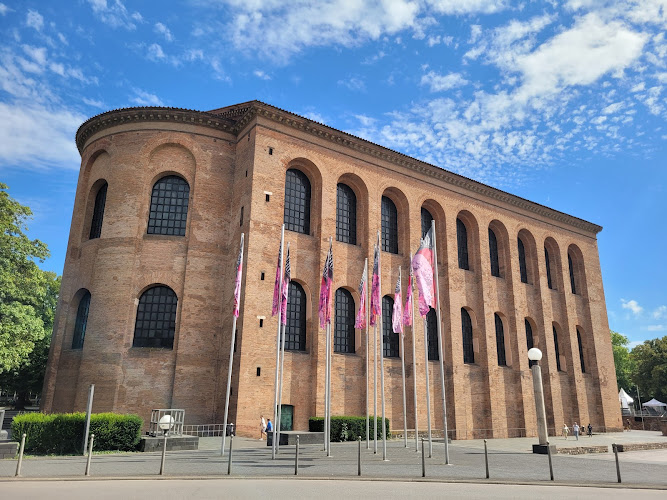
Konstantin-Basilika (Evangelische Kirche zum Erlöser)- Evangelische Kirchengemeinde Trier
Find Accommodations Nearby
Recommended Tours & Activities
Visitor Reviews
There are no reviews yet. Be the first one to write one.
Share Your Experience
Have you visited Karl Marx House? Help other travelers by leaving a review.