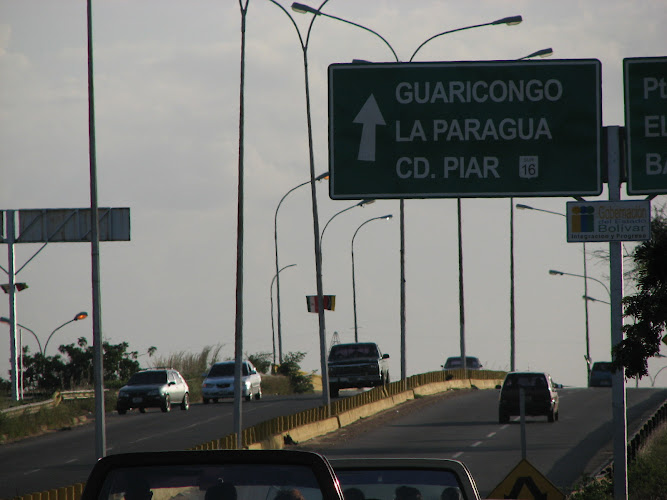
The Distribuidor Guaricongo in Ciudad Bolívar is an unassuming yet characterful urban landmark where busy Av. Perimetral channels traffic around a distinctive roundabout and flyover. Rooted in the city’s mid-to-late 20th century push to modernize transport links across the narrow stretch of the Orinoco valley, the distributor reflects Ciudad Bolívar’s adaptation to growing vehicular movement while preserving the town’s historic core nearby. From a travel-writer’s view it’s worth a pause: the structure frames lively street scenes, offers a glimpse into everyday Venezuelan city life, and provides useful vantage points for photographers capturing the juxtaposition of functional infrastructure and colonial-era neighborhoods a short drive away. Travelers interested in urban design, local commuting rhythms, or quick panoramic shots en route to the Orinoco riverfront will appreciate a brief stop. It’s not a museum piece but a civic crossroads that tells a small, authentic story about how a historic city handles modern mobility — best appreciated while exploring Ciudad Bolívar’s nearby plazas, riverside promenades, and colorful streets.
Highlights & Key Features
Prominent roundabout and flyover on Av. Perimetral
Good vantage for observing local urban life and traffic patterns
Close proximity to Ciudad Bolívar historic center and riverfront
Photogenic contrasts of modern infrastructure and colonial architecture nearby
Easily reached by car or local transit
Visitor Guide & Information
Description
The Distribuidor Guaricongo stands as one of those fascinating urban landmarks that most travelers zip past without a second glance, but honestly, that’s their loss. This traffic circle represents far more than just a place where cars merge and diverge – it’s actually a significant point in understanding how modern infrastructure intersects with the daily rhythm of local life in the Dominican Republic.
When you first encounter the Distribuidor Guaricongo, you might wonder what makes a traffic roundabout worthy of being labeled a historical landmark. And that’s a fair question. But here’s the thing: this isn’t just any ordinary intersection. The structure serves as a major artery connecting different neighborhoods and districts, making it a genuine crossroads where the pulse of the city becomes tangible. I remember the first time a local taxi driver explained to me how every neighborhood has its own personality, and you can sense the transition just by passing through this distribuidor.
The engineering behind this roundabout reflects a particular era of urban planning in the Caribbean, where rapid modernization met the practical needs of a growing population. Traffic flows in multiple directions here, creating this constant ballet of vehicles that somehow manages to work despite what might initially appear as controlled chaos to the uninitiated visitor. The landmark status comes from its role in the community’s development and its function as a recognizable reference point that locals have used for generations to navigate their city.
What strikes most observant travelers is how the Distribuidor Guaricongo acts as an informal gathering point and a marker in people’s mental maps of the area. You’ll hear locals giving directions like “two blocks past Guaricongo” or “meet me near the distribuidor,” which shows how deeply embedded this structure has become in the social fabric. It’s not glamorous in the traditional tourist sense, but it offers something arguably more valuable – an authentic glimpse into how cities actually function beyond the postcard-perfect images.
Key Features
The Distribuidor Guaricongo offers several characteristics that make it worth noting for travelers who appreciate urban landmarks:
Strategic location that connects multiple major thoroughfares, making it a central point for understanding the city’s layout and transportation networks
Architectural design that represents a specific period of Caribbean urban development, showcasing how infrastructure evolved to meet growing traffic demands
Serves as a reliable navigation landmark that even GPS-dependent travelers find useful when the technology fails (which, let’s be honest, happens more often than we’d like)
Provides insight into daily commuter patterns and local driving culture, offering an anthropological perspective on urban life
Acts as a transitional zone between different neighborhoods, each with distinct characteristics that become apparent as you pass through
Features practical elements like signage and road markings that reflect bilingual influences and local design standards
Surrounded by local businesses and establishments that cater primarily to residents rather than tourists, creating opportunities for authentic interactions
Represents the type of functional landmark that doesn’t appear in typical guidebooks but proves invaluable for understanding a place’s true character
Best Time to Visit
Now, talking about the “best time to visit” a traffic circle might seem a bit odd, but bear with me because timing actually matters here. If you’re genuinely interested in observing the Distribuidor Guaricongo and understanding its role in urban life, you’ll want to experience it at different times to get the full picture.
Early morning hours between 6:30 and 8:30 AM showcase the roundabout at its busiest, when commuters are rushing to work and the energy level peaks. This is when you’ll see the distribuidor performing its primary function at maximum capacity. The flow of vehicles, the quick decision-making of drivers, and the sheer volume of traffic create this fascinating urban spectacle. But I’ll warn you – it’s not for the faint of heart if you’re driving yourself.
Mid-morning around 10 AM to noon offers a more moderate experience. Traffic eases up, and you can actually appreciate the structure itself without being overwhelmed by the constant movement. This timing works better for travelers who want to photograph the landmark or simply observe without feeling rushed or stressed by peak-hour intensity.
Late afternoon from 5 PM to 7 PM brings another surge as people head home from work. The evening rush provides a different perspective than the morning commute – there’s often a slightly more relaxed atmosphere despite the traffic volume, as people are transitioning from work mode to home mode.
For those who prefer quieter observation, Sunday mornings are ideal. The Dominican Republic has this beautiful Sunday tradition where the pace of life naturally slows, and the Distribuidor Guaricongo reflects this cultural rhythm. You’ll see maybe 30% of the usual traffic, which allows for better appreciation of the landmark’s design and surrounding area.
Weather-wise, the dry season from December through April offers more comfortable conditions for any urban exploration. The rainy season from May through November doesn’t make the distribuidor inaccessible, but tropical downpours can make observation less pleasant and photography more challenging.
How to Get There
Reaching the Distribuidor Guaricongo is straightforward since it’s literally designed as a major connection point. Most travelers will probably encounter it naturally while moving around the city rather than seeking it out as a specific destination, and that’s actually the best way to experience it – organically, as part of your broader travels.
Public transportation serves the area extensively. Multiple bus routes and público (shared taxi) lines pass through or near the distribuidor, making it accessible from various parts of the city. If you’re using públicos, just tell the driver you need to go to Guaricongo, and they’ll know exactly where you mean. These shared taxis are incredibly affordable and give you an authentic local transport experience, though they require some patience and flexibility.
Private taxi services and ride-sharing apps work well for reaching the area, especially if you’re coming from hotels or tourist districts. The drivers are universally familiar with the Distribuidor Guaricongo since it’s such a well-known landmark. Make sure your driver understands you want to actually stop near the distribuidor rather than just pass through it – this distinction matters.
For self-drivers, the roundabout is well-marked on GPS systems and mapping applications. However, I’ll be straight with you: navigating Dominican traffic circles requires confidence and understanding of local driving customs. Vehicles already in the circle don’t always have clear right-of-way like they would in, say, European roundabouts. There’s this fluid negotiation that happens, and it takes some getting used to.
Walking to the distribuidor is possible if you’re staying in nearby neighborhoods, though the surrounding area is designed primarily for vehicles rather than pedestrians. Sidewalks exist but aren’t always continuous or well-maintained, which is pretty typical for major traffic infrastructure worldwide.
Tips for Visiting
Visiting a traffic circle might not be on most travelers’ bucket lists, but if you’re going to check out the Distribuidor Guaricongo, you might as well do it right. Here’s what I’ve learned from my own experiences and from talking with locals who deal with this landmark daily.
First off, safety should be your priority. This is an active traffic zone, not a pedestrian plaza. If you want to observe or photograph the distribuidor, find a safe vantage point nearby rather than trying to stand at the edge of the roundabout itself. Local cafés or businesses in the area often provide good observation points where you can watch the traffic flow without putting yourself at risk.
Timing your visit strategically enhances the experience significantly. As I mentioned earlier, different times of day offer different perspectives, so think about what you want to observe. Are you interested in the architectural aspects? Go during quieter hours. Want to see the distribuidor in action as a functioning piece of urban infrastructure? Hit it during rush hour, preferably as a passenger rather than a driver.
Understanding local driving culture adds context to what you’re observing. Dominican drivers communicate through a complex system of horn honks, hand gestures, and seemingly telepathic understanding. What might look like chaos actually has its own logic – drivers are generally skilled and attentive despite the apparent informality of traffic rules. Appreciating this helps you see the distribuidor as locals do rather than through an anxious tourist lens.
Photography requires some consideration here. The constant movement of traffic makes long-exposure shots interesting if you’re into that style. Early evening as lights begin to come on can create compelling images showing the flow of traffic through light trails. But please, please don’t try to get dramatic shots from dangerous positions. No photo is worth risking an accident.
Combining your visit to the Distribuidor Guaricongo with exploration of surrounding neighborhoods makes practical sense. The landmark sits at a convergence point, so multiple interesting areas are within reasonable distance. Use the distribuidor as an orientation point for exploring authentic local spots rather than treating it as an isolated destination.
Local etiquette matters if you’re asking for directions or discussing the landmark with residents. Dominicans are generally friendly and happy to share information, but approach with respect and genuine interest. Many locals might be surprised that a tourist cares about the distribuidor, which can lead to great conversations and unexpected insights.
Keep your expectations realistic. This isn’t going to be the highlight of your trip or a major Instagram moment (unless you’re really into urban infrastructure photography). The value lies in understanding how the city works, appreciating functional landmarks, and seeing a side of the destination that most tourists miss entirely. And honestly? There’s something satisfying about that.
Lastly, consider the educational aspect of your visit. The Distribuidor Guaricongo can teach you about traffic patterns, urban planning challenges in developing nations, and how communities adapt infrastructure to their needs. These lessons transfer to understanding other places you’ll visit, making you a more informed and observant traveler overall.
The Distribuidor Guaricongo stands as one of those fascinating urban landmarks that most travelers zip past without a second glance, but honestly, that’s their loss. This traffic circle represents far more than just a place where cars merge and diverge – it’s actually a significant point in understanding how modern infrastructure intersects with the daily rhythm of local life in the Dominican Republic.
When you first encounter the Distribuidor Guaricongo, you might wonder what makes a traffic roundabout worthy of being labeled a historical landmark. And that’s a fair question. But here’s the thing: this isn’t just any ordinary intersection. The structure serves as a major artery connecting different neighborhoods and districts, making it a genuine crossroads where the pulse of the city becomes tangible. I remember the first time a local taxi driver explained to me how every neighborhood has its own personality, and you can sense the transition just by passing through this distribuidor.
The engineering behind this roundabout reflects a particular era of urban planning in the Caribbean, where rapid modernization met the practical needs of a growing population. Traffic flows in multiple directions here, creating this constant ballet of vehicles that somehow manages to work despite what might initially appear as controlled chaos to the uninitiated visitor. The landmark status comes from its role in the community’s development and its function as a recognizable reference point that locals have used for generations to navigate their city.
What strikes most observant travelers is how the Distribuidor Guaricongo acts as an informal gathering point and a marker in people’s mental maps of the area. You’ll hear locals giving directions like “two blocks past Guaricongo” or “meet me near the distribuidor,” which shows how deeply embedded this structure has become in the social fabric. It’s not glamorous in the traditional tourist sense, but it offers something arguably more valuable – an authentic glimpse into how cities actually function beyond the postcard-perfect images.
Key Features
The Distribuidor Guaricongo offers several characteristics that make it worth noting for travelers who appreciate urban landmarks:
Strategic location that connects multiple major thoroughfares, making it a central point for understanding the city’s layout and transportation networks
Architectural design that represents a specific period of Caribbean urban development, showcasing how infrastructure evolved to meet growing traffic demands
Serves as a reliable navigation landmark that even GPS-dependent travelers find useful when the technology fails (which, let’s be honest, happens more often than we’d like)
Provides insight into daily commuter patterns and local driving culture, offering an anthropological perspective on urban life
Acts as a transitional zone between different neighborhoods, each with distinct characteristics that become apparent as you pass through
Features practical elements like signage and road markings that reflect bilingual influences and local design standards
Surrounded by local businesses and establishments that cater primarily to residents rather than tourists, creating opportunities for authentic interactions
Represents the type of functional landmark that doesn’t appear in typical guidebooks but proves invaluable for understanding a place’s true character
Best Time to Visit
Now, talking about the “best time to visit” a traffic circle might seem a bit odd, but bear with me because timing actually matters here. If you’re genuinely interested in observing the Distribuidor Guaricongo and understanding its role in urban life, you’ll want to experience it at different times to get the full picture.
Early morning hours between 6:30 and 8:30 AM showcase the roundabout at its busiest, when commuters are rushing to work and the energy level peaks. This is when you’ll see the distribuidor performing its primary function at maximum capacity. The flow of vehicles, the quick decision-making of drivers, and the sheer volume of traffic create this fascinating urban spectacle. But I’ll warn you – it’s not for the faint of heart if you’re driving yourself.
Mid-morning around 10 AM to noon offers a more moderate experience. Traffic eases up, and you can actually appreciate the structure itself without being overwhelmed by the constant movement. This timing works better for travelers who want to photograph the landmark or simply observe without feeling rushed or stressed by peak-hour intensity.
Late afternoon from 5 PM to 7 PM brings another surge as people head home from work. The evening rush provides a different perspective than the morning commute – there’s often a slightly more relaxed atmosphere despite the traffic volume, as people are transitioning from work mode to home mode.
For those who prefer quieter observation, Sunday mornings are ideal. The Dominican Republic has this beautiful Sunday tradition where the pace of life naturally slows, and the Distribuidor Guaricongo reflects this cultural rhythm. You’ll see maybe 30% of the usual traffic, which allows for better appreciation of the landmark’s design and surrounding area.
Weather-wise, the dry season from December through April offers more comfortable conditions for any urban exploration. The rainy season from May through November doesn’t make the distribuidor inaccessible, but tropical downpours can make observation less pleasant and photography more challenging.
How to Get There
Reaching the Distribuidor Guaricongo is straightforward since it’s literally designed as a major connection point. Most travelers will probably encounter it naturally while moving around the city rather than seeking it out as a specific destination, and that’s actually the best way to experience it – organically, as part of your broader travels.
Public transportation serves the area extensively. Multiple bus routes and público (shared taxi) lines pass through or near the distribuidor, making it accessible from various parts of the city. If you’re using públicos, just tell the driver you need to go to Guaricongo, and they’ll know exactly where you mean. These shared taxis are incredibly affordable and give you an authentic local transport experience, though they require some patience and flexibility.
Private taxi services and ride-sharing apps work well for reaching the area, especially if you’re coming from hotels or tourist districts. The drivers are universally familiar with the Distribuidor Guaricongo since it’s such a well-known landmark. Make sure your driver understands you want to actually stop near the distribuidor rather than just pass through it – this distinction matters.
For self-drivers, the roundabout is well-marked on GPS systems and mapping applications. However, I’ll be straight with you: navigating Dominican traffic circles requires confidence and understanding of local driving customs. Vehicles already in the circle don’t always have clear right-of-way like they would in, say, European roundabouts. There’s this fluid negotiation that happens, and it takes some getting used to.
Walking to the distribuidor is possible if you’re staying in nearby neighborhoods, though the surrounding area is designed primarily for vehicles rather than pedestrians. Sidewalks exist but aren’t always continuous or well-maintained, which is pretty typical for major traffic infrastructure worldwide.
Tips for Visiting
Visiting a traffic circle might not be on most travelers’ bucket lists, but if you’re going to check out the Distribuidor Guaricongo, you might as well do it right. Here’s what I’ve learned from my own experiences and from talking with locals who deal with this landmark daily.
First off, safety should be your priority. This is an active traffic zone, not a pedestrian plaza. If you want to observe or photograph the distribuidor, find a safe vantage point nearby rather than trying to stand at the edge of the roundabout itself. Local cafés or businesses in the area often provide good observation points where you can watch the traffic flow without putting yourself at risk.
Timing your visit strategically enhances the experience significantly. As I mentioned earlier, different times of day offer different perspectives, so think about what you want to observe. Are you interested in the architectural aspects? Go during quieter hours. Want to see the distribuidor in action as a functioning piece of urban infrastructure? Hit it during rush hour, preferably as a passenger rather than a driver.
Understanding local driving culture adds context to what you’re observing. Dominican drivers communicate through a complex system of horn honks, hand gestures, and seemingly telepathic understanding. What might look like chaos actually has its own logic – drivers are generally skilled and attentive despite the apparent informality of traffic rules. Appreciating this helps you see the distribuidor as locals do rather than through an anxious tourist lens.
Photography requires some consideration here. The constant movement of traffic makes long-exposure shots interesting if you’re into that style. Early evening as lights begin to come on can create compelling images showing the flow of traffic through light trails. But please, please don’t try to get dramatic shots from dangerous positions. No photo is worth risking an accident.
Combining your visit to the Distribuidor Guaricongo with exploration of surrounding neighborhoods makes practical sense. The landmark sits at a convergence point, so multiple interesting areas are within reasonable distance. Use the distribuidor as an orientation point for exploring authentic local spots rather than treating it as an isolated destination.
Local etiquette matters if you’re asking for directions or discussing the landmark with residents. Dominicans are generally friendly and happy to share information, but approach with respect and genuine interest. Many locals might be surprised that a tourist cares about the distribuidor, which can lead to great conversations and unexpected insights.
Keep your expectations realistic. This isn’t going to be the highlight of your trip or a major Instagram moment (unless you’re really into urban infrastructure photography). The value lies in understanding how the city works, appreciating functional landmarks, and seeing a side of the destination that most tourists miss entirely. And honestly? There’s something satisfying about that.
Lastly, consider the educational aspect of your visit. The Distribuidor Guaricongo can teach you about traffic patterns, urban planning challenges in developing nations, and how communities adapt infrastructure to their needs. These lessons transfer to understanding other places you’ll visit, making you a more informed and observant traveler overall.
Key Highlights
Prominent roundabout and flyover on Av. Perimetral
Good vantage for observing local urban life and traffic patterns
Close proximity to Ciudad Bolívar historic center and riverfront
Photogenic contrasts of modern infrastructure and colonial architecture nearby
Explore verified points of interest within walking or short transit distance.
No neighboring places mapped within 5 km yet.
Find Places to Stay Nearby
Stay22 provides this accommodation search. We may earn a commission if you book through it; verify current prices and terms with the provider.
🗺️
Interactive accommodation map requires marketing cookies to display live rates.
Recommended Experiences & Activities
GetYourGuide provides this tour inventory. We may earn a commission if you book through it; verify current availability, prices, and terms with the provider.
Top Viator Experiences & Guided Tours in Ciudad Bolívar
We may earn a commission if you book through links on this page at no extra cost to you. All tours feature verified customer reviews and flexible cancellation options.