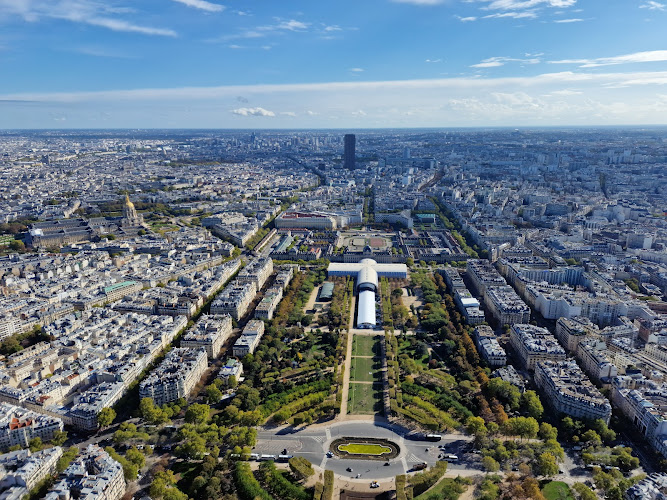
Few Paris green spaces are framed as dramatically as Champ de Mars. The garden forms a long, open axis between the Eiffel Tower at its northern end and the dignified façade of the École Militaire to the south. Its scale changes the experience of the surrounding city: rather than encountering the tower from a narrow street or crowded bridge, visitors can watch it rise above lawns, clipped planting and straight paths. The effect is both monumental and surprisingly communal, with residents, school groups, walkers and travelers sharing the same generous foreground.
Situated in the 7th arrondissement on the Left Bank, Champ de Mars is less a secluded garden than a civic landscape built for looking, gathering and moving through Paris. Its name recalls the Roman Campus Martius and its long role as a military field. Over time, the site became closely tied to national ceremonies, public events and the changing image of the capital. Today it is especially useful as a breathing space during a day of major sights: a place to slow down between the Eiffel Tower, the Seine and the formal avenues around the École Militaire.
What to See & Experience
The principal attraction is the composition itself. Stand along the central length of the park and the Eiffel Tower becomes the unmistakable visual anchor, while the École Militaire provides a calmer architectural counterpoint in the opposite direction. The broad sightline rewards a leisurely walk, but it also works for a brief stop when time is limited. Look beyond the tower as well: mature trees, geometric lawns, pathways and seasonal planting soften an area that otherwise feels defined by grand civic architecture.
- Walk the central axis for changing Eiffel Tower perspectives.
- Turn south to view the École Militaire across the lawns.
- Use the tree-lined paths for shade and slower strolling.
- Pause at the edges for wider views of Parisian streets.
- Observe how picnickers and walkers animate the public garden.
- Return near dusk for the shift from daylight to evening.
Photography is a major reason to visit, but the park is not only a photo stop. A wide view can make the Eiffel Tower feel more legible as part of Paris’s urban design, especially when seen in relation to the lawns and the military school. Morning generally brings a quieter mood and gentler activity, while later in the day the garden often feels more social. Light, weather, seasonal maintenance and event preparations can all alter the available views, so it is worth treating the space as a lived-in public park rather than a fixed backdrop.
Practical Visitor Strategy
| Planning Factor | Visitor Advice |
|---|
| Best Time to Go | Choose early morning for a calmer walk, or late afternoon and dusk for warmer light and a livelier atmosphere. |
| Suggested Duration | Allow 30 to 60 minutes for the main axis; linger longer if combining a stroll, photographs and a relaxed pause. |
| Crowd & Pacing Tips | Keep moving along the paths during busy periods, then step to a quieter edge before stopping for pictures or a break. |
| Getting Oriented | Use the Eiffel Tower and École Militaire as opposite visual anchors; the central lawn and paths connect the two. |
| Nearby Pairing | Combine it with the Eiffel Tower, the Seine embankment or a walk toward nearby Left Bank sights. |
Approach with a simple plan rather than trying to see every corner. If the Eiffel Tower is the main objective, Champ de Mars is an excellent place to arrive before or after a timed tower visit, allowing space for views without needing another formal attraction. If you are walking from the Seine, pause on the northern side first, then continue south toward the École Militaire to understand the full length of the site. Conversely, arriving from the south creates a gradual reveal of the tower ahead. Keep plans flexible around weather and any temporary barriers connected with maintenance, security or public events.
Who Will Enjoy It Most (and Trade-Offs)
Champ de Mars suits first-time visitors who want a classic Eiffel Tower setting, photographers seeking an uncluttered long view, and travelers who appreciate an unhurried outdoor break between museums and monuments. Families can use the open setting to reset after more structured sightseeing, while couples and solo walkers may prefer the change in pace offered by an evening stroll. It is also a useful choice for visitors who want the atmosphere of a Parisian public garden without committing to a destination garden farther from the central sights.
The trade-off is exposure and popularity. This is a large, open landmark setting, not a hushed botanical retreat, and it can feel busy when the Eiffel Tower area is active. Paths are generally the most practical route for a visit, while lawns, gravelly sections, changing surfaces and temporary controls may affect how easily every area can be used. Visitors needing the smoothest journey should stay on established routes and allow extra time. For a fuller nearby outing, pair the garden with the tower and the Seine; for a more contemplative contrast, continue into the surrounding 7th arrondissement, where formal avenues, civic buildings and quieter streets offer a different rhythm.
 Real Journey Travels