
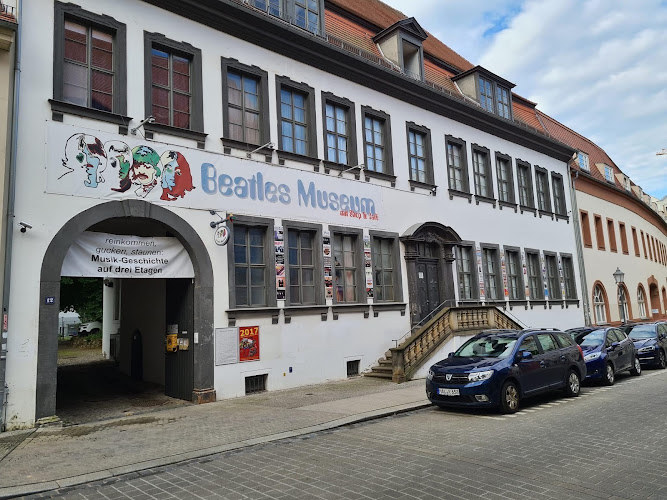
Beatles Museum
About Beatles Museum
Description
The Beatles Museum in Halle (Saale) is a compact, lovingly curated tribute to the band that reshaped popular music and to the solo careers that followed. It presents rarities, curiosities and well-known highlights from the Beatles years up to 1970, as well as artifacts and narratives charting John, Paul, George and Ringo after the group split. The collection favors personal objects, printed ephemera and media that let visitors step into moments rather than stare across a vast, impersonal archive. In short: this is a place made by fans, for fans — and that personality shows.
On the surface the museum appears modest. But once inside, many visitors find themselves suspended in time: vinyl sleeves, handwritten notes, oddities from Hamburg and Liverpool stints, and odd little souvenirs that spark memories or curiosity. The exhibition balances headline pieces with the smaller, human things that tell the story best — a set list stained from a gig, a promo photo with an eyebrow smudge, a flyer for a club nobody has heard of. Those small items do heavy lifting when it comes to emotion.
The emphasis is historical and narrative. Early rooms focus on the Beatles years: skiffle beginnings, the Hamburg era, Beatlemania and studio innovations. Later galleries follow the solo trajectories: the experimental voyages of John's & Yoko work, Paul's melodic pop and classical detours, George's spiritual and slide-guitar chapters, and Ringo's steady drumming and affable public persona. For travelers interested in the arc from Cavern Club to Abbey Road, and then into the decades that followed, the museum maps that evolution in approachable ways.
What sets this museum apart from larger, flashier institutions is intimacy. Visitors often remark on the closeness to the objects; labels are conversational, sometimes opinionated, and occasionally humorous. The curatorial voice does not pretend to be clinically neutral — it leans in, offers context and opinion, and yes, occasionally nudges the visitor toward a particular song or record. That voice can be a relief after stodgier museum text; it feels like someone who loves the subject is guiding the tour. The tone is friendly, even quirky at moments.
Practical features are plainspoken. The museum includes a small restaurant where visitors can grab a coffee and chat about favorite album tracks — an underrated perk for those who like to linger. Restroom facilities are available on site, and there is free parking nearby, which is a real convenience for travelers driving in from outside the city. On the flip side, the venue is not wheelchair accessible at the entrance, and there is no wheelchair-designated parking. That matters: anyone with limited mobility should call ahead or plan accordingly. It’s not a secret; the museum is frank about its constraints.
Many families are happy here. The layout and exhibits are approachable for children, and interactive moments — a listening station for classic tracks, tactile reproductions of instruments, and colorful display cases — hold younger attention spans. Teachers and parents have used the visit as a starting point for conversations about music history, 20th-century culture, and even basic media literacy: how a band’s image was crafted, why lyrics matter, and how technology shaped sound.
There are a few things that seasoned travelers should know but might not expect. First, the museum’s strength is depth rather than breadth: it does not aim to be the largest Beatles collection in Europe, but it does offer pockets of rare material and surprisingly thoughtful thematic displays. Second, the curators rotate small exhibits and loans more often than some might assume, so repeat visitors or those who come with a specific research interest could find new items on different visits. Third, the presentation sometimes errs on the personal side — expect handwritten notes from the curators and a tendency to include collector lore alongside verified provenance. For many, that mix is charming; for strict academics, it might provoke a raised eyebrow.
Storytelling is a big part of the museum’s appeal. The narrative arcs are built so that a casual visitor leaves with more than a list of artifacts — they leave with scenes. One room might recreate a late-night Hamburg club atmosphere, complete with dim lighting and a wall of posters from the era. Another space focuses on solo records that surprised critics and fans alike. Anecdotes on the panels make the music feel a human endeavor: the awkward first gigs, the long studio nights, the weirdness of fame. And yes, there are small museum-famous moments — a particular handwritten lyric sheet that reliably causes a hush in the room, and a battered suitcase that once belonged to a roadie and keeps drawing people closer to read the tiny labels.
For travelers who cherish context, the museum locates the Beatles within broader social and musical currents. Displays connect the band’s Liverpool roots and their formative Hamburg years to the rise of youth culture, shifts in recording technology, and post-war European travel patterns. The solo-career section is careful not to flatten those artists into caricatures; it points out unexpected collaborations, sonic experiments and late-career resurgences. Visitors leave with a sense of continuity rather than a tidy end-point.
Visitor experience here tends to be highly personal. Many older fans use the museum as a time machine, slipping back to days they lived through; younger visitors often come with fresh curiosity and leave with a new appreciation for craft and storytelling in pop music. The museum’s curators have designed flows of sight and sound to accommodate both approaches, though individuals who want deep archival research should contact the staff in advance — the public galleries are only one part of what the museum holds. Occasionally, small guided talks or themed evenings are announced; they sell quickly because of the museum’s devoted fan base, so those planning a trip on a specific date might want to check ahead.
People sometimes ask whether this museum is more for die-hard Beatles aficionados or for casual travelers. Truthfully, it sits in the middle. Die-hards will find fragments and fragments-of-fragments that delight — the chirpy little details that only collectors dream about. Casual visitors will still enjoy the sweep and the stories, plus the accessible listening points and the restaurant where music plays softly and conversations flow. Many travelers complain about museums that try to be everything; this one knows what it is and leans into that identity.
To be candid — and because this is useful when planning a visit — the size of the museum means a typical visit lasts between 45 minutes and 2 hours depending on how much time someone spends at listening stations and in the small café. That makes it a perfect half-hour detour for a day of sightseeing in the city or a satisfying main event on a rainy afternoon. It fits easily into travel itineraries that include architecture, markets and local food, so it’s a tidy cultural stop without hogging the whole day.
Finally, while the museum leans on nostalgia, it avoids being stuck in the past. It nods to contemporary reissues, to remastering debates, and to how Beatles songs get used and reused in film, advertising and the playlists of today. This isn’t a shrine frozen behind glass; it’s a conversation between generations. Travelers who value personality in interpretation, who enjoy a little collector lore with their facts, and who prefer museums that feel lived-in rather than polished to a shine will likely find the Beatles Museum in Halle (Saale) a memorable stop. It’s local in atmosphere, global in appeal, and, above all, a place where music still matters.
Key Features
More Details
Updated August 30, 2025
Table of Contents
Description
The Beatles Museum in Halle (Saale) is a compact, lovingly curated tribute to the band that reshaped popular music and to the solo careers that followed. It presents rarities, curiosities and well-known highlights from the Beatles years up to 1970, as well as artifacts and narratives charting John, Paul, George and Ringo after the group split. The collection favors personal objects, printed ephemera and media that let visitors step into moments rather than stare across a vast, impersonal archive. In short: this is a place made by fans, for fans — and that personality shows.
On the surface the museum appears modest. But once inside, many visitors find themselves suspended in time: vinyl sleeves, handwritten notes, oddities from Hamburg and Liverpool stints, and odd little souvenirs that spark memories or curiosity. The exhibition balances headline pieces with the smaller, human things that tell the story best — a set list stained from a gig, a promo photo with an eyebrow smudge, a flyer for a club nobody has heard of. Those small items do heavy lifting when it comes to emotion.
The emphasis is historical and narrative. Early rooms focus on the Beatles years: skiffle beginnings, the Hamburg era, Beatlemania and studio innovations. Later galleries follow the solo trajectories: the experimental voyages of John’s & Yoko work, Paul’s melodic pop and classical detours, George’s spiritual and slide-guitar chapters, and Ringo’s steady drumming and affable public persona. For travelers interested in the arc from Cavern Club to Abbey Road, and then into the decades that followed, the museum maps that evolution in approachable ways.
What sets this museum apart from larger, flashier institutions is intimacy. Visitors often remark on the closeness to the objects; labels are conversational, sometimes opinionated, and occasionally humorous. The curatorial voice does not pretend to be clinically neutral — it leans in, offers context and opinion, and yes, occasionally nudges the visitor toward a particular song or record. That voice can be a relief after stodgier museum text; it feels like someone who loves the subject is guiding the tour. The tone is friendly, even quirky at moments.
Practical features are plainspoken. The museum includes a small restaurant where visitors can grab a coffee and chat about favorite album tracks — an underrated perk for those who like to linger. Restroom facilities are available on site, and there is free parking nearby, which is a real convenience for travelers driving in from outside the city. On the flip side, the venue is not wheelchair accessible at the entrance, and there is no wheelchair-designated parking. That matters: anyone with limited mobility should call ahead or plan accordingly. It’s not a secret; the museum is frank about its constraints.
Many families are happy here. The layout and exhibits are approachable for children, and interactive moments — a listening station for classic tracks, tactile reproductions of instruments, and colorful display cases — hold younger attention spans. Teachers and parents have used the visit as a starting point for conversations about music history, 20th-century culture, and even basic media literacy: how a band’s image was crafted, why lyrics matter, and how technology shaped sound.
There are a few things that seasoned travelers should know but might not expect. First, the museum’s strength is depth rather than breadth: it does not aim to be the largest Beatles collection in Europe, but it does offer pockets of rare material and surprisingly thoughtful thematic displays. Second, the curators rotate small exhibits and loans more often than some might assume, so repeat visitors or those who come with a specific research interest could find new items on different visits. Third, the presentation sometimes errs on the personal side — expect handwritten notes from the curators and a tendency to include collector lore alongside verified provenance. For many, that mix is charming; for strict academics, it might provoke a raised eyebrow.
Storytelling is a big part of the museum’s appeal. The narrative arcs are built so that a casual visitor leaves with more than a list of artifacts — they leave with scenes. One room might recreate a late-night Hamburg club atmosphere, complete with dim lighting and a wall of posters from the era. Another space focuses on solo records that surprised critics and fans alike. Anecdotes on the panels make the music feel a human endeavor: the awkward first gigs, the long studio nights, the weirdness of fame. And yes, there are small museum-famous moments — a particular handwritten lyric sheet that reliably causes a hush in the room, and a battered suitcase that once belonged to a roadie and keeps drawing people closer to read the tiny labels.
For travelers who cherish context, the museum locates the Beatles within broader social and musical currents. Displays connect the band’s Liverpool roots and their formative Hamburg years to the rise of youth culture, shifts in recording technology, and post-war European travel patterns. The solo-career section is careful not to flatten those artists into caricatures; it points out unexpected collaborations, sonic experiments and late-career resurgences. Visitors leave with a sense of continuity rather than a tidy end-point.
Visitor experience here tends to be highly personal. Many older fans use the museum as a time machine, slipping back to days they lived through; younger visitors often come with fresh curiosity and leave with a new appreciation for craft and storytelling in pop music. The museum’s curators have designed flows of sight and sound to accommodate both approaches, though individuals who want deep archival research should contact the staff in advance — the public galleries are only one part of what the museum holds. Occasionally, small guided talks or themed evenings are announced; they sell quickly because of the museum’s devoted fan base, so those planning a trip on a specific date might want to check ahead.
People sometimes ask whether this museum is more for die-hard Beatles aficionados or for casual travelers. Truthfully, it sits in the middle. Die-hards will find fragments and fragments-of-fragments that delight — the chirpy little details that only collectors dream about. Casual visitors will still enjoy the sweep and the stories, plus the accessible listening points and the restaurant where music plays softly and conversations flow. Many travelers complain about museums that try to be everything; this one knows what it is and leans into that identity.
To be candid — and because this is useful when planning a visit — the size of the museum means a typical visit lasts between 45 minutes and 2 hours depending on how much time someone spends at listening stations and in the small café. That makes it a perfect half-hour detour for a day of sightseeing in the city or a satisfying main event on a rainy afternoon. It fits easily into travel itineraries that include architecture, markets and local food, so it’s a tidy cultural stop without hogging the whole day.
Finally, while the museum leans on nostalgia, it avoids being stuck in the past. It nods to contemporary reissues, to remastering debates, and to how Beatles songs get used and reused in film, advertising and the playlists of today. This isn’t a shrine frozen behind glass; it’s a conversation between generations. Travelers who value personality in interpretation, who enjoy a little collector lore with their facts, and who prefer museums that feel lived-in rather than polished to a shine will likely find the Beatles Museum in Halle (Saale) a memorable stop. It’s local in atmosphere, global in appeal, and, above all, a place where music still matters.
Key Highlights
Beatles Museum
Location
Places to Stay Near Beatles Museum
Find and Book a Tour
Explore More Travel Guides
No reviews found! Be the first to review!
Traveler Reviews for Beatles Museum
There are no reviews yet. Be the first one to write one.
Have you visited Beatles Museum? Help other travelers by sharing your review.
You Might Also Like

Händel-Haus

Gedenkstätte ROTER OCHSE Halle (Saale)

Marktplatz Halle
Find Accommodations Nearby
Recommended Tours & Activities
Visitor Reviews
There are no reviews yet. Be the first one to write one.
Share Your Experience
Have you visited Beatles Museum? Help other travelers by leaving a review.