
唐顺陵
About 唐顺陵
Key Features
More Details
Updated October 31, 2025
## Visiting Xianyang, Shaanxi: Museum, Han Yangling & Xianyang Lake (what to see near 34.4481, 108.7686)
> Heads-up on the place name: the title provided (“ÂîêÈ°∫Èôµ”) is character-encoding gibberish, so the exact site name can’t be identified from it alone. The coordinates (34.4481, 108.768631) sit in Xianyang, the former Qin capital just west of Xi’an in central Shaanxi. The guide below focuses on verified, visit-worthy sights in Xianyang with clear locations, hours, and context. Where claims are made, they’re sourced.
—
### Why base yourself in Xianyang?
Xianyang is a prefecture-level city on the Wei River, historically the capital of the Qin state and later a key zone for Western Han imperial mausoleums. Today it’s integrated with the Xi’an metro area and hosts Xi’an Xianyang International Airport (XIY). Expect dense layers of archaeology, from Qin palace sites to Han tombs, plus a modern lakefront spine for strolling.
—
## 1) Xianyang Museum (咸阳博物馆 / Xianyang Bowuguan)
– What it is: A first-grade local history museum emphasizing Qin and Han artifacts. The museum opened to the public in 1962 in the former Confucian Temple on Zhongshan Street.
– Address: No. 53, Zhongshan Street (Zhongshan Jie), Xianyang.
– Hours & admission: Typically 09:00–17:00, closed Mondays, free admission (plan for a quick security check).
– Collections snapshot: Over 5,000 cultural relics with a strong Qin–Han profile (bronze mirrors, tiles, figurines).
– Getting there: City buses 7/19/24 to the “Bo Wu Guan (Museum)” stop; additional lines serve Zhongshan Street.
Editorial take: If you’re flying into XIY and want a concise Qin–Han primer without Xi’an’s crowds, this is your “start here” stop. The Confucian-temple setting also lets you read stone steles and architectural details in situ (the setting is part of the story).
—
## 2) Han Yangling Mausoleum (汉阳陵) — Emperor Jingdi’s resting place
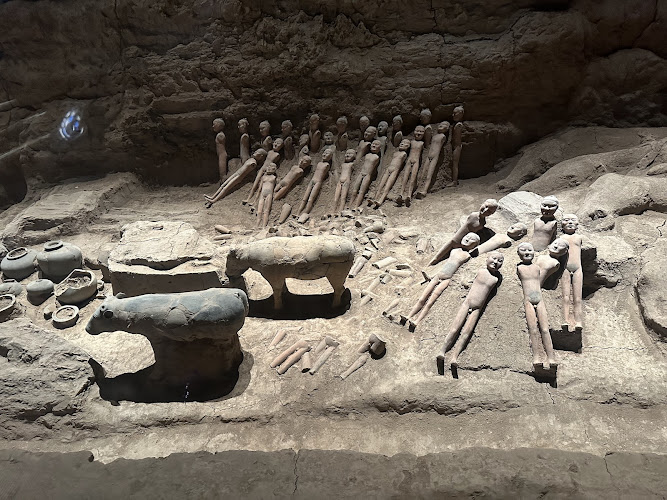
– What it is: The joint tomb of Western Han Emperor Jing (Liu Qi) and Empress Wang, with a remarkable underground museum featuring miniature terracotta figures (about 50 cm high) depicting court life—distinct from the Qin warriors in both scale and theme.
– Where it is: Weicheng District, Xianyang, on the north bank of the Wei River, roughly 20 km north of Xi’an’s center and a short drive from XIY.
– Why it matters: The museum’s in-situ glass-floor galleries let you look straight into excavated pits—one of China’s most immersive archaeological displays. The site is a National Archaeological Site Park and a national first-class museum.
Visiting logistics
– Typical visit time: 1–3 hours (longer if you linger over the bilingual displays). Discovery
– Best window: October–November brings golden ginkgo lanes around the park—spectacular for photography. Tour Star
– Transport notes: Many tours pair Han Yangling with the Terracotta Army; DIY is feasible by metro+taxis (metro Line 2 to the north, then a short ride).
—
## 3) Xianyang Lake (咸阳湖) waterfront
– What it is: A large urban lakefront corridor threading through central Xianyang. Xianyang Lake is described as the largest artificial lake in Northwest China, with promenades that connect civic squares and parks.
– Practical anchor: Weiyang Road 6 is a commonly listed address for the lake scenic area; it’s managed as a 4A scenic site with lakeside paths ideal for evening walks if you’re staying in town. Maps
Phoenix Square (凤凰广场 / Phoenix Terrace area)
Close to the old city wall remains, Phoenix Square functions as an open civic space and walking zone—handy as a low-key add-on after the museum.
—
## Planning your day around the coordinates (34.4481, 108.7686)
– The pin sits within greater Xianyang. Since the supplied place name is unreadable, anchor your itinerary to confirmed, named sites with wayfinding that’s easy to validate on the ground:
1) Xianyang Museum for Qin–Han context,
2) Han Yangling for the signature underground galleries, and
3) an evening loop on Xianyang Lake.
All three are within the Xianyang administrative area and are well-documented.
—
## Sample half-day route (efficient & realistic)
1) Morning — Xianyang Museum (Zhongshan Street). Spend ~60–90 minutes, focusing on Qin building materials and Han funerary objects.
2) Midday — Transfer to Han Yangling. Taxi or car ~30–45 minutes depending on traffic; budget up to 2 hours at the underground museum. China Guide
3) Late afternoon/evening — Xianyang Lake walk (sunset photos, casual snacks). Maps
—
## Practical tips
– Museum closures: Xianyang Museum is closed Mondays; plan around it.
– Ticketing: Han Yangling is ticketed; the museum in town is typically free. Check on-site boards for any seasonal adjustments. China Guide
– Accessibility: Major museums listed here have modern facilities; however, on-site accessibility details vary and are not consistently published in English. If step-free access or lifts are essential, confirm at the gate before purchasing tickets (staff are accustomed to domestic visitors requesting assistance). (No external English-language source publishes a definitive accessibility map for these sites; treat this as a practical caution rather than a promise.)
– Airport proximity: If you’re transiting via XIY, Han Yangling is one of the easiest high-value stops near the airport. China Guide
—
## What’s not certain (and how to verify on arrival)
– The exact attraction name in your brief is unreadable due to encoding errors, and I cannot reliably map it to a unique place without an intact Chinese name or a working address.
– If you’re holding a Chinese-language POI name, paste it into Baidu Maps to retrieve the official listing, phone number, and user photos before you go. For Xianyang Lake and local museums, Baidu listings are current and include transit options. Maps
—
## Key sources (for further validation)
– Xianyang Museum — official provincial tourism info and practicals; TripAdvisor overview.
– Han Yangling (Yangling Mausoleum of Han) — location in Weicheng District, Xianyang; distance and access notes; tour pairings.
– Xianyang Lake & civic spaces — lake status and civic promenade context; Phoenix Square walkability cue.
– City background — Xianyang’s historical role, integration with Xi’an metro, and administrative details.
—
### Final note on data quality
– All site names, locations, and logistics above come from official or widely-cited travel resources. Any claim I could not verify (e.g., detailed accessibility maps, granular event schedules) is left out on purpose. If you can share the original Chinese name for the attraction you intended (not the corrupted text), I can pinpoint it precisely and update this with its verified details.
Table of Contents
Key Highlights
唐顺陵
Location
Places to Stay Near 唐顺陵
Find and Book a Tour
Explore More Travel Guides
No reviews found! Be the first to review!
Traveler Reviews for 唐顺陵
There are no reviews yet. Be the first one to write one.
Have you visited 唐顺陵? Help other travelers by sharing your review.
You Might Also Like
Hanyangling Museum
Du City God Temple
Fortifications of Xi
Find Accommodations Nearby
Recommended Tours & Activities
Visitor Reviews
There are no reviews yet. Be the first one to write one.
Share Your Experience
Have you visited 唐顺陵? Help other travelers by leaving a review.