 Real Journey Travels
Last modified August 8, 2026
Some links below are affiliate links. If you book through them, Real Journey Travels may earn a commission at no extra cost to you. That does not change what this review says about Trip.com.
Yes, Trip.com is legit. It is the consumer brand of Trip.com Group Limited, a company listed on Nasdaq as TCOM and on the Hong Kong exchange as 9961, and the site you book on is operated by Trip.com Travel Singapore Pte. Ltd. under Singapore travel licence no. 02943. Your money is not going to a fake storefront. Legitimate is not the same as low risk, though. The Better Business Bureau rates Trip.com F, its lowest grade, after logging 207 complaints in three years and recording that Trip.com never answered 50 of them. This Trip.com review sets the corporate facts against the complaint record and against what Trip.com’s own terms of service allow the company to do.
Is Trip.com legit, or is it a scam?
Trip.com is a real company, not a scam. Trip.com Group Limited started out in 1999, listed on Nasdaq in 2003 and on the Hong Kong Stock Exchange in 2021, and files audited results with the US Securities and Exchange Commission. It is headquartered in Singapore and owns four consumer brands: Trip.com, Ctrip, Qunar and Skyscanner. Numerous travel websites are white-label storefronts resold by companies you cannot identify from the outside. This is not one of them, and a company that publishes quarterly numbers to a US regulator is not going to vanish with your money.
The useful question is not whether Trip.com is a legit company. It is what happens to your travel plans when something goes wrong, because that is where every serious complaint against Trip.com sits. Legitimacy and reliability are different tests, and Trip.com passes the first far more comfortably than the second. The rest of this review answers the second one.
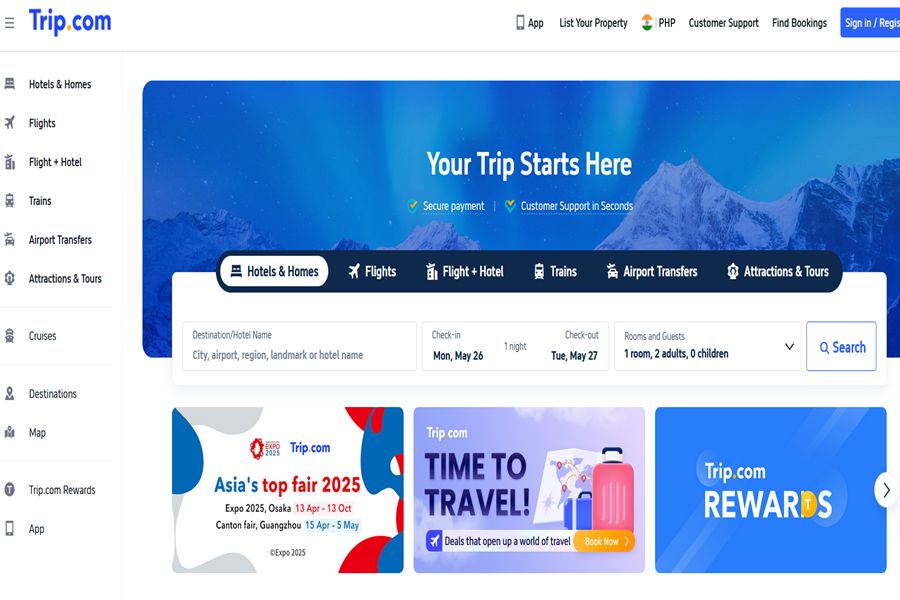
The booking process itself is not the problem. Easy booking is what Trip.com is good at: the search is fast, the app is capable, and most people who book with Trip.com fly, check in and never think about it again. The bad reviews cluster at one point, which is the moment a trip is cancelled by the airline and somebody has to get the refund back into a card.
Is Trip.com trustworthy, and whose law applies to your booking?
The contract you sign is with Trip.com Travel Singapore Pte. Ltd., 30 Raffles Place #29-01, Singapore 048622, holding Singapore travel licence no. 02943. Trip.com discloses both in section 1 of its own terms and conditions. Singapore’s Tourism Board keeps a public travel agent register where that licence can be checked.
Section 12 of those terms sets the governing law as Singapore, with Singapore courts holding jurisdiction. It then adds a clause that matters more than travellers realise: neither the law choice nor the court choice “shall deprive you of any mandatory right to choose instead to resolve any such dispute or claim in the courts of the country in which you are resident.” So a US or UK traveller keeps the right to sue at home. There is also no arbitration clause and no class action waiver, which makes Trip.com’s dispute terms less restrictive than several US booking sites. That is a genuine point in its favour, and almost nobody reports it.
Why does the Better Business Bureau give Trip.com an F?
The BBB rates Trip.com F and lists it as not accredited. The BBB names two reasons on the profile: failure to respond to 50 complaints, and 10 complaints that were closed unresolved. The full ledger, read from the BBB profile on 7 August 2026, looks like this.
| BBB record for Trip.com | Figure |
|---|---|
| Rating | F (lowest grade) |
| Accredited | No |
| Complaints closed, last 3 years | 207 |
| Complaints closed, last 12 months | 90 |
| Answered by Trip.com | 103 |
| Unanswered by Trip.com | 50 |
| Resolved to complainant’s satisfaction | 44 |
| Closed unresolved | 10 |
| Largest complaint category | Product issues (132) |
Read the answered figure carefully before you panic and before you shrug. Trip.com replied to 103 of 207 complaints, so the company is not ignoring the channel wholesale. But only 44 of 207, roughly one in five, ended with the traveller saying the problem was fixed. That ratio, not the letter grade, is the number worth carrying into a booking decision.
What is the real customer experience with Trip.com when things go wrong?
Reading the ten most recent BBB complaints, all filed between April and June 2026 and all unanswered, the failures are structural rather than random. However you weigh any single review, the same four patterns repeat across these customers.
| Failure pattern | What the complaint describes |
|---|---|
| Two airlines stitched into one round trip | A return booked outbound on Frontier and inbound on Spirit. Frontier cancelled and refunded its leg. The Spirit leg could not be cancelled because it was a separate airline, so $207.90 was lost on a flight that had become impossible to take. |
| The refund runs in a circle | The airline says Trip.com holds the money because Trip.com took the payment. Trip.com refers the traveller back to the airline. Several complainants describe waiver codes issued by the airline that Trip.com then did not act on. |
| Bulk tickets the airline cannot see | More than one complainant was told by the carrier that it could not see the fare paid, because the seat had been issued as a bulk ticket. If the airline cannot read your fare, it cannot price your refund. |
| Agents contradicting each other | A refund promised by one agent is withdrawn by the next agent hours later. This recurs often enough that no verbal assurance should be treated as binding. |
None of these are hotel problems. Almost every serious Trip.com complaint concerns a flight.
Do Trip.com’s terms override the airline’s own rules?
Yes, and this is the single most overlooked sentence in the whole agreement. Trip.com’s terms tell you that your booking is also governed by the airline’s or hotel’s terms, then add: “If there are any inconsistencies between the Supplier’s term and conditions and these terms, these terms apply.” The flight section repeats it with an example attached, saying the same override holds “for e.g. where you have selected a cheaper flight ticket that cannot be changed or refunded.”
Practically, that means checking the airline’s published refund policy does not settle what you are entitled to. Where the two documents disagree, the agency’s document wins, and the agency’s document is the one you did not read. If you want the airline’s rules to govern your ticket, the only reliable way to get that is to buy the ticket from the airline.
Do you have a ticket the moment you pay?
No. Payment and ticketing are separate events on Trip.com, and the gap between them explains a large share of the complaints. The terms describe two emails: a “Flight Payment Successful” message, and later a “Flight Booking Confirmed” message that carries the airline’s own booking reference. Only the second one means a ticket exists.
Trip.com commits only to “reasonable endeavors” to issue within the window shown at checkout, warns that cheaper tickets “might take a little longer,” and states that if you book within three days of departure the ticket will be issued within 72 hours before departure. So on a last-minute booking you can be paid up, in an airport queue, and still not hold a ticket. Do not treat the payment email as an itinerary. Wait for the airline booking reference, then look your name up on the airline’s own site.
What happens if Trip.com cancels your booking?
Trip.com reserves broad discretion here, and states plainly that a cancellation by them may come with no explanation and no refund. This table lists what the terms permit, quoting the operative language.
| What Trip.com’s terms allow | The wording |
|---|---|
| Cancel with no reason given | “we may not provide you with an explanation for the cancellation” |
| Cancel with no refund | “If we cancel your booking, you may not be entitled to a refund” |
| Decide eligibility alone | “if we determine, at our sole discretion, that you are not eligible for a refund” |
| Cancel bookings tied to your name or email | “Reject or cancel any bookings associated with your name, email address or account” |
| Take back rewards you already earned | “Cancel or revoke any Trip Coins, coupons, incentives, promotional rewards or other benefits that you may earn or have previously earned” |
| Override the airline’s terms | “If there are any inconsistencies… these terms apply” |
One more clause is worth knowing if you travel for work. The terms state that Trip.com provides the site “for domestic and private use” and that you agree not to use it “for any commercial or business purposes,” with no liability for loss of profit or business interruption. Booking a work trip on Trip.com puts you outside the use the contract describes.
Can Trip.com take back your Trip Coins?
Yes. Trip Coins are the loyalty currency you earn on bookings and redeem against later ones, and the terms let Trip.com revoke coins, coupons and promotional rewards you “may earn or have previously earned” if it decides you breached the terms. Rewards balances on Trip.com are a discretionary benefit, not a stored value you own. Spend them rather than stockpiling them.

Why is Trip.com so cheap, and are the travel deals real?
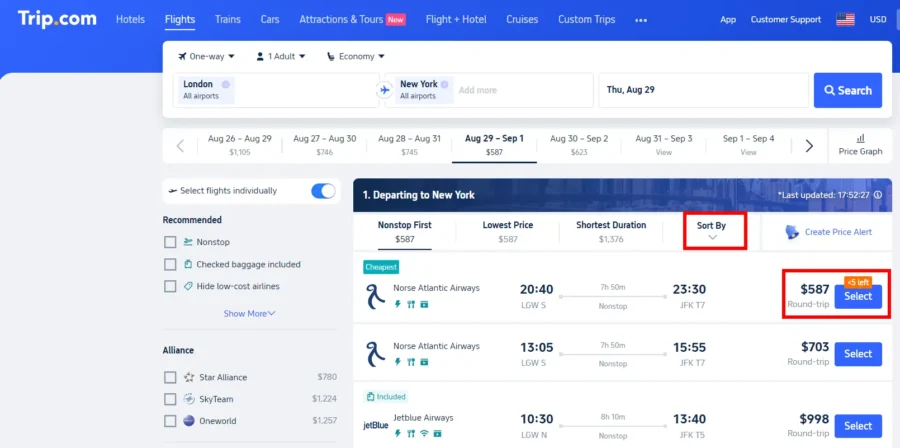
Trip.com prices are often below the airline’s own, and the reasons are ordinary rather than sinister. The group buys air tickets in volume, including consolidator and bulk fares that carry lower published prices and tighter change rules. It runs a coupon and Trip Coins discount layer funded as customer acquisition. And it builds cheap itineraries by combining separate tickets on separate airlines into one screen, which is exactly the construction behind the refund failures above.
The travel deals are real in the sense that the lower number is genuinely charged. What the number does not include is the friction cost. Discounted economy and business class fares sold this way are frequently non refundable, are often ineligible for frequent flyer credit, and are the fares most likely to be reissued through a consolidator the airline cannot easily trace. Online travel agencies price that friction into the discount on purpose. Discounts are advertised as savings; the information users need to judge them sits in the fare rules, not on the deal banner.
So the discount is real, and it is not free. You are usually trading refund flexibility, fare transparency and a direct line to the airline for the lower number. On a cheap non-refundable seat you were never going to change, that is a fine trade. On an expensive long-haul ticket you might need to move, it is a poor one.
Is Trip.com reliable for flights and hotels equally?
No, and treating Trip.com as one uniform risk is the mistake most reviews make. Trip.com sells air tickets, hotel booking, train tickets, car rentals, airport transfers and attraction tickets under one login, but the exposure differs sharply by product, because it depends on how much money is at stake and how easily you can rebook on the spot. A Trip.com hotel reservation and a Trip.com flight are not the same bet.
| What you book | Risk if it fails | Why |
|---|---|---|
| Hotel, free cancellation | Low | Worst case you rebook at the desk. Trip.com states an unconfirmable booking gets a full refund. |
| Hotel, non-refundable | Medium | Name changes are often refused; one BBB complainant could not correct a guest name at all. |
| Attraction ticket, eSIM, transfer | Low | Small sums, redeemable instantly, easy to replace. |
| Train ticket | Low to medium | Rail operator rules govern; China rail has its own separate policy page. |
| Single-airline flight, refundable | Medium | The refund exists but has to travel through Trip.com to reach you. |
| Multi-airline or self-transfer flight | High | One carrier cancelling does not release the other leg. This is where the money is lost. |
What does a self-transfer booking commit you to?
A self-transfer itinerary is two or more separate tickets that no single airline is responsible for connecting. Trip.com sells these under a Self-transfer Package with its own guarantee document, and the terms tell you to satisfy yourself before booking “that the time provided to transfer or make your connecting flight is sufficient for your individual needs.” That sentence is the airline’s duty of care being handed to you.
Two further rules bite here, and delays are what triggers both. Trip.com’s liability section says it is not responsible for loss where you fail to make an onward flight “due to your own acts or ommisions,” using the spelling in the published document, and a missed connection caused by a late first leg lands in exactly that gap. And tickets must be flown in sequence: skip the outbound and the airline may refuse to board you on the return. If a Trip.com itinerary shows two different airline names, read it as two bookings that happen to share a page.
Is Trip.com or Expedia better, and should you just book directly?
Booking directly is better whenever the price gap is small, because it removes an entire party from your refund path. Use Trip.com when the saving is large enough to fund the risk. One detail to hold onto while comparing: Skyscanner is owned by Trip.com Group, so cross-checking a Trip.com fare on Skyscanner is not an independent second opinion.
| Trip.com | Booking directly with the airline or hotel | |
|---|---|---|
| Headline price | Often lower, especially Asia routes | Usually higher |
| Who holds your money | Trip.com Travel Singapore Pte. Ltd. | The airline or hotel |
| Whose terms win a conflict | Trip.com’s | The supplier’s, with nothing on top |
| Refund path | You, then Trip.com, then the supplier | You, then the supplier |
| Ticket in hand at payment | Not guaranteed | Usually immediate |
| Loyalty points and status | Frequently not credited on discounted fares | Credited |
| Governing law | Singapore, but you may still sue at home | Usually your own country |
For a wider comparison of booking sites, see our guide to choosing the best travel website to use. We have applied the same trust checks to Kiwi.com, Gotogate, FlightNetwork, FlightHub and BudgetAir.
Who should use Trip.com, and who should not?
- Trip.com is a reasonable fit for hotels and flights booked separately with free cancellation, plus attraction tickets, eSIMs, airport transfers, China and wider Asia rail, and cheap single-airline flights you would not change anyway.
- Book with care on non-refundable hotels where the guest name must be exact, and on any flight over a few hundred dollars.
- Book elsewhere for multi-airline or self-transfer itineraries, business travel, trips where a visa or a work commitment depends on the exact flight, and any booking you can already tell you may need to change. If the cancelation terms are the part of the travel experience you are most worried about, that is the signal to buy direct.
How do you use Trip.com with less risk?
Book so that a failure costs you time rather than money. These eight tips do not improve Trip.com’s terms. They reduce how much of your trip is exposed when those terms are enforced against you, and they all take under a minute each.
| Step | Why it matters |
|---|---|
| Pay by credit card, never by bank transfer or debit | Chargeback rights are your real backstop when a refund stalls |
| Screenshot the cancellation terms shown at checkout | Those terms form part of your contract and are hard to retrieve later |
| Check the traveller name against your passport before you pay | Trip.com is not responsible for loss caused by ID details that do not match |
| Count the airline names on the itinerary | More than one means separate tickets and no protected connection |
| Wait for the “Flight Booking Confirmed” email | Only that email carries the airline’s own booking reference |
| Look yourself up on the airline’s site using that reference | Confirms a ticket exists rather than a reservation |
| Keep every request in the app chat, in writing | Agents contradict each other; written records survive shift changes |
| Escalate in writing to the BBB profile if a refund stalls | Trip.com answered 103 of 207 BBB complaints, so the channel does work |
How do you contact Trip.com customer support?
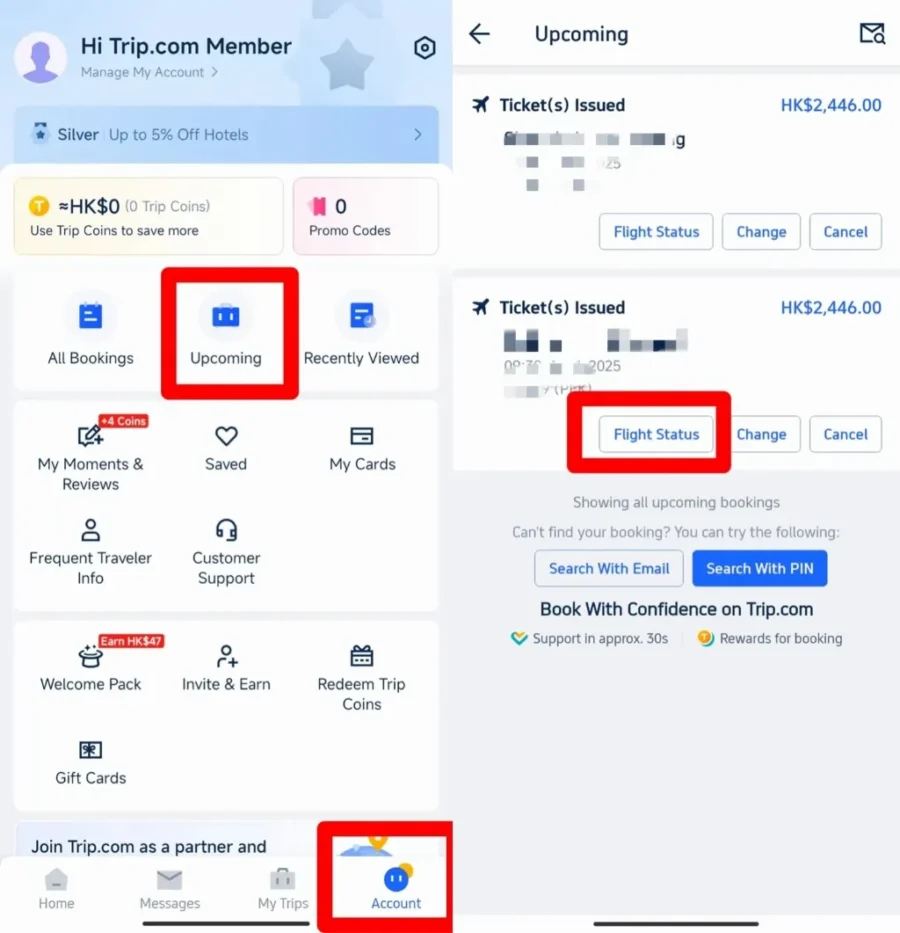
Trip.com routes customer support through the service chat in the Trip.com mobile app and through regional helpline numbers on its help page. You can manage most travel services via the app without speaking to anyone, and that works well right up until it does not. Support is available around the clock, but there is no general contact us email address for complaints, and section 11 of the terms simply points you back at the same chat. The BBB profile lists a US contact number of (646) 362-8606 and a Los Angeles address at 1150 S Olive St. Several complainants describe replying into a mailbox that bounces, so the customer service team is reachable in practice only through the channel it controls. Keep the chat transcript, since that is the written record that does survive a shift change.
Sources, and what this Trip.com review does not claim
Every figure above comes from a primary document: the Better Business Bureau business profile for Trip.com, read 7 August 2026; the Trip.com Terms and Conditions dated 27 May 2025; and Trip.com Group’s investor disclosures. Four things are deliberately left out because they could not be verified to that standard on this date.
- No star rating is quoted. Published Trustpilot and Sitejabber scores for Trip.com conflict across sources and across separate profiles for the same brand, and neither site would serve a page for direct checking. Averaging positive and negative reviews into one Trustpilot-style number would be the weakest figure here, so none is quoted.
- No first-hand booking test was run. Nobody at Real Journey Travels bought a ticket to write this. Any review claiming a personal Trip.com refund saga is describing one traveller’s case, not the pattern.
- No price comparison figures appear here. Fares move hourly by route, currency and date, so a percentage saving quoted in an article is stale before you read it.
- Licence 02943 has not been independently confirmed. The number is disclosed by Trip.com in its own terms. Singapore’s Tourism Board publishes a searchable travel agent register if you want to verify it yourself.
One structural note on the search results themselves: several of the top pages answering “is Trip.com legit” are published on Trip.com’s own regional domains. They are worth reading, but they are marketing rather than review.
Frequently asked questions about Trip.com
Is Trip.com safe to use?
Trip.com is safe in the sense that it is a Nasdaq-listed, licensed travel agency that delivers most bookings without incident. It is less safe than booking directly when a trip goes wrong, because Trip.com’s terms override the airline’s where the two conflict, and because the BBB records 50 complaints the company never answered.
Is Trip.com legit for flights?
A flight on Trip.com is the riskiest thing you can book there. The tickets are real, but payment and ticket issuance are separate steps, last-minute tickets may only be issued 72 hours before departure, and multi-airline itineraries leave one leg unrefundable when the other is cancelled. It is safe to book a flight this way if the fare is low and fixed; check the flight details against the airline’s own site once the confirmation email arrives.
Is Trip.com legit for hotels?
Hotel booking on Trip.com carries much less exposure than flights. Trip.com states that a booking it cannot confirm is fully refunded, and that a hotel being unable to find your reservation before arrival is normal. Choose free cancellation where the price gap is small, and enter the guest name exactly as it appears on the ID, since name changes are often refused.
Is Trip.com a Chinese company?
Trip.com Group began in Shanghai in 1999 as Ctrip and is now headquartered in Singapore, listed on Nasdaq and in Hong Kong. So the group is no longer based in China, though much of its engineering and its largest travel companies by volume still are. The website you book flights on is run by a Singapore entity. Ctrip still operates as a separate brand within the same group, alongside Qunar and Skyscanner.
How do I get a refund from Trip.com?
Request it through the booking details screen in your account or the app chat, and keep everything in writing, because BBB complainants repeatedly describe one agent promising a refund that another withdraws. Refunds go back to the original payment method. If you would rather reschedule than cancel, ask to rebook first, since a change is often permitted on a fare that is non refundable. If the request stalls, escalate in writing through the BBB profile and open a card chargeback before your issuer’s time limit expires.
What happens if the airline cancels my Trip.com flight?
Trip.com’s terms say the airline’s own conditions generally apply and direct you to contact Trip.com for support. In practice that means the refund has to pass through Trip.com to reach you. If your booking combined two airlines, expect the cancelled carrier to refund its leg while the other leg stays live and non-refundable.
Is Trip.com under investigation?
No regulatory investigation into Trip.com was found on this date. The BBB is a private non-profit rather than a regulator, so its F rating is a complaint-handling grade, not an enforcement action. Trip.com Group’s disclosures as a Nasdaq-listed company are the place any material legal proceeding would appear.
Last updated 7 August 2026. This review was rebuilt from primary sources: Trip.com’s Terms and Conditions dated 27 May 2025, the Better Business Bureau business profile and complaint ledger for Trip.com read on 7 August 2026, and Trip.com Group’s Nasdaq and Hong Kong listing disclosures. Complaint figures, licence details and contract quotations are current as of that date and are worth re-checking before you book. Ready to compare? You can check current Trip.com prices, or price the same stay on Booking.com before deciding.


