
Last modified August 27, 2026
Munich runs one integrated network. A single MVV ticket covers the U-Bahn, S-Bahn, tram, bus and regional trains inside the zones you pay for, so the only real decision is how far you are going and how many times you will ride. Since 1 January 2026 a single ticket for Zone M, which covers the whole city, costs €4.20, and a Single Day Ticket for Zone M costs €10.10. If you plan three or more rides in a day, the day ticket wins. The change most visitors miss: from January 2026, children aged 6 to 14 travel free on a Single Day Ticket. Riding without a valid ticket costs €60.
What does Munich public transport cost in 2026?
A single ride in Zone M costs €4.20 and an all-day Zone M ticket costs €10.10. Every fare below took effect on 1 January 2026 and applies across the U-Bahn, S-Bahn, tram, bus and regional trains within the zones purchased.
| Ticket | Price (2026) | What it covers |
|---|---|---|
| Kurzstrecke (short trip) | €2.10 | Up to 4 stops, maximum travel time 1 hour |
| Single ticket, Zone M | €4.20 | One person, one journey, one direction |
| Single ticket, child 6–14 | €2.00 | Flat rate, all zones |
| Single Day Ticket, Zone M | €10.10 | One adult, unlimited rides until 6am next day |
| Day Ticket, child 6–14 | €3.80 | Flat rate, entire MVV area (Zones M–12) |
| Group Day Ticket | from €15.40 | Up to 5 people, unlimited rides until 6am next day |
| Streifenkarte (strip ticket) | €18.70 | Multiple journeys, one or several people |
| Streifenkarte U21 | €10.20 | Same, for travelers under 21 |
| Airport-City-Day-Ticket, single | €17.50 | Zones M–5, one adult, airport included |
| Airport-City-Day-Ticket, group | €32.60 | Zones M–5, up to 5 people |
| Bicycle day ticket | €3.70 | Carrying a bike, entire MVV area |
| Weekly ticket, Zone M | €23.80 | Seven days, unlimited rides |
| Monthly ticket, Zone M | €71.40 | One month, unlimited rides |
| Deutschlandticket | €63 / month | All local transport nationwide, subscription |
Two numbers do the most work here. The Kurzstrecke at €2.10 is half the price of a Zone M single, and it now covers up to four stops rather than the old split between rail and surface stops. And the Zone M day ticket pays for itself on the third ride, which almost any sightseeing day involves.
How does the MVV zone system work?
The MVV prices every ticket by zone. Zone M covers the entire city of Munich and extends slightly past the city boundary; Zones 1 to 12 fan out into the surrounding districts. Munich Airport sits in Zone 5. For a normal visit, Zone M is the only zone you need, because it contains Marienplatz, the Residenz, the Deutsches Museum, the English Garden, Nymphenburg Palace and the Olympiapark.
- Count the zones you actually pass through. A zone crossed more than once is counted only once.
- Many stops sit on a boundary and are marked with two zones, for example Zone M/1. Choose the zone that matches your direction of travel.
- In the zone tariff you always pay for at least Zone M or two tariff zones. That is the floor price for single, strip and day tickets.
- MVV’s ZonenCheck tool and the printed network plans both confirm which zones a route needs.
Which Munich ticket should you buy?
Match the ticket to the number of rides, not to the length of your stay. This table covers the situations most visitors are actually in.
| Your situation | Buy this | 2026 cost |
|---|---|---|
| One short hop, up to 4 stops | Kurzstrecke | €2.10 |
| One journey across the city | Single ticket, Zone M | €4.20 |
| A full sightseeing day, 3+ rides | Single Day Ticket, Zone M | €10.10 |
| Two adults sightseeing together | Group Day Ticket | from €15.40 |
| One adult with children aged 6–14 | Single Day Ticket (children ride free) | €10.10 |
| Arriving or leaving via the airport | Airport-City-Day-Ticket | €17.50 single / €32.60 group |
| Occasional rides across several days | Streifenkarte | €18.70 |
| A week or more, or day trips beyond Bavaria | Deutschlandticket | €63 / month |
The Deutschlandticket is the outlier worth thinking about. At €63 it costs more than six Zone M day tickets, but it is valid on every local and regional train in Germany, so it earns its keep the moment your trip includes another city. It is a subscription, not a tourist pass, and it runs on a monthly cycle with the cancellation deadlines that implies. If Munich is one stop on a longer German route, compare it against buying separate tickets in each city.
What are the parts of Munich’s transport network?
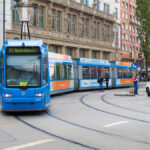
Munich’s public transportation network has four modes and one ticket. The U-Bahn is the underground subway, the S-Bahn is the suburban rail network that reaches far past the city, and the tram network and bus network cover the surface in between. Because the MVV network sells a single fare across all four, you never need to think about which operator runs the vehicle in front of you, only about which zones you are traveling through.
| Mode | Lines | What it is best for |
|---|---|---|
| U-Bahn (subway) | U1–U8 | Fast travel across the city center and to Olympiapark, Theresienwiese and the outer districts |
| S-Bahn (suburban trains) | S1–S8 | The airport, day trips into Bavaria, and the fast east–west run through the center |
| Tram network | Numbered day lines plus NachtTram | Short surface hops and routes the U-Bahn does not follow |
| Bus network | ExpressBus, MetroBus, StadtBus, NachtBus | Filling gaps between rail stops and reaching residential areas |
Two things follow from this. The airport zone matters more than the mode: only the S-Bahn reaches Munich Airport, and the airport sits in Zone 5 regardless of how you travel there. And transfers are free within the validity of your ticket, so a journey that mixes subway, tram and bus still costs one fare.
The main interchanges are Hauptbahnhof, Marienplatz, Sendlinger Tor, Odeonsplatz and Karlsplatz (Stachus). If you learn those five names you can navigate most routes without a network map, though MVV publishes free network maps for Zone M, Zones M–5 and the full Zones M–12 area, and both apps carry the same maps. A quick way to find your route without reading a map at all: enter your destination in the MVV or MVGO app and it returns the available options with live departure times.

What changed in the MVV fare system in 2026?
The 2026 tariff brought five changes, and two of them save visitors real money. Anything you read that quotes a €3.70 single ticket, an €8.80 day ticket or a €58 Deutschlandticket is describing the 2025 fares.
- Children 6 to 14 ride free on a Single Day Ticket. From January 2026, one adult can bring any number of their own children or grandchildren, or up to three other children. Nieces and nephews count as other children, not as your own.
- A new one-zone tariff cuts outer-zone fares by up to 50 percent. Journeys within a single zone in Zones 2 to 12 became substantially cheaper for single, day and strip tickets. One strip now covers a journey through an entire zone instead of only a short trip. This does not apply to the Streifenkarte U21.
- The Deutschlandticket rose to €63 a month, up from €58 in 2026 and €49 at launch in 2023.
- A single first-class supplement replaced the old patchwork for upgrading on regional trains inside the MVV area: €10 for one journey, €150 for a month, both valid for price levels M to 12.
- Subscription rules were simplified. The “10 für 12” arrangement and the annual-payment option ended; subscriptions now bill monthly with a three-month minimum term.
One smaller change matters if you are traveling with a bike in the wider region: bike carriage became free on Südostbayernbahn services inside the MVV area in the Mühldorf am Inn, Landshut and Rosenheim districts, excluding the Munich–Grafing–Ebersberg–Wasserburg and Munich–Schwindegg routes.

How do you get from Munich Airport to the city center?
Two S-Bahn lines run directly from Munich Airport to the city center, and the journey takes about 35 minutes. The S1 approaches from the west via Neufahrn and Moosach; the S8 comes in from the east via Ostbahnhof and Marienplatz. They alternate roughly every 10 minutes, which means each individual line runs about every 20 minutes. Both stop at Hauptbahnhof and Marienplatz.
The airport is in Zone 5, so a city ticket will not cover it. The Airport-City-Day-Ticket is the ticket built for this trip.
| Option | 2026 price | Covers |
|---|---|---|
| Airport-City-Day-Ticket, single | €17.50 | One adult, Zones M–5, unlimited rides until 6am next day. Children 6–14 ride free. |
| Airport-City-Day-Ticket, group | €32.60 | 2 to 5 people, Zones M–5, same validity. Two children 6–14 count as one person. |
| Day ticket, Zones M–5 | Same as above | MVV states the two are equivalent in price and service |
Buy before you set off. Airport machines, S-Bahn station machines, mobile machines on MVG buses and trams, and fixed MVG machines in the city all sell it. Tickets bought at the airport, at S-Bahn machines, online or on board are already validated; only tickets from fixed MVG machines inside the city carry a “Validate here” instruction and need stamping first.
One quirk worth knowing: at a handful of S-Bahn stations near the airport the machines will not sell the Airport-City-Day-Ticket at all. At Eching, Freising, Lohhof, Feldmoching, Neufahrn, Oberschleissheim, Pulling and Unterschleissheim on the S1, at Altenerding, Aufhausen, Erding, Feldkirchen, Grub, Heimstetten, Markt Schwaben, Ottenhofen, Poing and St. Koloman on the S2, and at Hallbergmoos and Ismaning on the S8, select “Airport” as your destination instead.
If you are still choosing a base for your trip, our guide to where to stay in Munich maps the neighborhoods against these S-Bahn and U-Bahn lines.
How do you buy and validate a ticket in Munich?
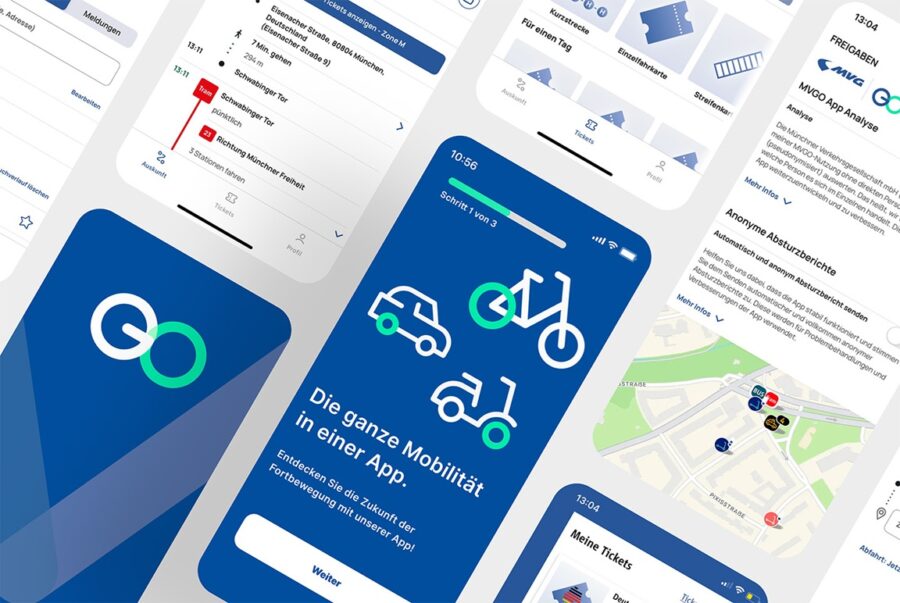
Buy in an app and validation stops being your problem. Digital tickets bought through MVGO or the MVV app are already valid when issued, so there is nothing to stamp and nothing to forget. That single habit removes the most expensive mistake a visitor can make here.
- MVGO is MVG’s own app and sells the full ticket range, including the MVVswipe option that works out the correct fare from where you actually traveled.
- The MVV app combines journey planning, live departures, network maps and ticket sales across the whole association area.
- DB Navigator is the one to use for the Bayern-Ticket and for long-distance connections beyond the MVV boundary.
- Machines take coins, notes, debit cards and credit cards. At the airport and S-Bahn machines that means Mastercard, VISA and Diners Club; at MVG machines it means Mastercard, VISA and American Express. Apple Pay, Google Pay and PayPal work in the ticket shop.
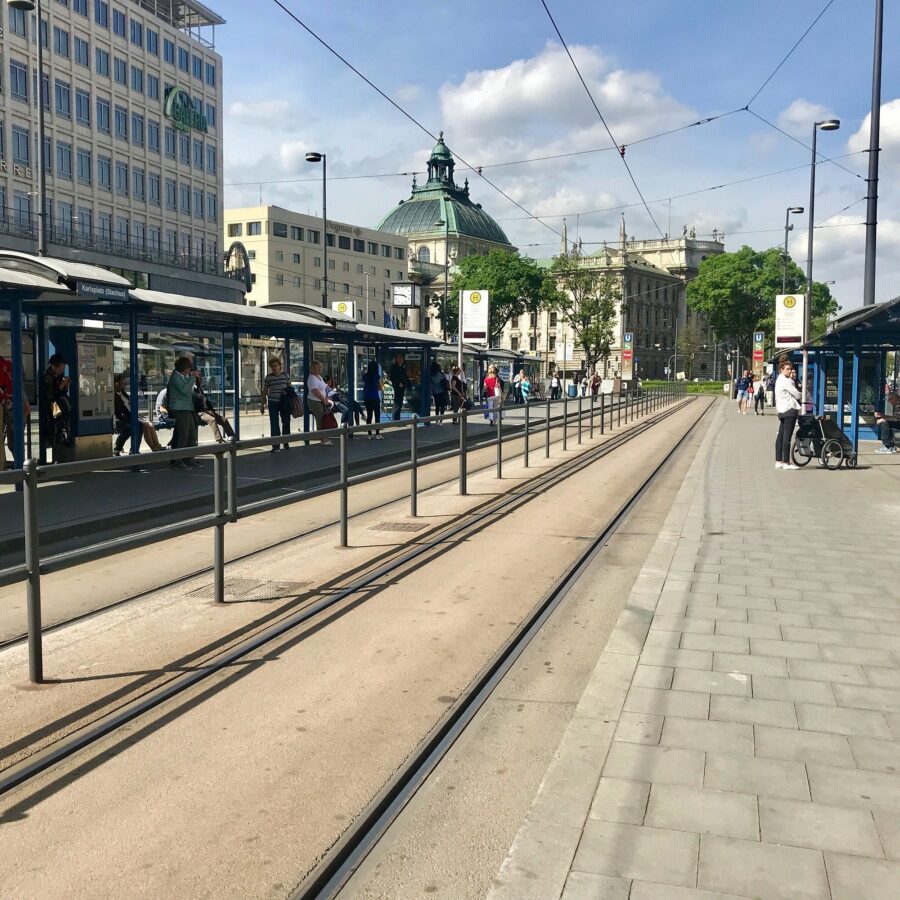
Paper tickets bought from a machine that says “Validate here” must be stamped in the blue box before you board. Munich has no ticket barriers, which fools people into thinking the system runs on trust. It runs on inspection instead.
Traveling without a valid ticket triggers an increased fare of €60. There is one narrow escape: if you genuinely held a valid personal ticket and simply did not have it with you, you can present it within 14 days through the MVG’s EBE contact form or at a customer center and pay a €7 processing fee instead. That relief does not exist if you had no ticket at all.

When do Munich’s U-Bahn, trams and buses run at night?
Munich runs its U-Bahn all night on weekends. From Monday to Thursday the U-Bahn stops around 1am, but on Friday and Saturday nights and before public holidays it operates through the night: U2, U3 and U5 at 30-minute intervals, with U1, U4 and U6 running on the same 30-minute cycle offset by 15 minutes, which gives a train roughly every 15 minutes per direction through the city center.
On the nights when the U-Bahn does close, the NachtTram and NachtBus network fills the gap.
| Service | Lines | Frequency |
|---|---|---|
| NachtTram | N17, N19, N20, N27 | Hourly through the night |
| NachtBus | N40–N45, N72, N74 | Hourly through the night |
| Denser sections | N19, N27, N40, N41 | Every 15 minutes on parts of the route |
| Weekend U-Bahn | U1–U6 | All night, about every 15 minutes in the center |
The detail that makes the night network usable: every NachtTram line and the N40 and N41 buses meet at Karlsplatz (Stachus) once an hour between 1:30am and 4:30am, and they hold a common five-minute wait so passengers can change in any direction. Plan a late night around that meeting point and you can cross the city without a taxi. Your day ticket is still valid on night services until 6am, which is the same clock the ticket already runs on.
What replaced MVG Rad for bike sharing in Munich?
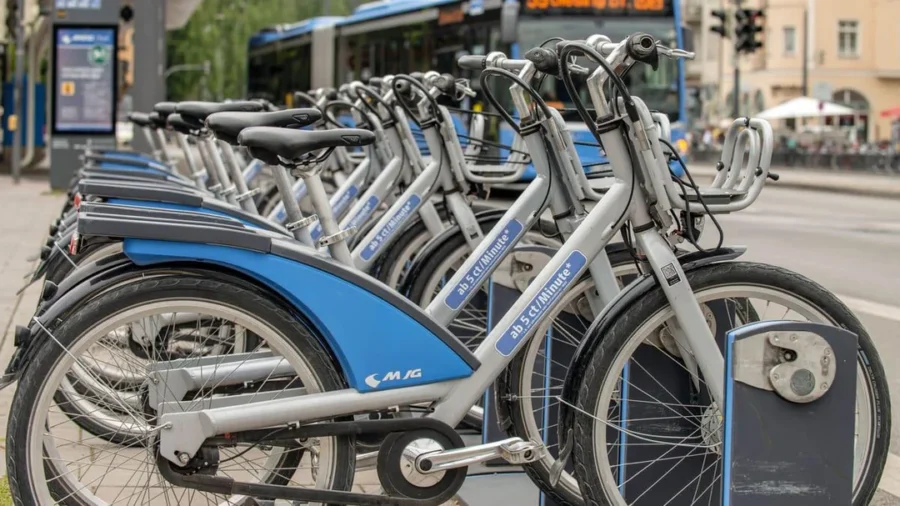
MyRadl replaced MVG Rad and launched on 7 May 2026. MVG Rad closed on 30 September 2025 after roughly ten years, and Munich then spent about seven months without a city bike-share scheme because a losing bidder challenged the original tender and the contract had to be re-run. The new operator is nextbike, working under the MVV rather than the MVG.
Most guides still describing the replacement as “unannounced” were written during that gap. Here is what actually launched.
| MyRadl | Detail |
|---|---|
| Launch date | 7 May 2026 |
| Operator | nextbike, on behalf of the MVV |
| Fleet at launch | About 2,000 bikes, 700 of them inside the city of Munich |
| Planned fleet | Up to 6,700 bikes across the MVV area |
| Classic bike | €1 base fare per 30 minutes, €9 for a full day |
| E-bike | €3 base fare, €18 for a full day |
| Booking | MVV app, MVG app or the nextbike app |
| Return rule | Station-based only. Free-floating parking has ended. |
Three groups get the base fare waived, which makes the first 30 minutes on a classic bike free and cuts the e-bike base fare to €1.50: Deutschlandticket customers who bought their subscription directly from the MVV, MVG subscription customers apart from the €365 school ticket, and Landshut university students holding a discounted Deutschlandticket. If you are already buying a monthly pass, buying it through the MVV rather than elsewhere is worth a few euros a week here.
The station-only return rule is the practical catch. MVG Rad let you leave a bike almost anywhere in the operating area; MyRadl does not. Check where the nearest station is before you set off, not when you arrive.
Can you take a bike on Munich public transport?
Bikes are allowed on the S-Bahn and U-Bahn but not during rush hour, and never on trams or buses. A bicycle needs its own ticket: the MVV bicycle day ticket costs €3.70 flat for the whole MVV area, and the DB bicycle day ticket at €7.50 extends that to DB regional trains across Bavaria, plus BOB, Meridian and alex services.
Every passenger may also bring one dog free; additional dogs pay the child fare. If you are planning to move a bike further than the city, the rules across German rail are their own subject, and we cover them in our guide to train travel with a bike in Germany.
Which mistakes cost visitors the most money?
Four errors account for most of what visitors overpay here, and each one takes under a minute to avoid.
- Assuming no barriers means no checks. Munich has open platforms and roaming inspectors. The penalty is €60 and inspectors do not accept a language barrier as an answer.
- Buying a city ticket for the airport. The airport is Zone 5. A Zone M ticket does not reach it, and this is the single most common fare-evasion charge against arriving travelers.
- Buying singles all day. Three Zone M singles cost €12.60 against €10.10 for the day ticket. Anyone sightseeing crosses that line before lunch.
- Paying a child fare that is no longer owed. Since January 2026, children aged 6 to 14 travel free on an adult’s Single Day Ticket. A family that buys separate child day tickets is spending €3.80 a head for nothing.

Is Munich public transport worth it against taxis and ride-hailing?
For the airport run and for city sightseeing, transport wins on both cost and time. An Airport-City-Day-Ticket at €17.50 covers the 35-minute S-Bahn ride to the airport plus every other journey you make that day; a taxi covers one trip and takes longer whenever the A9 is busy. Taxi and ride-hailing tariffs are adjusted by the city and by each operator, so check the current rate in the app before you book rather than trusting a figure printed in a guide.
Where a car does earn its place is a day trip outside the network’s reach or an arrival with heavy luggage late at night. For everything inside Zone M, the U-Bahn is faster than a car on the same route during the working day, because it does not queue.
Frequently asked questions
How much is a single ticket in Munich in 2026?
A single ticket for Zone M costs €4.20. A Kurzstrecke short-trip ticket, valid for up to four stops and a maximum of one hour, costs €2.10. A child aged 6 to 14 pays a flat €2.00 for a single ticket in any zone.
Do children travel free on Munich public transport?
Children under 6 always travel free. From January 2026, children aged 6 to 14 also travel free on an adult’s Single Day Ticket: any number of your own children or grandchildren, or up to three other children. Nieces and nephews count as other children.
What is the fine for riding without a ticket in Munich?
The increased fare is €60. If you held a valid personal ticket but did not have it on you, you can present it within 14 days via the MVG’s EBE contact form or at a customer center and pay a €7 processing fee instead.
Which ticket covers Munich Airport?
Munich Airport is in Zone 5, so you need a ticket covering Zones M to 5. The Airport-City-Day-Ticket costs €17.50 for one adult or €32.60 for a group of two to five, and is valid until 6am the following day. Children aged 6 to 14 ride free on the single version.
Does the Munich U-Bahn run all night?
On Friday and Saturday nights and before public holidays, yes. U2, U3 and U5 run every 30 minutes and U1, U4 and U6 run on the same cycle offset by 15 minutes, giving about a train every 15 minutes through the center. Monday to Thursday the U-Bahn stops around 1am and the NachtTram and NachtBus lines take over.
Is the Deutschlandticket worth buying for a Munich trip?
At €63 a month it beats buying day tickets only if you ride more than six full days or travel to other German cities on regional trains. For a short Munich-only stay, day tickets or a Streifenkarte cost less.
Can you still buy a paper Streifenkarte?
The Streifenkarte still exists at €18.70, with a U21 version at €10.20. Under the 2026 one-zone tariff, one strip now covers a journey through an entire zone in Zones 2 to 12 rather than only a short trip, which is what makes it noticeably better value outside the city. The U21 version is excluded from that change.
Where these numbers come from
Every fare on this page was checked against a primary source in August 2026 rather than carried over from an earlier version of this guide. Fares come from the City of Munich’s official portal price list, updated 1 January 2026, and from MVG’s own ticket overview. The Airport-City-Day-Ticket price was confirmed in MVV’s live ticket shop for a journey dated within the next month, which is why it reads €17.50 and not the €16.30 still circulating in older articles. The 2026 tariff changes come from MVV’s own summary of the new Gemeinschaftstarif. MyRadl’s launch date, fleet size and pricing come from the MVV press release of 29 April 2026. Night network frequencies come from MVG and the City of Munich.
Fares in Germany are normally revised for the January timetable change, so treat any price here as accurate for the 2026 tariff year and check the app before you buy in 2027.
- City of Munich: current MVV ticket prices
- MVG: single and day tickets
- MVV: fare changes for 2026
- MVV: Airport-City-Day-Ticket
- MVG: night lines
Planning the rest of your Munich trip
Transport decisions get easier once you know where you are sleeping and what you are seeing. Our guide to the best neighborhoods to stay in Munich pairs each area with its nearest U-Bahn line, and our safety guide to Munich covers what to expect late at night on the network. If Munich is one stop on a longer route, see our one-week Germany itinerary and the 20 best places to visit in Germany. For navigation once you are on the ground, whether Waze works in Germany answers a question the MVV apps do not, and our guide to German souvenirs covers what is worth carrying home.
Last updated 27 August 2026. This guide was rebuilt against the 2026 MVV tariff that took effect on 1 January 2026. Fares, the free-child rule, the one-zone tariff, the €63 Deutschlandticket and the MyRadl bike-share launch were all re-verified against primary sources on this date. The previous version quoted 2025 fares and described the bike-share replacement as unannounced.