## Historical Origins of Parc du Coteau – Marcel-Rosette
Parc du Coteau – Marcel-Rosette is one of the most charming and botanically sophisticated public gardens in the Val-de-Marne department. Situated on a natural hillside (*coteau*) sloping gently toward the Seine Valley in central Vitry-sur-Seine, this 3.5-hectare sanctuary offers a serene retreat characterized by stepped stone terraces, dense flower borders, and evocative 19th-century architectural relics.
The land carries a noble history of social and medical innovation. In the late 19th century, the estate belonged to **Dr. Désiré-Magloire Bourneville** (1840–1909), a pioneering French neurologist, pediatrician, and progressive politician who studied under Jean-Martin Charcot at the Salpêtrière Hospital in Paris. Bourneville purchased the hillside estate in Vitry to establish an innovative medico-pedagogical institute dedicated to the humane education, medical rehabilitation, and horticultural therapy of children with intellectual disabilities and neurological conditions.
Following the institute’s relocation in the late 20th century, the municipality acquired the walled estate. In 1991, under the leadership of longtime Mayor Marcel Rosette, the site was opened as an urban public park, later renamed in his honor following his passing.
## Terraced Landscape Design and Botanical Collections
Designed by municipal landscape architects to honor the natural slope of the hill, the park is laid out across stepped horizontal terraces supported by massive limestone masonry walls:
– **Perennial Border Collections:** The park is famous for its collection of over 200 distinct species of flowering perennial plants (*plantes vivaces*). The borders are choreographed to provide continuous color from early spring through late autumn, combining salvias, echinaceas, daylilies, hostas, and ornamental grasses that ripple in the breeze.
– **Centennial Specimen Trees:** Towering mature trees planted during Bourneville’s era have been lovingly preserved, including stately Lebanese cedars, weeping beeches, Austrian black pines, and flowering horse chestnuts.
– **The Rose Pergolas:** Shaded wooden walkways draped in climbing heritage roses, clematis, and wisteria provide fragrant, sun-dappled tunnels for leisurely strolls.
## Architectural Heritage: The Pigeonnier and Maison aux Cygnes
Scattered throughout the park grounds are picturesque historical buildings that survived the site’s transformation:
– **The Stone Pigeonnier (Dovecote):** A freestanding cylindrical stone tower with a conical slate roof, historically used for housing homing pigeons and providing natural fertilizer for estate gardens.
– **La Maison aux Cygnes (The Swan House):** A charming 19th-century brick and timber pavilion that originally served as a dormitory building for Dr. Bourneville’s pedagogical students. Today, it stands beside a decorative water basin, serving as a historic reminder of the property’s philanthropic past.
– **The Restored Stone Boundary Walls:** The perimeter of the park is defined by high rubble-stone walls (*murs en meulière*) that shield the interior gardens from the surrounding street noise, creating an atmosphere of secluded intimacy.
## Family Recreation and Community Culture
Parc du Coteau functions as an active civic cultural hub:
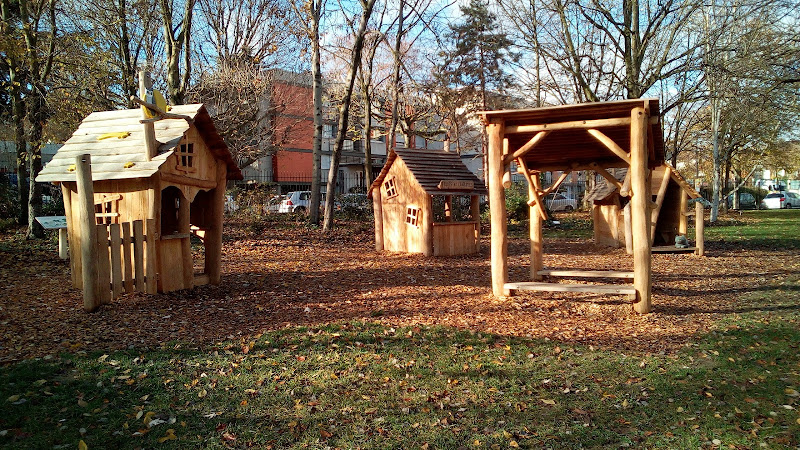
– **Children’s Playgrounds and Lawns:** Terraced grassy lawns provide picnic spots, while dedicated play areas feature timber balance obstacles, slides, and swings.
– **Proximity to Vitry Cultural Institutions:** Located directly adjacent to the **Médiathèque Nelson-Mandela** (Vitry’s flagship municipal library) and a short walk from the **MAC VAL** (Museum of Contemporary Art of Val-de-Marne), visitors frequently pair a museum visit with a quiet outdoor reading session in the park.
## Practical Visitor Information and Hours
– **Address:** Rue Édouard Tremblay / Avenue Youri Gagarine, 94400 Vitry-sur-Seine, France.
– **Opening Hours:** Open daily year-round with seasonal hours:
– May to September: 08:30 AM – 20:30 PM
– October to April: 08:30 AM – 18:00 PM
– **Admission:** Free public park access.
– **Accessibility:** While the park is set on a hillside, gently inclined paved ramps connect the various terrace levels, allowing access for strollers and wheelchairs.
– **How to Get There:**
– *By Public Transit:* Located 300 meters from Vitry Town Hall. Accessible via Tramway T9 (Mairie de Vitry-sur-Seine stop) or bus routes 132, 172, or 180.
## Urban Topography and Water Retention Engineering
The distinctive hillside terrain of Parc du Coteau – Marcel-Rosette is a showcase of sustainable urban hydrology and geotechnical engineering. Situated on a natural slope dropping from the Plateau de Vitry toward the Seine valley, the park was designed to naturally capture and filter municipal stormwater runoff. A network of terraced bioswales, retention basins, and stepped limestone cascades slows rainwater flow during heavy downpours, preventing regional street flooding while recharging local groundwater tables. The terraced hillside also creates distinct climatic microzones, with sun-drenched upper lawns ideal for sunbathing and sheltered, shaded lower woodland groves where ferns and mosses flourish.
## Contemporary Public Art and Community Picnics
In keeping with Vitry-sur-Seine’s signature cultural policy, Parc du Coteau serves as an open-air exhibition space for modern civic sculpture. Monumental abstract steel and stone sculptures by prominent 20th-century French and international artists are positioned thoughtfully against the green lawns, framed by stands of silver birch and flowering hornbeam. On warm spring and summer weekends, the open amphitheater lawns become a lively neighborhood meeting point where families spread out picnic blankets, community music groups hold informal acoustic rehearsals, and residents gather to enjoy uninterrupted views across the Seine river valley.