
Panorama 1326 Bursa Conquest Museum
About Panorama 1326 Bursa Conquest Museum
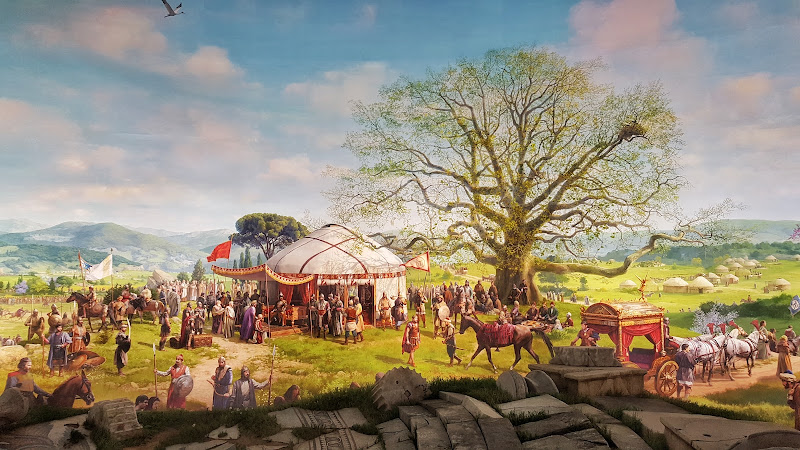
Panorama 1326 Bursa Conquest Museum sits under a futuristic dome that, at first glance, makes people do a double-take — it looks less like a traditional museum and more like a compact planetarium for history. The building's curved interior holds a fully circular, 360-degree painted scene of the 14th-century Ottoman conquest of the city, and the effect is immediate: visitors find themselves standing in the middle of a painted battlefield, surrounded by cavalry, city walls, banners, smoke and the bustle of a pivotal moment in regional history. It is not just a painting; it is an experience designed to place people at the heart of a story that shaped the early Ottoman world.
The museum approaches history in cinematic fashion. Lighting, sound and carefully staged diorama elements combine with the panoramic image to guide viewers from one vignette to another. A narrated timeline threads through the presentation, offering context about the Ottoman rise, the strategies used in the conquest, and the significance of Bursa becoming an early center of Ottoman administration and culture. For travelers who usually nod politely at plaques, Panorama 1326 makes the past feel immediate and, frankly, a little theatrical. But in a good way — it helps the history stick.
Visually, the dome is the star. The painting curves overhead and around the visitor, using perspective tricks that make the scene feel deep and populated even though it is, in reality, flat. The scale feels generous: horses seem to move, banners ripple in imagined wind, and distant troops fade into painted hills. The museum's designers clearly thought about how to make history visceral. That said, this is not a history textbook; it prioritizes experience over exhaustive detail. Visitors who want dense academic analysis might feel a tad hungry afterward, but most people leave impressed and more curious than they arrived.
One of the things that makes Panorama 1326 so effective is its balance between spectacle and commentary. Audio tracks explain who the key figures were, why Bursa mattered to the Ottomans, and how the conquest influenced commerce, architecture and political life in the region. Short panels around the dome expand on those points for anyone who wants to linger. And, importantly for family travelers, the museum has kid-friendly touches — animated narration, dramatic visuals and hands-on moments — that make a complicated slice of Ottoman history accessible to younger minds without dumbing the story down.
From a travel-planning standpoint, the museum has two practical strengths. First, its wheelchair accessible entrance and facilities mean a wider range of visitors can enjoy the panorama comfortably. Second, live performances are sometimes scheduled in connection with the displays; local actors and musicians recreate scenes from daily life in early Ottoman Bursa. Those performances are not every day, so if someone has specific dates in mind, it can be worth checking ahead. When a performance is on, the whole visit feels richer — like seeing the painting come off the walls.
Some personal-flavored aside: a local guide once joked that standing inside the dome is a bit like stepping into a history movie set where the camera never stops turning. He went on to admit he comes back sometimes, not for new facts, but for the sensation of being literally surrounded by a past city. That’s the odd, magnetic quality of the place — it’s less about acquiring factoids and more about feeling the narrative. For travelers who love storytelling, this works exceptionally well.
The museum also works well as part of a broader day of exploring Bursa. It provides a focused capsule of Ottoman conquest and early rule, which helps visitors make sense of nearby historical sites, architecture and the local museums that explore later periods. People who begin their Bursa wanderings here often report that later stops — mosques, tombs, old bazaars — suddenly read differently. Context matters, and Panorama 1326 supplies that context in a memorable, sensory way.
Accessibility and practicalities aside, there are a few lesser-known aspects that seasoned visitors appreciate. The dome's artist team referenced period costumes, contemporary chronicles and archaeological findings to make characters and scenes feel authentic rather than just romanticized. That attention to detail shows up in the uniforms, weaponry and the painted cityscape, which borrows from medieval Anatolian layouts rather than generic fantasy city forms. Also, the museum occasionally collaborates with local historians to rotate short thematic exhibits or special panels that deep-dive into subjects like trade routes that passed through Bursa, or the social life of early Ottoman elites. These pop-up touches mean repeat visits can still reveal something new.
Of course, the museum has a performance-leaning style, and that can divide opinion. Some prefer quiet galleries where artifacts sit behind glass, but others, especially travelers who get bored quickly by text panels, find the dome format illuminating. The museum’s curators seem to accept that trade-off; their aim is not to replace detailed scholarship but to spark curiosity. If a visitor leaves wanting more, that is arguably success. And honestly, having been to many museums that try to do everything, a focused, well-executed theme museum like this is a relief.
From an SEO-minded perspective for travelers researching Bursa, keywords that people search for naturally align with what Panorama 1326 offers: panorama, conquest, Ottoman history, 360-degree painting, panoramic museum and Bursa city experience. The content on-site mirrors those search queries because the museum is exactly that — a panoramic depiction of the conquest. Tourists who want to dive into the Ottoman narrative without committing hours to reading will find this format particularly appealing.
Practical mood notes: the museum is best enjoyed with a relaxed pace. The central dome experience is relatively short — perhaps 20 to 30 minutes for the main show — followed by panels and occasional displays that can be skimmed or studied at leisure. Travelers with limited time can still appreciate the core experience in under an hour, but allow extra time if a live performance or an in-depth panel topic is on display. Also, because the attraction leans heavily on auditory narration and staged lighting, people who are sensitive to loud soundscapes or sudden lights might want to prepare; ear-sensitive visitors should bring earplugs or ask at the desk about quieter viewing options.
Finally, for those planning a family day, the museum's design works surprisingly well across ages. Children are drawn to the visual drama and the feeling of stepping inside a story; parents will appreciate the clear narrative that connects what they see here to other historical sites around Bursa. For travelers who enjoy mixing culture with a dash of theatricality, Panorama 1326 is a solid pick. It’s not a dusty archive of relics; it is a stage where the past performs itself, and once in a while, that kind of museum is exactly what a traveler needs to make history come alive.
Key Features
Panorama 1326 Bursa Conquest Museum
You Might Also Like

*BDT BELEK DOGA TOUR | Daily Tours, Day Trips and Excursions in Antalya*
1464. Sk. No:55
2006. Sk. No:2
Tours & Activities
GetYourGuide provides this tour inventory. We may earn a commission if you book through it; verify current availability, prices, and terms with the provider.
Visitor Reviews
There are no reviews yet. Be the first one to write one.
Share Your Experience
Have you visited Panorama 1326 Bursa Conquest Museum? Help other travelers by leaving a review.