
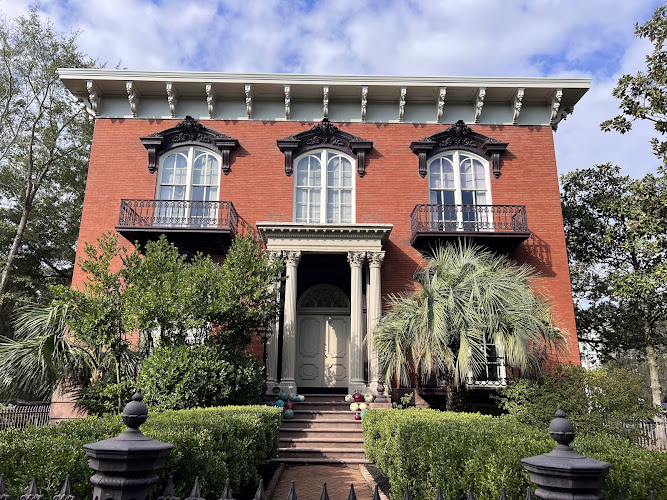
Mercer Williams House Museum
About Mercer Williams House Museum
Description
The Mercer Williams House Museum sits as a well-known house museum in Savannah's historic core, an 1860s Italianate mansion that draws people for its architecture, its collection and, yes, the stories that swirl around it. Visitors step into rooms furnished with period antiques, portraiture that seems to watch the comings and goings, and delicate Chinese porcelain pieces displayed like small, stubborn treasures. The layout of the house leans toward the intimate rather than the grandiose; this is a domestic-scale landmark, not an encyclopedic museum.
Guided tours lead groups through the first and second floors, pausing to point out architectural details, restored finishes, and the provenance of certain objets d'art. Those tours are the main way to experience the house—self-guided wandering is limited—so the docent's anecdotes and the cadence of interpretation matter. A casual admirer of architecture will find the Italianate elements satisfying: bracketed eaves, tall windows, and an interior scale that reflects middle-19th-century taste. And for readers of Midnight in the Garden of Good and Evil, the house has an extra layer of literary and cinematic resonance; it registers both as a historic home and as a piece of Savannah lore.
The museum is compact in footprint but rich in detail. Portraits and furniture tell family and civic stories; ceramics and porcelain hint at trade networks and 19th-century collecting habits. The carriage house and surrounding garden spaces add texture to the visit, though the property was never meant to be an expansive estate. People who come hoping for long, cathedral-like galleries might be disappointed. But those who enjoy close-up encounters with fine period pieces, who like an atmospheric guided narrative, will leave feeling they've been guided into a particular moment of Savannah history rather than through a broad survey of it.
Practical note: the house offers onsite services like a gift shop and public restrooms, and it charges an admission fee. The museum is welcoming to families with discounts for children and programming geared to younger visitors, though the physical layout may challenge some mobility needs because there is not a wheelchair-accessible entrance at the main house. Paid street parking is common in the area; visitors who dislike meter hunting should plan ahead. Overall, the house tends to attract enthusiastic responses for its charm and storytelling, while some visitors point out that it can be crowded during peak hours and that the small scale means tours sell out faster than at larger institutions.
Key Features
- 1860s Italianate mansion architecture with preserved period details
- Guided tours that focus on history, architecture and the house collection
- Antiques and period furniture, including portraits that reflect family history
- Significant collection of Chinese porcelain and decorative arts
- Carriage house and modest gardens that enhance the historic setting
- Onsite gift shop offering curated souvenirs and books
- Restrooms available for visitors; no on-site restaurant
- Admission fee required; discounts available for children
- Good destination for families and history-minded travelers
- Limited wheelchair accessibility at the main entrance
- Paid street parking typical in the surrounding neighborhood
Best Time to Visit
The best time to tour the Mercer Williams House Museum is during the shoulder seasons of spring and fall when Savannah's temperatures are agreeable and the streets feel lively but not overloaded. Early mornings on weekdays are the sweet spot: fewer crowds, cooler air and a better chance to hear the guide without straining over other visitors. Summers bring intense heat and humidity, and while the museum is air-conditioned in parts, the sidewalks and squares can be tiring; still, summer evenings in the city have a particular glow that some travelers prefer.
Timing also matters because tours run on schedules and the house is small. If a visitor wants a quieter, more contemplative experience, aim for the first tour of the day or a late afternoon slot when schools and tour groups have dispersed. Holiday weekends and festival weekends in Savannah can spike attendance, so planning ahead or choosing an off-peak day will pay off. And if someone wants to link the visit to other nearby attractions—Monterey Square, walking tours, or riverfront dining—allow at least an hour to 90 minutes for the Mercer Williams House so the guided pace does not feel rushed.
How to Get There
The museum is located in the heart of Savannah's historic district on a well-known street that threads through several of the city's squares. Most visitors arrive on foot from nearby hotels or from other squares and attractions; Savannah is famously walkable and the house is well-situated for a walking day. For those driving, paid street parking is the norm in the vicinity. Metered spaces fill up quickly on busy days, so leave extra time to find parking or look into parking garages a short walk away.
Public transportation options include local buses and tourist shuttles that stop near the historic district. Ride-hailing services are also widely used and drop-off points are convenient for a short walk to the entrance. Cyclists will find the area easy to navigate, though secure bike parking is not always abundant right at the doorstep. Travelers coming from farther away often combine a visit to this museum with other walking-friendly landmarks so that car time is minimized. In short, plan for a little walking and a little patience with parking during peak hours.
Tips for Visiting
A few practical tips make the experience smoother. Arrive early, buy or reserve tickets if possible, and pick a tour time that matches one's stamina for walking and standing. The guided format is central to the house experience; listening closely will reveal quirky provenance stories about objects and people that a mere look-around would miss. And yes, the docents often have great personal takes on the details—so listen up. They know the house intimately and often share the small, human stories that make historic houses memorable.
Accessibility deserves a clear call-out: the main entrance does not have wheelchair access. Visitors with mobility concerns should contact the museum in advance to discuss accommodations or alternative entry points. The museum does provide restroom facilities, but there is no onsite restaurant, so plan to eat before or after the visit. The gift shop is small but thoughtfully stocked—good for picking up a book about local history or a small decorative keepsake.
Photography policies vary; visitors should check signage and ask staff before taking pictures, especially inside rooms with fragile displays. It is respectful to avoid flash and to follow the docent's guidance about where to stand during talk segments. Families with children will want to note that tours require quiet attention at times; small kids can absolutely enjoy the house, but bringing a quiet activity or planning for a shorter visit might help. The museum's atmosphere rewards curiosity, so encourage young visitors to ask the guide questions when appropriate.
For those who like to be slightly idiosyncratic: combine the museum visit with a square-side picnic or a walk to the riverfront. Many people find that splitting the day between the close-up experience of the house and the wider sweep of Savannah's streets gives a fuller sense of place. Bring comfortable shoes. Pack a small umbrella in spring or fall—Savannah weather can be charmingly unpredictable. And if someone is traveling specifically because of the house's connection to local literature or film, they should mention that to the guide; it often leads to richer, contextual anecdotes about Jim Williams and the city around him.
Finally, a word about expectations: the Mercer Williams House Museum is prized for its atmosphere and its narrative-led tours. It is not a massive museum with long galleries, but rather a slice of Savannah life, preserved and interpreted. People who want a quiet, layered history—who appreciate antiques, architecture and the odd, intimate story—will likely find the visit rewarding. People seeking a long, broad museum day with lots of interactive displays might feel constrained by the house's size. Both responses are valid. Planning, timing and a curiosity for detail will make the visit feel worth every minute.
In the end, the Mercer Williams House Museum offers a concentrated, character-rich window into 19th-century design, collecting habits and Savannah social life, all wrapped in guided storytelling. For travelers who like history up-close, it delivers. For those who come with a literary lens, it adds an extra, almost cinematic texture. And for anybody who loves a good antique story or a well-told house tour, it is a stop in the historic district that tends to linger in memory longer than its footprint suggests.
Key Features
- 1860s Italianate mansion architecture with preserved period details
- Guided tours that focus on history, architecture and the house collection
- Antiques and period furniture, including portraits that reflect family history
- Significant collection of Chinese porcelain and decorative arts
- Carriage house and modest gardens that enhance the historic setting
- Onsite gift shop offering curated souvenirs and books
- Restrooms available for visitors; no on-site restaurant
- Admission fee required; discounts available for children
More Details
Updated August 29, 2025
Table of Contents
Description
The Mercer Williams House Museum sits as a well-known house museum in Savannah’s historic core, an 1860s Italianate mansion that draws people for its architecture, its collection and, yes, the stories that swirl around it. Visitors step into rooms furnished with period antiques, portraiture that seems to watch the comings and goings, and delicate Chinese porcelain pieces displayed like small, stubborn treasures. The layout of the house leans toward the intimate rather than the grandiose; this is a domestic-scale landmark, not an encyclopedic museum.
Guided tours lead groups through the first and second floors, pausing to point out architectural details, restored finishes, and the provenance of certain objets d’art. Those tours are the main way to experience the house—self-guided wandering is limited—so the docent’s anecdotes and the cadence of interpretation matter. A casual admirer of architecture will find the Italianate elements satisfying: bracketed eaves, tall windows, and an interior scale that reflects middle-19th-century taste. And for readers of Midnight in the Garden of Good and Evil, the house has an extra layer of literary and cinematic resonance; it registers both as a historic home and as a piece of Savannah lore.
The museum is compact in footprint but rich in detail. Portraits and furniture tell family and civic stories; ceramics and porcelain hint at trade networks and 19th-century collecting habits. The carriage house and surrounding garden spaces add texture to the visit, though the property was never meant to be an expansive estate. People who come hoping for long, cathedral-like galleries might be disappointed. But those who enjoy close-up encounters with fine period pieces, who like an atmospheric guided narrative, will leave feeling they’ve been guided into a particular moment of Savannah history rather than through a broad survey of it.
Practical note: the house offers onsite services like a gift shop and public restrooms, and it charges an admission fee. The museum is welcoming to families with discounts for children and programming geared to younger visitors, though the physical layout may challenge some mobility needs because there is not a wheelchair-accessible entrance at the main house. Paid street parking is common in the area; visitors who dislike meter hunting should plan ahead. Overall, the house tends to attract enthusiastic responses for its charm and storytelling, while some visitors point out that it can be crowded during peak hours and that the small scale means tours sell out faster than at larger institutions.
Key Features
- 1860s Italianate mansion architecture with preserved period details
- Guided tours that focus on history, architecture and the house collection
- Antiques and period furniture, including portraits that reflect family history
- Significant collection of Chinese porcelain and decorative arts
- Carriage house and modest gardens that enhance the historic setting
- Onsite gift shop offering curated souvenirs and books
- Restrooms available for visitors; no on-site restaurant
- Admission fee required; discounts available for children
- Good destination for families and history-minded travelers
- Limited wheelchair accessibility at the main entrance
- Paid street parking typical in the surrounding neighborhood
Best Time to Visit
The best time to tour the Mercer Williams House Museum is during the shoulder seasons of spring and fall when Savannah’s temperatures are agreeable and the streets feel lively but not overloaded. Early mornings on weekdays are the sweet spot: fewer crowds, cooler air and a better chance to hear the guide without straining over other visitors. Summers bring intense heat and humidity, and while the museum is air-conditioned in parts, the sidewalks and squares can be tiring; still, summer evenings in the city have a particular glow that some travelers prefer.
Timing also matters because tours run on schedules and the house is small. If a visitor wants a quieter, more contemplative experience, aim for the first tour of the day or a late afternoon slot when schools and tour groups have dispersed. Holiday weekends and festival weekends in Savannah can spike attendance, so planning ahead or choosing an off-peak day will pay off. And if someone wants to link the visit to other nearby attractions—Monterey Square, walking tours, or riverfront dining—allow at least an hour to 90 minutes for the Mercer Williams House so the guided pace does not feel rushed.
How to Get There
The museum is located in the heart of Savannah’s historic district on a well-known street that threads through several of the city’s squares. Most visitors arrive on foot from nearby hotels or from other squares and attractions; Savannah is famously walkable and the house is well-situated for a walking day. For those driving, paid street parking is the norm in the vicinity. Metered spaces fill up quickly on busy days, so leave extra time to find parking or look into parking garages a short walk away.
Public transportation options include local buses and tourist shuttles that stop near the historic district. Ride-hailing services are also widely used and drop-off points are convenient for a short walk to the entrance. Cyclists will find the area easy to navigate, though secure bike parking is not always abundant right at the doorstep. Travelers coming from farther away often combine a visit to this museum with other walking-friendly landmarks so that car time is minimized. In short, plan for a little walking and a little patience with parking during peak hours.
Tips for Visiting
A few practical tips make the experience smoother. Arrive early, buy or reserve tickets if possible, and pick a tour time that matches one’s stamina for walking and standing. The guided format is central to the house experience; listening closely will reveal quirky provenance stories about objects and people that a mere look-around would miss. And yes, the docents often have great personal takes on the details—so listen up. They know the house intimately and often share the small, human stories that make historic houses memorable.
Accessibility deserves a clear call-out: the main entrance does not have wheelchair access. Visitors with mobility concerns should contact the museum in advance to discuss accommodations or alternative entry points. The museum does provide restroom facilities, but there is no onsite restaurant, so plan to eat before or after the visit. The gift shop is small but thoughtfully stocked—good for picking up a book about local history or a small decorative keepsake.
Photography policies vary; visitors should check signage and ask staff before taking pictures, especially inside rooms with fragile displays. It is respectful to avoid flash and to follow the docent’s guidance about where to stand during talk segments. Families with children will want to note that tours require quiet attention at times; small kids can absolutely enjoy the house, but bringing a quiet activity or planning for a shorter visit might help. The museum’s atmosphere rewards curiosity, so encourage young visitors to ask the guide questions when appropriate.
For those who like to be slightly idiosyncratic: combine the museum visit with a square-side picnic or a walk to the riverfront. Many people find that splitting the day between the close-up experience of the house and the wider sweep of Savannah’s streets gives a fuller sense of place. Bring comfortable shoes. Pack a small umbrella in spring or fall—Savannah weather can be charmingly unpredictable. And if someone is traveling specifically because of the house’s connection to local literature or film, they should mention that to the guide; it often leads to richer, contextual anecdotes about Jim Williams and the city around him.
Finally, a word about expectations: the Mercer Williams House Museum is prized for its atmosphere and its narrative-led tours. It is not a massive museum with long galleries, but rather a slice of Savannah life, preserved and interpreted. People who want a quiet, layered history—who appreciate antiques, architecture and the odd, intimate story—will likely find the visit rewarding. People seeking a long, broad museum day with lots of interactive displays might feel constrained by the house’s size. Both responses are valid. Planning, timing and a curiosity for detail will make the visit feel worth every minute.
In the end, the Mercer Williams House Museum offers a concentrated, character-rich window into 19th-century design, collecting habits and Savannah social life, all wrapped in guided storytelling. For travelers who like history up-close, it delivers. For those who come with a literary lens, it adds an extra, almost cinematic texture. And for anybody who loves a good antique story or a well-told house tour, it is a stop in the historic district that tends to linger in memory longer than its footprint suggests.
Key Highlights
- 1860s Italianate mansion architecture with preserved period details
- Guided tours that focus on history, architecture and the house collection
- Antiques and period furniture, including portraits that reflect family history
- Significant collection of Chinese porcelain and decorative arts
- Carriage house and modest gardens that enhance the historic setting
- Onsite gift shop offering curated souvenirs and books
- Restrooms available for visitors; no on-site restaurant
- Admission fee required; discounts available for children
Location
Places to Stay Near Mercer Williams House Museum
Find and Book a Tour
Explore More Travel Guides
No reviews found! Be the first to review!
Traveler Reviews for Mercer Williams House Museum
There are no reviews yet. Be the first one to write one.
Have you visited Mercer Williams House Museum? Help other travelers by sharing your review.
You Might Also Like

Forsyth Park

Savannah African Art Museum

Savannah Ogeechee Canal Museum and Nature Center
Find Accommodations Nearby
Recommended Tours & Activities
Visitor Reviews
There are no reviews yet. Be the first one to write one.
Share Your Experience
Have you visited Mercer Williams House Museum? Help other travelers by leaving a review.