
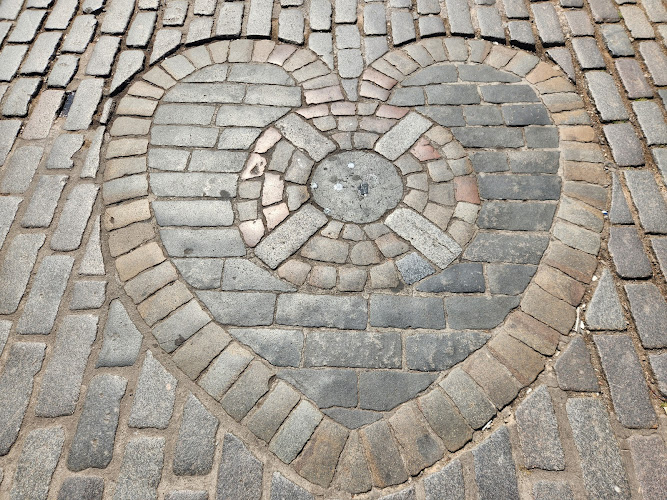
Heart of Midlothian Mosaic
About Heart of Midlothian Mosaic
Description
The Heart of Midlothian Mosaic sits embedded in the cobblestones along Edinburgh's famous Royal Mile, and honestly, it's one of those curious little historical markers that many visitors walk right past without giving it a second glance. But here's the thing - this unassuming heart-shaped pattern of colored stones marks the exact spot where the Old Tolbooth once stood, a building that served as the town's administrative center, prison, and execution site from the 15th century until its demolition in 1817. I remember the first time I walked the Royal Mile, my eyes were so focused on the castle looming ahead and the street performers all around that I nearly missed this little gem entirely. It wasn't until I noticed a small crowd gathered around what looked like just a spot on the ground that I realized something special was happening here. The mosaic itself is surprisingly modest - no grand monument, no towering statue - just a simple heart pattern worked into the pavement in brass and stone. And yet, there's something deeply moving about standing on the exact spot where so much of Edinburgh's turbulent history unfolded. The Old Tolbooth, which locals knew as the "Heart of Midlothian," wasn't just any building. It witnessed executions, housed prisoners in deplorable conditions, and served as the backdrop for some of Scotland's most dramatic historical moments. Sir Walter Scott immortalized it in his novel "The Heart of Midlothian," ensuring that even after the building's physical demolition, its memory would live on. Today, the mosaic serves as a tangible connection to that past, a reminder that we're literally walking through history with every step along the Royal Mile. What makes this spot particularly fascinating is the tradition that's grown up around it. You'll often see locals and tourists alike spitting on the heart - yes, you read that right. Before you wrinkle your nose in disgust, there's actually a historical reason for this peculiar custom. Prisoners being taken to their execution would spit on the door of the Tolbooth as a sign of contempt and defiance. The tradition has evolved over time, and now people spit on the mosaic for good luck or to show their disdain for the injustices that occurred here centuries ago.Key Features
The Heart of Midlothian Mosaic offers visitors several distinctive elements that make it worth seeking out: • The intricate heart-shaped design measures approximately two feet across and features a decorative pattern worked in brass and colored stones set into the granite cobblestones • Historical significance as the exact location of Edinburgh's Old Tolbooth, which stood from the 1400s until 1817 and served multiple civic functions • Connection to Sir Walter Scott's famous novel, providing literary enthusiasts with a tangible link to Scottish literature • The unusual spitting tradition that continues to this day, representing one of Edinburgh's more quirky cultural practices • Wheelchair accessible location right on the main pedestrian thoroughfare of the Royal Mile • Free to visit at any time of day or night, making it one of Edinburgh's most accessible historical markers • Proximity to St. Giles' Cathedral, which stands just steps away and adds architectural context to the site • The worn appearance of the stones around the mosaic, testament to the thousands upon thousands of feet that have passed over this spot • Child-friendly attraction that provides an easy entry point for discussing Scottish history with younger travelers • Photo opportunities that capture both the mosaic itself and the surrounding medieval streetscapeBest Time to Visit
Here's where I'm gonna be completely honest with you - timing your visit to the Heart of Midlothian makes a bigger difference than you might think for what's essentially just a design in the pavement. The Royal Mile gets absolutely packed during peak tourist season, which runs from June through August. During these months, you might find yourself jostling for position just to get a decent look at the mosaic, let alone snap a photo without someone's foot in the frame. Early morning visits, particularly before 9 AM, offer the best experience. The Royal Mile transforms into a completely different place when it's relatively empty. You can actually hear your footsteps on the cobblestones, and you'll have time to appreciate the mosaic without feeling rushed. Plus, the morning light in Edinburgh has this particular quality that makes even the simplest historical markers feel somehow more profound. If you're visiting during Edinburgh's famous festivals - the Fringe in August or Hogmanay celebrations at New Year - well, good luck finding a quiet moment here. The street becomes shoulder-to-shoulder people, and while that energy is exciting, it's not ideal for contemplating history. That said, there's something oddly appropriate about experiencing the Heart during festival times, since the Royal Mile has always been a place of public gathering and spectacle. Winter months from November through February bring fewer crowds and often provide that moody Scottish atmosphere that really suits the somber history of this site. Yes, it'll be cold and possibly wet, but bundling up and experiencing Edinburgh in winter has its own rewards. The mosaic often gets overlooked when there's frost on the ground, which means you might have it entirely to yourself. Late afternoon around 4 or 5 PM during spring and autumn months hits a sweet spot - most tour groups have moved on, but there's still enough daylight to see everything clearly. And the autumn colors on the trees along the Royal Mile create a particularly photogenic backdrop.How to Get There
Finding the Heart of Midlothian is refreshingly straightforward, though I've watched plenty of tourists unknowingly stand right on top of it while consulting their maps. The mosaic sits on the Royal Mile, specifically on the High Street section, right outside St. Giles' Cathedral near the main entrance. If you're walking down from Edinburgh Castle, you'll find it on your right side after about a five-minute walk. Edinburgh's public transportation makes reaching this spot incredibly easy. The city's extensive bus network stops at various points along the Royal Mile and nearby streets. Buses 23, 27, 41, and 42 all stop close to the cathedral, putting you within a minute's walk of the mosaic. Just tell the driver you're heading to St. Giles' Cathedral, and they'll let you know when you've arrived. The Edinburgh Trams run along Princes Street, and from there it's about a 10-minute uphill walk to reach the Royal Mile. The Waverley train station sits at the bottom of the hill just off the Royal Mile, making this an easy first or last stop if you're arriving by train. From Waverley, head up either the Waverley Steps or the ramp system, and you'll emerge right onto the Royal Mile. For those staying in Edinburgh's city center, walking is genuinely the best option. The entire Old Town is quite compact, and chances are your accommodation isn't more than 15 or 20 minutes away on foot. The walk itself provides constant visual interest - Edinburgh's architecture alone is worth the trek. Driving to this location isn't recommended, honestly. The Royal Mile is pedestrian-friendly but not particularly car-friendly, and parking in Edinburgh's Old Town ranges from difficult to nearly impossible. If you must drive, there are several parking garages near the Royal Mile, including facilities on Castle Terrace and under St. James Quarter, but expect to pay premium prices and walk the final distance anyway. The location is indeed wheelchair accessible, with a relatively smooth path along the Royal Mile. However, be aware that the Royal Mile does have a noticeable slope running its entire length, which might require some effort depending on your direction of travel.Tips for Visiting
Look down. I know this sounds absurdly simple, but the number of people who walk right over the Heart without noticing it is remarkable. The Royal Mile has so much visual stimulation at eye level and above - the buildings, the castle, the cathedral, the street performers - that visitors often forget to watch where they're stepping. The mosaic isn't raised or particularly prominent, so keeping your eyes on the pavement is essential. About that spitting tradition - you'll need to decide for yourself whether to participate. Some find it disrespectful in a modern context, while others see it as honoring an old tradition. If the idea bothers you, simply standing on or touching the mosaic is perfectly acceptable. Nobody's keeping score, despite what enthusiastic tour guides might suggest. And if you do decide to spit, maybe keep it subtle? The locals appreciate discretion. Combine your visit with St. Giles' Cathedral right next door. The cathedral's architecture is stunning, and understanding the religious and political context of medieval Edinburgh really enriches your appreciation of why the Tolbooth's location was so significant. Plus, the cathedral has public restrooms, which are surprisingly hard to find along the Royal Mile. Photography works best when you're willing to wait a bit. Rather than trying to snap a quick shot while people are walking over the mosaic, take a moment to observe the flow of foot traffic. There are natural lulls every few minutes when you can capture the Heart without shoes and legs cluttering your composition. A straight-down angle works better than shooting from the side. Watch the tour groups that gather here - you might learn something interesting without paying for a guided tour yourself. Many Edinburgh walking tours stop at the Heart, and guides often share fascinating details about the Tolbooth's history. Just be respectful and don't obviously eavesdrop, but if you happen to be nearby when a guide is speaking loudly enough for everyone to hear, well, that's just happy coincidence. Wear appropriate footwear for cobblestones. This might seem obvious, but the Royal Mile's uneven stones have claimed many an ankle, particularly when people are distracted by sights like the Heart of Midlothian. Those cute sandals or fancy dress shoes might look great in photos, but they're murder on cobblestones. Consider visiting after dark when the street lighting creates a completely different atmosphere. The Heart takes on an almost ethereal quality in the evening, and the reduced crowds make it easier to contemplate the weight of history beneath your feet. Edinburgh feels particularly magical at night, and the Royal Mile maintains a safe, well-lit environment even in later hours. Don't expect a grand experience or elaborate signage. The beauty of the Heart of Midlothian lies in its understated nature. This isn't a theme park attraction with information boards and visitor centers - it's a simple memorial to a demolished building and the lives affected by what happened within its walls. Adjusting your expectations accordingly will help you appreciate what's actually there rather than being disappointed by what isn't.Key Features
- Key Features
- Best Time to Visit
- How to Get There
- Tips for Visiting
More Details
Updated January 19, 2026
Table of Contents
Description
The Heart of Midlothian Mosaic sits embedded in the cobblestones along Edinburgh’s famous Royal Mile, and honestly, it’s one of those curious little historical markers that many visitors walk right past without giving it a second glance. But here’s the thing – this unassuming heart-shaped pattern of colored stones marks the exact spot where the Old Tolbooth once stood, a building that served as the town’s administrative center, prison, and execution site from the 15th century until its demolition in 1817.
I remember the first time I walked the Royal Mile, my eyes were so focused on the castle looming ahead and the street performers all around that I nearly missed this little gem entirely. It wasn’t until I noticed a small crowd gathered around what looked like just a spot on the ground that I realized something special was happening here. The mosaic itself is surprisingly modest – no grand monument, no towering statue – just a simple heart pattern worked into the pavement in brass and stone. And yet, there’s something deeply moving about standing on the exact spot where so much of Edinburgh’s turbulent history unfolded.
The Old Tolbooth, which locals knew as the “Heart of Midlothian,” wasn’t just any building. It witnessed executions, housed prisoners in deplorable conditions, and served as the backdrop for some of Scotland’s most dramatic historical moments. Sir Walter Scott immortalized it in his novel “The Heart of Midlothian,” ensuring that even after the building’s physical demolition, its memory would live on. Today, the mosaic serves as a tangible connection to that past, a reminder that we’re literally walking through history with every step along the Royal Mile.
What makes this spot particularly fascinating is the tradition that’s grown up around it. You’ll often see locals and tourists alike spitting on the heart – yes, you read that right. Before you wrinkle your nose in disgust, there’s actually a historical reason for this peculiar custom. Prisoners being taken to their execution would spit on the door of the Tolbooth as a sign of contempt and defiance. The tradition has evolved over time, and now people spit on the mosaic for good luck or to show their disdain for the injustices that occurred here centuries ago.
Key Features
The Heart of Midlothian Mosaic offers visitors several distinctive elements that make it worth seeking out:
• The intricate heart-shaped design measures approximately two feet across and features a decorative pattern worked in brass and colored stones set into the granite cobblestones
• Historical significance as the exact location of Edinburgh’s Old Tolbooth, which stood from the 1400s until 1817 and served multiple civic functions
• Connection to Sir Walter Scott’s famous novel, providing literary enthusiasts with a tangible link to Scottish literature
• The unusual spitting tradition that continues to this day, representing one of Edinburgh’s more quirky cultural practices
• Wheelchair accessible location right on the main pedestrian thoroughfare of the Royal Mile
• Free to visit at any time of day or night, making it one of Edinburgh’s most accessible historical markers
• Proximity to St. Giles’ Cathedral, which stands just steps away and adds architectural context to the site
• The worn appearance of the stones around the mosaic, testament to the thousands upon thousands of feet that have passed over this spot
• Child-friendly attraction that provides an easy entry point for discussing Scottish history with younger travelers
• Photo opportunities that capture both the mosaic itself and the surrounding medieval streetscape
Best Time to Visit
Here’s where I’m gonna be completely honest with you – timing your visit to the Heart of Midlothian makes a bigger difference than you might think for what’s essentially just a design in the pavement. The Royal Mile gets absolutely packed during peak tourist season, which runs from June through August. During these months, you might find yourself jostling for position just to get a decent look at the mosaic, let alone snap a photo without someone’s foot in the frame.
Early morning visits, particularly before 9 AM, offer the best experience. The Royal Mile transforms into a completely different place when it’s relatively empty. You can actually hear your footsteps on the cobblestones, and you’ll have time to appreciate the mosaic without feeling rushed. Plus, the morning light in Edinburgh has this particular quality that makes even the simplest historical markers feel somehow more profound.
If you’re visiting during Edinburgh’s famous festivals – the Fringe in August or Hogmanay celebrations at New Year – well, good luck finding a quiet moment here. The street becomes shoulder-to-shoulder people, and while that energy is exciting, it’s not ideal for contemplating history. That said, there’s something oddly appropriate about experiencing the Heart during festival times, since the Royal Mile has always been a place of public gathering and spectacle.
Winter months from November through February bring fewer crowds and often provide that moody Scottish atmosphere that really suits the somber history of this site. Yes, it’ll be cold and possibly wet, but bundling up and experiencing Edinburgh in winter has its own rewards. The mosaic often gets overlooked when there’s frost on the ground, which means you might have it entirely to yourself.
Late afternoon around 4 or 5 PM during spring and autumn months hits a sweet spot – most tour groups have moved on, but there’s still enough daylight to see everything clearly. And the autumn colors on the trees along the Royal Mile create a particularly photogenic backdrop.
How to Get There
Finding the Heart of Midlothian is refreshingly straightforward, though I’ve watched plenty of tourists unknowingly stand right on top of it while consulting their maps. The mosaic sits on the Royal Mile, specifically on the High Street section, right outside St. Giles’ Cathedral near the main entrance. If you’re walking down from Edinburgh Castle, you’ll find it on your right side after about a five-minute walk.
Edinburgh’s public transportation makes reaching this spot incredibly easy. The city’s extensive bus network stops at various points along the Royal Mile and nearby streets. Buses 23, 27, 41, and 42 all stop close to the cathedral, putting you within a minute’s walk of the mosaic. Just tell the driver you’re heading to St. Giles’ Cathedral, and they’ll let you know when you’ve arrived.
The Edinburgh Trams run along Princes Street, and from there it’s about a 10-minute uphill walk to reach the Royal Mile. The Waverley train station sits at the bottom of the hill just off the Royal Mile, making this an easy first or last stop if you’re arriving by train. From Waverley, head up either the Waverley Steps or the ramp system, and you’ll emerge right onto the Royal Mile.
For those staying in Edinburgh’s city center, walking is genuinely the best option. The entire Old Town is quite compact, and chances are your accommodation isn’t more than 15 or 20 minutes away on foot. The walk itself provides constant visual interest – Edinburgh’s architecture alone is worth the trek.
Driving to this location isn’t recommended, honestly. The Royal Mile is pedestrian-friendly but not particularly car-friendly, and parking in Edinburgh’s Old Town ranges from difficult to nearly impossible. If you must drive, there are several parking garages near the Royal Mile, including facilities on Castle Terrace and under St. James Quarter, but expect to pay premium prices and walk the final distance anyway.
The location is indeed wheelchair accessible, with a relatively smooth path along the Royal Mile. However, be aware that the Royal Mile does have a noticeable slope running its entire length, which might require some effort depending on your direction of travel.
Tips for Visiting
Look down. I know this sounds absurdly simple, but the number of people who walk right over the Heart without noticing it is remarkable. The Royal Mile has so much visual stimulation at eye level and above – the buildings, the castle, the cathedral, the street performers – that visitors often forget to watch where they’re stepping. The mosaic isn’t raised or particularly prominent, so keeping your eyes on the pavement is essential.
About that spitting tradition – you’ll need to decide for yourself whether to participate. Some find it disrespectful in a modern context, while others see it as honoring an old tradition. If the idea bothers you, simply standing on or touching the mosaic is perfectly acceptable. Nobody’s keeping score, despite what enthusiastic tour guides might suggest. And if you do decide to spit, maybe keep it subtle? The locals appreciate discretion.
Combine your visit with St. Giles’ Cathedral right next door. The cathedral’s architecture is stunning, and understanding the religious and political context of medieval Edinburgh really enriches your appreciation of why the Tolbooth’s location was so significant. Plus, the cathedral has public restrooms, which are surprisingly hard to find along the Royal Mile.
Photography works best when you’re willing to wait a bit. Rather than trying to snap a quick shot while people are walking over the mosaic, take a moment to observe the flow of foot traffic. There are natural lulls every few minutes when you can capture the Heart without shoes and legs cluttering your composition. A straight-down angle works better than shooting from the side.
Watch the tour groups that gather here – you might learn something interesting without paying for a guided tour yourself. Many Edinburgh walking tours stop at the Heart, and guides often share fascinating details about the Tolbooth’s history. Just be respectful and don’t obviously eavesdrop, but if you happen to be nearby when a guide is speaking loudly enough for everyone to hear, well, that’s just happy coincidence.
Wear appropriate footwear for cobblestones. This might seem obvious, but the Royal Mile’s uneven stones have claimed many an ankle, particularly when people are distracted by sights like the Heart of Midlothian. Those cute sandals or fancy dress shoes might look great in photos, but they’re murder on cobblestones.
Consider visiting after dark when the street lighting creates a completely different atmosphere. The Heart takes on an almost ethereal quality in the evening, and the reduced crowds make it easier to contemplate the weight of history beneath your feet. Edinburgh feels particularly magical at night, and the Royal Mile maintains a safe, well-lit environment even in later hours.
Don’t expect a grand experience or elaborate signage. The beauty of the Heart of Midlothian lies in its understated nature. This isn’t a theme park attraction with information boards and visitor centers – it’s a simple memorial to a demolished building and the lives affected by what happened within its walls. Adjusting your expectations accordingly will help you appreciate what’s actually there rather than being disappointed by what isn’t.
Key Highlights
- Key Features
- Best Time to Visit
- How to Get There
- Tips for Visiting
Location
Places to Stay Near Heart of Midlothian Mosaic
Find and Book a Tour
Explore More Travel Guides
No reviews found! Be the first to review!
Traveler Reviews for Heart of Midlothian Mosaic
There are no reviews yet. Be the first one to write one.
Have you visited Heart of Midlothian Mosaic? Help other travelers by sharing your review.
You Might Also Like

Museum of Childhood

Museum on the Mound

The Royal Yacht Britannia
Find Accommodations Nearby
Recommended Tours & Activities
Visitor Reviews
There are no reviews yet. Be the first one to write one.
Share Your Experience
Have you visited Heart of Midlothian Mosaic? Help other travelers by leaving a review.