
Last modified September 1, 2026
The battery inside your toothbrush decides which bag it travels in. A rechargeable electric toothbrush runs on a lithium-ion cell, and the TSA says devices containing lithium batteries should be carried in your carry-on. A toothbrush that runs on a single AAA alkaline battery carries no lithium restriction at all, so it can ride in checked luggage, needs no charger, and raises no voltage question abroad. That one difference matters more on a trip than bristle patterns or three cleaning modes, and almost no guide to the best travel toothbrush leads with it.
The second thing worth knowing before you buy a portable toothbrush: the American Dental Association advises against storing a damp toothbrush in a closed container. The travel cover is for the plane, not for the bathroom. Everything below is built on those two rules, because they are the two that change what you pack.
Which travel toothbrush should you buy?
Choosing an electric toothbrush for travel is a different problem from choosing one for home. Match the brush to the trip rather than to a star rating. Four buying situations cover almost everyone, whether you want a travel electric toothbrush, a battery toothbrush with replaceable batteries, or a plain folding one.
| Your trip | What to pack | Why |
|---|---|---|
| Carry-on only, 3 to 10 days | AAA-powered brush (Philips One) | No charger, no cable, no voltage question. One battery outlasts the trip. |
| Checked bag, or you fly with a hold bag every time | AAA-powered or manual folding brush | Alkaline cells are not lithium, so no carry-on-only rule applies. |
| Two weeks or less and you already own a Sonicare | Your existing rechargeable, packed in the carry-on | The Sonicare 4100 is rated at 14 days per charge, so many trips never need the charger. |
| Backpacking, hostels, or a bag you cannot charge in | Manual folding brush plus spares | Nothing to break, nothing to charge, replaceable anywhere. |
Are electric toothbrushes TSA approved?
Yes. The TSA lists the electronic toothbrush as allowed in both carry-on and checked bags, with special instructions attached to each. The instruction that matters is the battery one: “Devices containing lithium metal or lithium ion batteries should be carried in carry-on baggage.” Every rechargeable electric toothbrush has a sealed lithium-ion cell inside it, so the recommendation applies to all of them.
The FAA’s PackSafe guidance fills in what happens if you put one in the hold anyway. A lithium-powered device in checked baggage has to be completely switched off, not asleep or hibernating, and protected against being switched on by accident or crushed. A toothbrush loose in a packed bag fails both tests, which is exactly why the case is worth using in transit even though it is the wrong place to store the brush afterwards.
Spare batteries are a harder rule than devices. Loose, uninstalled lithium batteries are prohibited from checked baggage outright and must travel in the cabin. Spare alkaline AAA cells are not lithium and are not covered by that prohibition.
| Toothbrush type | Battery | Carry-on | Checked bag | Spare batteries in the hold |
|---|---|---|---|---|
| Rechargeable electric (Sonicare, Oral-B, Burst) | Sealed lithium-ion | Recommended | Allowed, but must be fully off and protected | Not applicable, cell is sealed in |
| AAA battery electric (Philips One) | 1.5V alkaline AAA | Fine | Fine | Fine, alkaline cells are not restricted |
| Manual folding or disposable | None | Fine | Fine | Not applicable |
One caveat the TSA prints on its own page and no guide should leave out: the final decision at the checkpoint rests with the officer in front of you.
Should you store your toothbrush in its travel case?
Use the case to move the brush and open it the moment you arrive. The ADA’s guidance on toothbrush care, last updated in August 2026, is explicit: “Store toothbrushes in an upright position after use and allow them to air dry. Storing a moist toothbrush in a closed container promotes microbial growth more so than leaving it exposed to the open air.”
That sentence sits awkwardly against a whole product category sold on the promise of a sealed case. It does not make travel cases pointless, and it is not an argument for letting a wet brush roll around your toiletry bag. It is an argument about duration. A case protects bristles for the hours you are in transit. A case is the wrong home for the brush for the days you are in the hotel.
| Moment | Where the brush should be | Source of the rule |
|---|---|---|
| Packing, flying, moving between hotels | Closed case, brush as dry as you can get it | FAA: protect the device from damage and accidental activation |
| Arrived, unpacked, staying put | Out of the case, upright, air drying | ADA: a closed container promotes microbial growth |
| Sharing a hostel or family bathroom | Upright and not touching anyone else’s brush | ADA: toothbrushes should not be shared |
| Brush is visibly damp at check-out | Shake it dry, then case it, then air it on arrival | Composite of both rules above |
Two more ADA points travellers get wrong. Microwaving a brush or running it through a dishwasher is not recommended, because the heat damages it. And if you want to sanitise one, the ADA cites a study in which soaking in 3 percent hydrogen peroxide or in Listerine cut bacterial load by roughly 85 percent, while noting there is no evidence that the bacteria a toothbrush harbours cause any health effect in the first place.
Which electric toothbrush is best for travel?
For travel specifically, the AAA-powered Philips One beats the rechargeables, because the thing that fails on a trip is the charging, not the brushing. A standard electric toothbrush is built for a bathroom shelf with a socket beside it. If you want the stronger clean and you are away for two weeks or less, a Sonicare 4100 charged at home will finish the trip without its base.
Philips One by Sonicare: the one to buy if you only buy one
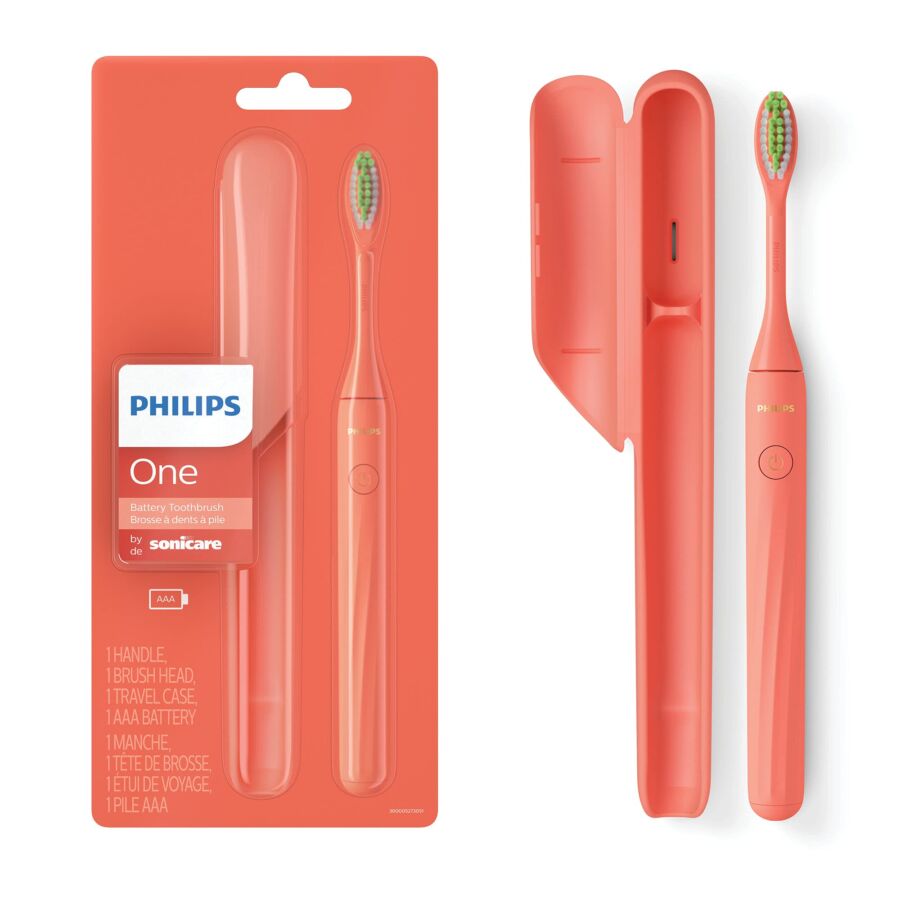
Philips’ own support documentation is unusually specific about this brush: a single AAA battery “should provide enough power for 3 months (180-2 minute brushings),” and the company instructs owners to replace it only with a 1.5V alkaline AAA. The battery swaps out through a coin slot in the base of the handle.
Read that alongside the TSA rule and the case for travel writes itself. An alkaline cell is not a lithium cell, so this brush and its spares are unrestricted in checked baggage, there is no charger to lose, no cable to pack, and no charger rating to check against a foreign socket. Three months of battery also means the brush outlasts any normal trip, including a long one.
The trade-off is real and worth stating. You are getting micro-vibrations and a timer, not the plaque-removal performance Philips claims for its rechargeable Sonicare line, and you are buying alkaline batteries forever instead of charging a cell.
Philips Sonicare 4100: the rechargeable that survives a two-week trip
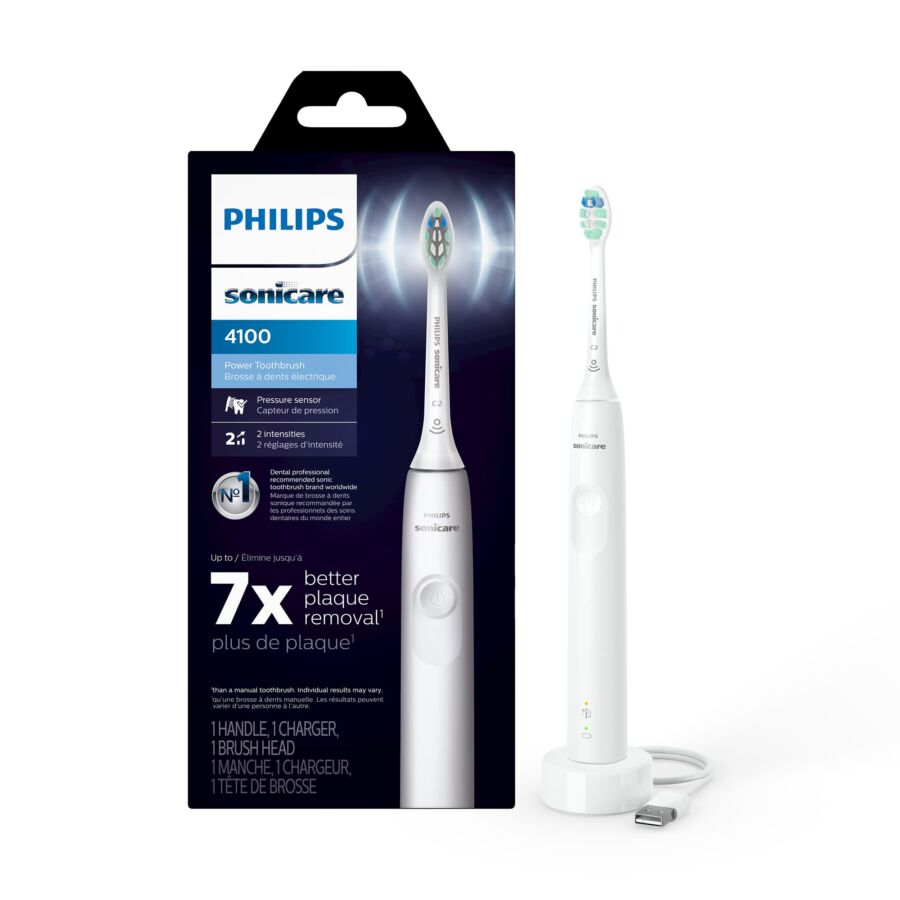
Philips lists the 4100 at a 14-day battery life, with QuadPacer and SmarTimer pacing that keeps you brushing for two minutes, a built-in pressure sensor that warns you and then damps the vibration when you press too hard, and a 2-year warranty. Fourteen days is the number that decides whether you pack the charging base, and for most holidays the answer is that you do not.
It is lithium-ion, so it belongs in the carry-on. It does not ship with a travel case in most bundles, which is a real omission for a brush marketed to people who travel.
Burst Sonic: the long-battery alternative
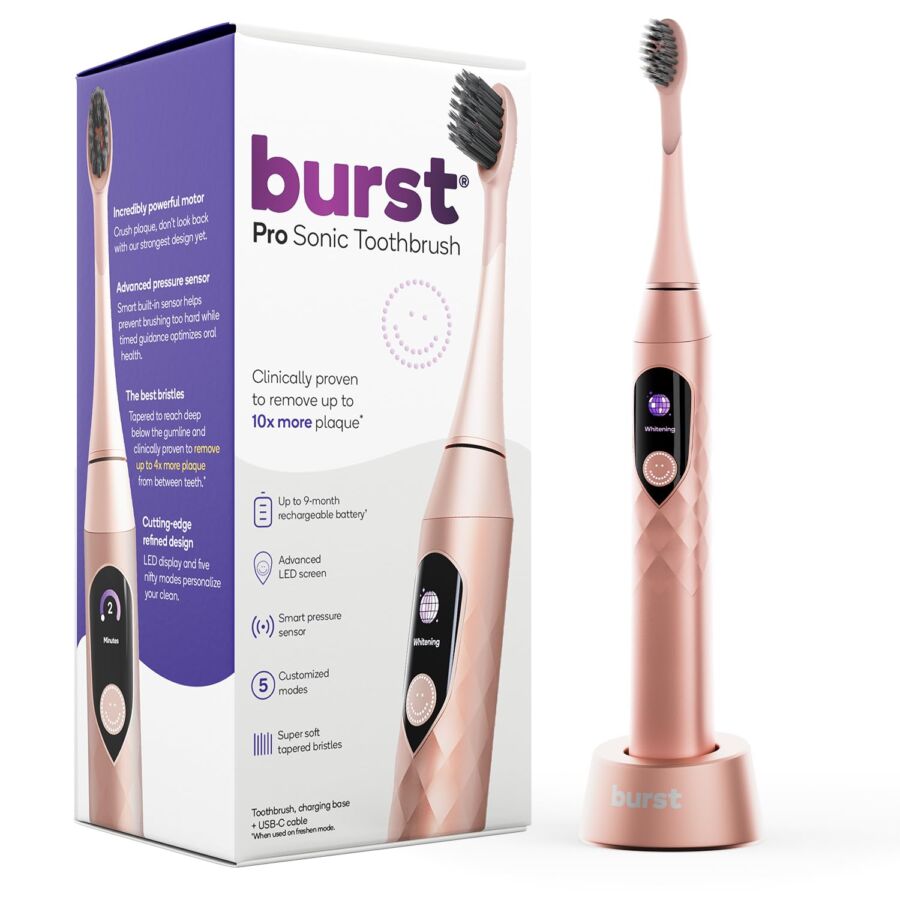
Burst sells its sonic brush on sonic vibrations, a long claimed runtime between charges, and a subscription for replacement heads. It charges via USB, which removes the voltage question below. The subscription is the part to think about before a trip rather than after it, because a head that arrives at your home address while you are away is a head you are not brushing with. Same lithium-ion carry-on rule as any rechargeable.
What is the best manual or disposable toothbrush for travel?
A folding manual brush is the most reliable thing you can pack, because there is nothing in it that can run out. The ADA is clear that manual and electric toothbrushes can both be used effectively, so a folding brush is not a compromise on cleaning or on oral health, only on convenience features like the timer. A regular toothbrush that you actually use twice a day beats a dead electric one.
GUM Folding Travel Toothbrush
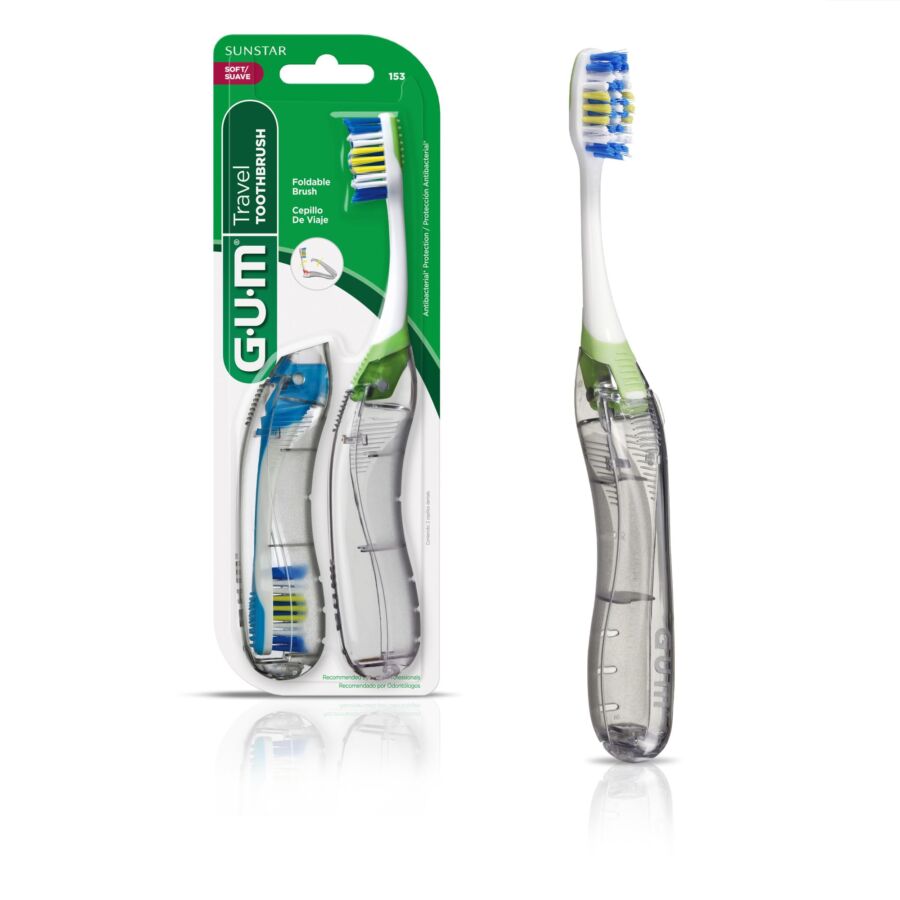
The head folds into the handle, which keeps the bristles off the inside of your bag without sealing them into a damp box. Buy the soft-bristle version. The ADA recommends soft bristles specifically because they lower the risk of abrading the gums, and notes that medium bristles remove biofilm effectively too.
GuruNanda Folding Toothbrush
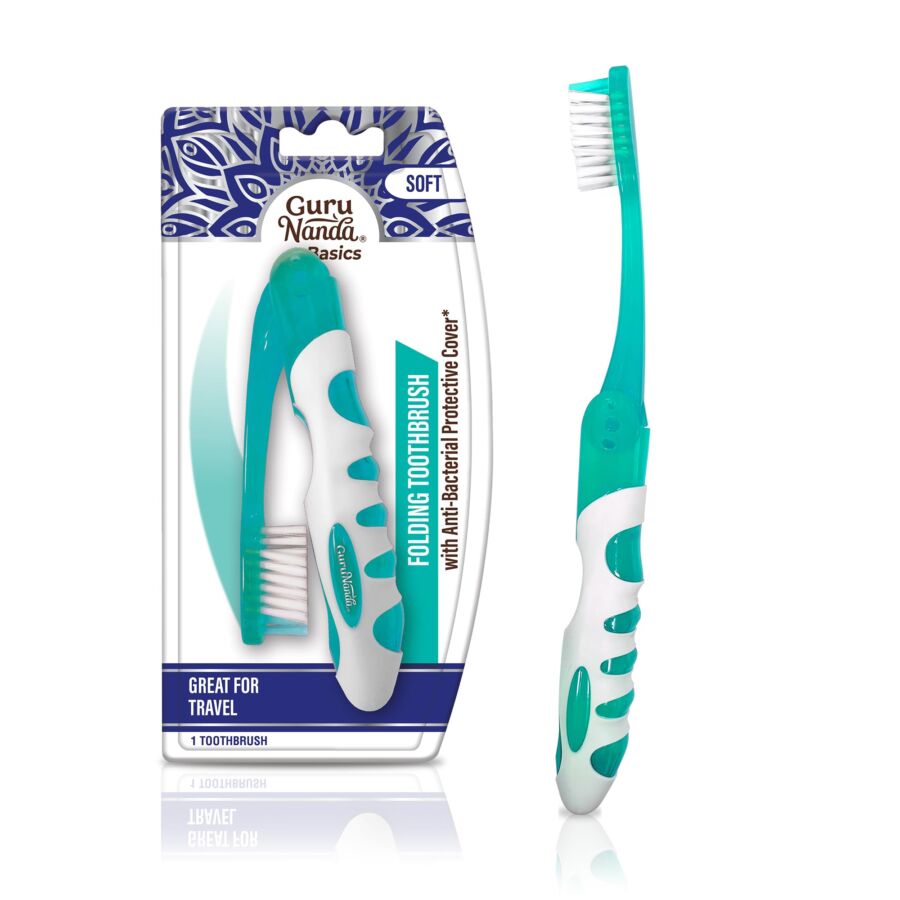
Same folding principle, sold in multipacks. Multipacks are the point rather than a bonus: the ADA replacement window is three to four months, so a brush you bought for a trip in March is spent by July whether you used it every day or not.
Crest Mini Brushes for the no-sink situation

Pre-pasted disposables solve one narrow problem well: the long-haul flight, the overnight bus, the border queue where there is no running water. They are not a substitute for a brush over a whole trip, and they will not get you a two-minute clean. Keep two in the seat pocket bag and a real brush in the toiletry bag.
How do the six brushes compare?
| Brush | Power | Runtime the maker states | Charger to pack | Which bag | Best for |
|---|---|---|---|---|---|
| Philips One by Sonicare | 1 x 1.5V alkaline AAA | 3 months, 180 two-minute brushings | None | Either | Any trip, any length |
| Philips Sonicare 4100 | Lithium-ion, rechargeable | 14 days | Only for trips over 2 weeks | Carry-on | Best clean, shorter trips |
| Burst Sonic | Lithium-ion, rechargeable | Long claimed runtime, subscription heads | Only for long trips | Carry-on | Existing Burst subscribers |
| GUM Folding | None | Unlimited | None | Either | Backpacking, hostels |
| GuruNanda Folding | None | Unlimited | None | Either | Multipack spares |
| Crest Mini Brushes | None, pre-pasted | Single use | None | Either | Flights and transit only |
What about quip, Oral-B iO and Suri?
All three come up constantly in searches for the best travel toothbrush, and each one lands in a different place once you apply the battery rule. Here is where they sit.
quip runs on a single AAA battery replaced roughly every three months, with sonic vibrations, a two-minute timer that pulses every 30 seconds, and a travel cover that doubles as a mirror mount and a stand. That puts it in the same category as the Philips One: replaceable batteries, no charger, no restriction on which bag it travels in. The cover doubling as a stand is genuinely useful, because standing the brush upright is what the ADA asks you to do.
Suri is the interesting one for anyone who dislikes the closed-case problem. The Suri 2.0 line, sold as the Suri Pro 2.0, ships with a travel case carrying a UV-C light that cleans the brush head in about a minute, the handle is rated at over a month per charge, and it recharges via USB-C. A case that actively sanitises is a different proposition from a case that just seals in damp, so it is the one product design here that answers the ADA’s objection rather than ignoring it. It is a rechargeable brush, so it is still a carry-on item.
Oral-B iO, the Oral-B iO Series, is a rechargeable premium range built for the bathroom rather than the suitcase. It cleans well, and rotation oscillation is one of the powered head movements the ADA lists among accepted designs, but you are packing a charging base for a standard electric toothbrush that was never designed around travel weight. Dentists recommend the brush you will actually use twice a day, which on a trip is usually the light one. Take it if it is the brush you already own and love; do not buy it as a dedicated travel brush.
| Brand | Power | Case or cover | Which bag | Verdict for travel |
|---|---|---|---|---|
| quip | 1 x AAA, about 3 months | Travel cover, mirror mount and stand | Either | Strong. Same checked-bag freedom as the Philips One. |
| Suri Pro 2.0 | Rechargeable, over 1 month, USB-C | UV-C case, cleans the head in about a minute | Carry-on | The only case here that answers the damp-storage problem. |
| Oral-B iO | Rechargeable lithium-ion | Varies by bundle | Carry-on | Great brush, poor dedicated travel choice. |
Do you need a travel toothbrush holder or cover?
You need something between the bristles and the inside of your bag, and you need it to come off the moment you unpack. That is the whole specification, and it rules out one popular product and rules in three.
A sealed plastic toothbrush cover is the one to avoid for anything longer than a transfer, because it is exactly the closed container the ADA describes, and it is where travel hygiene quietly goes wrong. A ventilated cover with slots is better. A cover that folds out into a stand, as quip’s does, is better again, because it converts from transit mode to the upright air-drying position the ADA recommends without you needing a second object. A UV-C case like Suri’s goes further and treats the head instead of just containing it.
A folding brush needs no holder at all. The head folds into the handle, the bristles never touch your toiletry bag, and there is nothing to seal.
| Holder type | Protects bristles | Lets the brush dry | Use it for |
|---|---|---|---|
| Sealed plastic tube or travel cover | Yes | No | Transit only, then take the brush out |
| Ventilated cap with slots | Yes | Partly | Transit, and short stops |
| Cover that folds into a stand | Yes | Yes, once opened out | Transit and the hotel bathroom |
| UV-C sanitising case | Yes | It treats the head instead | Travellers who want the case to earn its place |
| No holder, folding brush | Yes, by design | Yes | Backpacking and minimal packing |
Can you use an electric toothbrush overseas without a voltage converter?
Read the input rating printed on the charger before you pack it. If it reads 100 to 240 volts, the charger handles the world’s mains supplies and you need only a plug adapter to change the pin shape. If it names a single voltage, you need a converter, not an adapter, and the two are not interchangeable. Philips’ own travel guidance puts the responsibility exactly there: check that the power supply where you are going matches the specifications printed on the charger or adapter.
A brush that charges over USB sidesteps most of this, because you are plugging into a USB port or a phone charger you already carry and already trust. A brush that runs on a AAA cell sidesteps all of it.
| What the charger says | What you need | What you do not need |
|---|---|---|
| 100-240V, 50/60Hz | Plug adapter for the local socket shape | A voltage converter |
| 120V only | A step-down converter plus an adapter | Nothing, but check the wattage rating |
| USB or USB-C input | The phone charger already in your bag | Anything brush-specific |
| No charger at all (AAA) | A spare battery | Adapter, converter, cable, base |
How often should you replace a travel toothbrush or brush head?
Every three to four months, and sooner if the bristles are matted or frayed, because a worn brush cleans worse. Travel-friendly or not, that is the ADA’s window, and it applies to the brush that lives in your suitcase exactly as it applies to the one on your bathroom shelf. A travel brush used twice a year still ages out on the calendar.
There is a neat coincidence worth building a habit on. Philips rates one AAA cell at three months, and the ADA’s replacement window is three to four months. Change the battery and the brush head in the same operation and you never have to track two schedules.
| What you own | What you replace per year | Arithmetic |
|---|---|---|
| AAA-powered brush | 4 batteries, 3 to 4 brush heads | 12 months divided by 3 months per battery |
| Rechargeable electric | 3 to 4 brush heads, no batteries | ADA window, 3 to 4 months per head |
| Manual folding brush | 3 to 4 whole brushes | The handle and head expire together |
| Disposables | One per use | Buy for the flights, not for the trip |
What does the ADA Seal of Acceptance actually test?
It is a real laboratory credential, not a marketing badge, and it is worth more than any review score on a listing page. A manual toothbrush is tested against ANSI/ADA Standard No. 119. The manufacturer has to show that every component is safe in the mouth, that bristles have no sharp or jagged ends and will not fall out in normal use, that the handle survives normal use, and that an average adult can use the brush unsupervised and still get a meaningful reduction in plaque and mild gum disease.
A powered toothbrush faces a longer list. It is tested against ANSI/ADA Standard No. 120 for electrical safety, tuft retention, mechanical strength and chemical resistance, it has to pass a safety laboratory such as Underwriters Laboratories, and it has to complete a clinical study showing it is safe on hard tissue, soft tissue and existing restorations.
The practical move is to look the product up rather than trust the box. The ADA runs a searchable product database of accepted manual and powered brushes, and a listing that says “ADA accepted” in its title means nothing until you have found it there.
What do travel toothbrushes cost, and why is this guide vague about it?
This category is promoted so aggressively that a single price is misleading the week after it is published. On the Sonicare 4100 alone, NBC Select reported a 30 percent discount bringing it to $35 in mid-August 2026, while DealNews was flagging a $40 Target deal in the same period. Two published numbers for one product inside one month, and neither of them is the list price.
So rather than print a price table that rots, here is the shape of the spending. A rechargeable brush is a one-time purchase in the tens of dollars followed by three or four toothbrush heads a year. An AAA brush replaces the charger with four alkaline cells a year and nothing else. A folding manual brush has no consumables at all beyond the brush itself, replaced three or four times a year. Over a year the running costs sit closer together than the shelf prices suggest, and the rechargeable is the one whose consumables cost the most.
Five mistakes that cost travellers a clean brush
| Mistake | What happens | The fix |
|---|---|---|
| Leaving the brush sealed in its case all week | A damp closed container is the condition the ADA warns about | Open the case on arrival, stand the brush upright to dry |
| Putting a rechargeable brush loose in checked luggage | Fails the FAA condition that the device be protected from accidental activation | Carry it in the cabin, or case it and switch it fully off |
| Packing spare lithium batteries in the hold | Prohibited outright, not merely discouraged | Spare lithium cells travel in the cabin only |
| Buying an adapter when the charger needs a converter | An adapter changes the pin shape and nothing electrical | Read the input rating on the charger before you leave |
| Keeping the same travel brush for years because it is “only for trips” | Bristles age on the calendar, not on use | Replace it every three to four months like any other brush |
What this guide deliberately does not publish
Three things were checked and left out on purpose, because publishing them would have meant guessing.
- Per-product prices. See the section above. The discounting on this category makes any single figure wrong within weeks, so the guide publishes the observed spread and its dates instead.
- ADA Seal status for each brush named here. The ADA’s product database is the only authority on which products currently hold the Seal, and it is the reader’s five-second check rather than a claim this page should make on the ADA’s behalf. Several listings in this category assert acceptance in the product title.
- Independent runtime testing. The battery figures above are the manufacturers’ own published claims, attributed as such. Nobody has bench-tested these brushes for this article.
Frequently asked questions
Can you bring an electric toothbrush on a plane?
Yes. The TSA allows electronic toothbrushes in both carry-on and checked bags. Because rechargeable models contain a lithium-ion battery, the TSA advises carrying them in the cabin, and the final call at the checkpoint belongs to the officer.
Can you put an electric toothbrush in checked luggage?
You can, but a lithium-powered device in the hold must be completely switched off, not in sleep mode, and protected so it cannot be activated or damaged. A brush that runs on an alkaline AAA cell carries none of those conditions.
Is it bad to keep a toothbrush in a travel case?
For transit it is sensible. For storage the ADA advises against it, because storing a moist toothbrush in a closed container promotes microbial growth more than leaving it in open air. Take the brush out when you unpack.
How long does a travel toothbrush battery last?
Philips rates a single AAA cell in the Philips One at three months, which it describes as 180 two-minute brushings, and rates the rechargeable Sonicare 4100 at 14 days per charge. Both figures are the manufacturer’s own.
Do you need a voltage converter for an electric toothbrush abroad?
Only if the charger is rated for one voltage. A charger marked 100 to 240 volts needs nothing but a plug adapter. Philips tells owners to check the destination’s supply against the specifications printed on the charger itself.
How often should you replace a travel toothbrush?
Every three to four months, or sooner if the bristles are matted or frayed, according to the ADA. Occasional use does not extend that window.
Is a manual toothbrush good enough for travel?
Yes. The ADA states that manual and powered toothbrushes can both be used effectively for oral hygiene, and recommends soft bristles either way. A folding manual brush gives up the timer and the pressure sensor, not the clean.
What is the most hygienic way to travel with a toothbrush?
Rinse it thoroughly after brushing, shake it as dry as you can, close it in the travel cover only while you are moving, then stand it upright in open air once you arrive. Keeping the toothbrush clean on the road is mostly about drying it. Never share it, and do not try to sanitise it in a microwave or a dishwasher.
Sources and how this guide was checked
- TSA, “Electronic Toothbrush”, What Can I Bring for the carry-on and checked-bag positions and the lithium-battery instruction.
- FAA PackSafe, portable electronic devices containing batteries for the switched-off and protected-from-activation conditions, and the ban on spare lithium batteries in checked baggage.
- American Dental Association, Toothbrushes (last updated August 2026) for storage, the three-to-four-month replacement window, soft bristles, sharing, sanitising, and the ANSI/ADA Standard No. 119 and No. 120 Seal requirements.
- Philips, ONE battery replacement instructions for the three-month, 180-brushing AAA figure and the 1.5V alkaline requirement.
- Philips, Sonicare 4100 Series product page for the 14-day battery life, QuadPacer and SmarTimer, pressure sensor and 2-year warranty.
- Price observations from NBC Select and DealNews coverage during August 2026, cited as dated observations rather than as prices.
Last updated 1 September 2026. This revision rebuilt the guide around the two rules that actually change what you pack: the TSA and FAA position on lithium batteries, and the ADA’s guidance on storing a damp brush in a closed case. Battery and warranty figures were taken from the manufacturers’ own pages on the date above. An earlier version of this article advised readers to look for a toothbrush with a cover to keep it clean, which runs against the ADA’s own storage guidance; that advice has been corrected. Duplicate product entries and several unrelated internal links were removed.
More travel gear from Real Journey Travels: travel toiletry bags, TSA-approved medication bags, the TSA rules on razors, what counts as a personal item, travel gadgets for backpacking, an ultralight Europe packing list and carry-on backpacks for international travel.
Affiliate disclosure: some links in this article are affiliate links. If you buy through one, Real Journey Travels may earn a commission at no extra cost to you. It does not change which products are recommended or what the sources above say.


