

Solar Power Banks Airplane Compliance: Top 7 Essential Rules and Surprising Tips for Safe Travel
Updated February 24, 2026
Let’s be real—traveling with a power bank is almost second nature now, especially if you’re the type who hates seeing that dreaded “low battery” warning halfway through a travel day. Solar power banks are kind of brilliant for those off-the-grid adventures, camping trips, or even just when you’re stranded in an airport with zero outlets. Personally, I love not having to hunt down a plug—just toss the thing in the sun and let it do its thing.
When it comes to flying, though, you need to watch out for a few gotchas. Airlines don’t let just any power bank on board, and solar ones aren’t magically exempt.
What should you double-check? Battery capacity (usually in watt-hours or mAh), making sure you only pack it in your carry-on, and that the labeling is clear. I’ve definitely stood in front of a TSA agent while they squinted at my charger, and trust me, it’s not a fun way to start a trip.
Honestly, it sounds trickier than it is. Once you know what to look for, bringing a solar power bank on a plane gets a lot less stressful.
Table of Contents
- Best Solar Power Banks for Airplane Travel
- 1. Mregb Solar Power Bank 42800mAh
- 2. BLAVOR Solar Power Bank 10,000mAh
- 3. Sudrov Solar Power Bank 42800mAh
- 4. Mregb Solar Power Bank (Orange)
- 5. Tranmix Solar Charger Power Bank 25000mAh
- 6. YELOMIN 38800mAh Solar Power Bank
- 7. Durecopow Solar Power Bank 20,000mAh
- Buying Guide
- Frequently Asked Questions
- What is the maximum capacity of a power bank permitted on a commercial flight?
- How can I tell if my solar power bank complies with airline regulations?
- Are there specific airline restrictions pertaining to solar power banks on international flights?
- What should I consider when selecting a travel-friendly solar power bank?
- How does the Federal Aviation Administration (FAA) categorize power banks for air travel?
- Can solar power banks with a capacity over 20,000mAh be carried on airplanes?
- Book Your Dream Experience
- More Travel Guides
Best Solar Power Banks for Airplane Travel

Finding a solar power bank that actually clears security isn’t always straightforward—been there, done that, had to leave one behind once (ouch). I’ve put together my favorite picks that won’t cause you grief at the airport and still keep your devices running. Here’s what you should pack before your next flight.
1. Mregb Solar Power Bank 42800mAh

If you’re after a high-capacity, rugged solar power bank for those trips where outlets are a myth, this one’s got your back.
Pros
- Seriously tough—drops, water, dirt, it shrugs them off
- Big battery keeps you going for days
- The built-in flashlight is surprisingly useful
Cons
- Solar charging is slow—think backup, not main
- A bit heavy for ultralight travelers
- Only two USB outputs, so not for charging a whole tech arsenal
Let’s talk about the Mregb Solar Power Bank. First thing you’ll notice? It feels like a tank.
I’ve tossed it in my bag, dropped it, gotten it wet—no drama. The waterproofing is real, so you can just throw it in your daypack and go, rain or shine.
Battery life? It’s got loads. I can get several days of phone charges out of it, which is a lifesaver if you’re nowhere near an outlet for a while. The flashlight isn’t just a gimmick either—having one less thing to pack for emergencies or late-night hostel searches really does help.
But let’s not kid ourselves: solar charging is glacial. It’s there for emergencies, not everyday use.
If you’re a “just a fanny pack” traveler, you might find it a bit bulky. Still, for anyone who values durability and all-day power over featherweight gear, this one’s tough to beat.
2. BLAVOR Solar Power Bank 10,000mAh

If compact and compliant is your style, the BLAVOR Solar Charger keeps things simple but comes with a few quirks you should know.
Pros
- Super light—easy to stash in your carry-on
- Can charge multiple devices at once
- Supports wireless and USB-C charging
Cons
- Solar charging is slow and not super reliable
- Battery’s not huge, so don’t expect days of power
- Needs regular cable charging to stay dependable
I like the BLAVOR for its no-fuss size and weight. I can throw it in my bag and not worry about battery limits or airline rules. Plus, USB-C and wireless support means it works with most modern gadgets.
But let’s be honest: the solar charging is more “last resort” than main event. If you’re hoping to power up quickly with sunlight, you’ll be disappointed. That’s not just me being picky—it’s what most users find out, too. Always plug it in before you leave.
The dual flashlight setup is a clever touch, especially for camping or midnight luggage hunts. It’s tough enough to survive a few knocks, and the waterproofing is a nice bonus.
If you’re planning on charging a tablet and phone back-to-back, you’ll run out of juice faster than with the bigger models. For short trips or as a backup, though, it’s a handy, plane-friendly pick. Just don’t bet on the sun alone.
See Related: Airplane Foot Hammocks for Economy: Surprising Benefits for Comfortable Travel
3. Sudrov Solar Power Bank 42800mAh
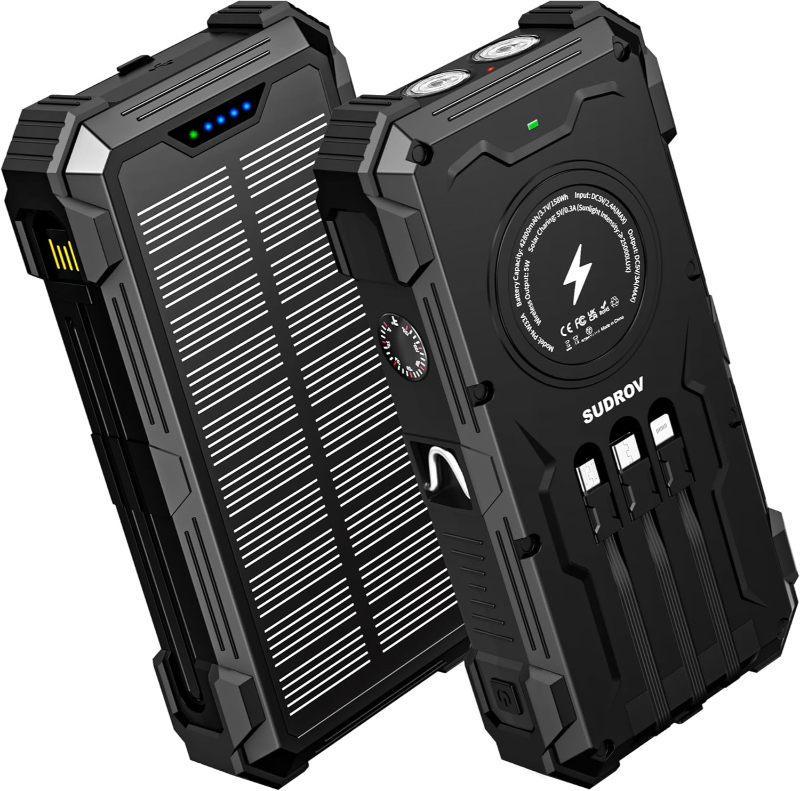
If you want a power bank that’ll last for days and still clear airport security, the Sudrov Solar Power Bank should be on your radar.
Pros
- Six devices at once? No problem
- Built-in cables for all sorts of gadgets
- Waterproof and dustproof—good for rough travel
Cons
- Solar charging is slow, just for emergencies
- It’s a bit of a brick—heavy and bulky
- Solar performance drops way off in cloudy weather
I get it—traveling with a big power bank can be nerve-wracking if you’re not sure it’ll get through security. The Sudrov slides in under the 100Wh limit, so you can bring it on board (just keep it out of checked bags—airlines really don’t like that).
It’s not light, so if you’re a minimalist, maybe keep looking. But if you’re juggling multiple devices or traveling with someone else, the big battery is a legit advantage. I’ve kept a phone, camera, and e-reader topped up for two days straight with this thing.
The solar panel? Again, it’s backup only. Unless you’ve got hours of blazing sunlight, don’t expect miracles. But the built-in cables and wireless charging make life easier, and the flashlight is one of those features you’ll end up using more than you’d think—hostel bunk beds, late-night bus rides, you name it.
4. Mregb Solar Power Bank (Orange)

Need a sturdy, airline-friendly solar power bank that just gets the job done? This one strikes a good balance between capacity and simplicity.
Pros
- Charges multiple devices at once
- Built to handle rough conditions
- Flashlight and compass—nice touches for emergencies
Cons
- Solar charging is slow, for backup only
- Some folks say the battery doesn’t quite match the label
- Heavier than pocket-sized models
I’ve been there—your phone’s at 5%, you’re in a new city, and the only outlet is already taken. This Mregb Solar Power Bank lets you charge a couple of devices at once, so you’re not fighting for cables. The built-in flashlight has saved me more than once (ever tried finding your earbuds in a pitch-black hostel dorm?).
Don’t expect the solar panel to work miracles. It’s for those moments when you really need a bit of extra juice, not for full recharges. Plug it in before you leave, and you’ll be much happier.
It’s a bit chunky, so make sure you’ve got space in your carry-on. Some buyers say the actual battery life is a tad less than advertised, so if you’re planning a full weekend off-grid, maybe bring a backup. Still, for most travelers, the Mregb is a reliable, tough-as-nails companion that won’t get you side-eyed by airport security.
5. Tranmix Solar Charger Power Bank 25000mAh

You want a solar power bank that won’t get you flagged at airport security and actually works out in the wild? Put this one on your radar.
Pros
- High-capacity battery keeps you powered for days
- Rugged and splash-proof—built for outdoor trips
- Foldable panels make it surprisingly easy to pack
Cons
- It’s a bit heavy, so ultralight travelers might grumble
- Solar charging speed really depends on the sun
- Just two output ports
I’ve found the Tranmix Solar Charger Power Bank checks the right boxes for air travel and outdoor reliability. With a 25000mAh capacity, you can keep your phone and small gadgets juiced up for those long, unpredictable days.
The foldable panels aren’t just for show—they’re genuinely useful when you’re waiting out a layover or parked at a sunny campsite. Sure, it’s not the lightest thing I’ve tossed in my bag, but I’ll take a little extra weight for the durability. It shrugs off splashes and bumps, so you don’t have to baby it.
I wouldn’t drag it up a mountain for a week, but for a weekend trip, a day at the beach, or some car camping, it’s a solid companion. The four solar panels help speed up charging when the weather’s on your side, but don’t expect miracles—solar is more of a backup trick here.
Honestly, I always charge it fully before heading out and treat the solar panels as a nice emergency feature. If you want something sturdy, versatile, and airline-friendly, the Tranmix is a dependable pick for your next trip.
See Related: Game-Changing Travel Products for Easy Packing
6. YELOMIN 38800mAh Solar Power Bank

If you need a solar power bank that’s versatile and airline-approved, YELOMIN’s got you covered for most travel scenarios.
Pros
- Big battery can recharge your devices several times
- Waterproof and dustproof—great for the outdoors
- Three devices can charge at once
Cons
- Solar charging is honestly slow
- A bit bulky
- Included USB cable isn’t perfect for every device
YELOMIN’s 38800mAh charger stands out because you get loads of backup power for your phone and other gadgets. The battery size flies under airline limits, so you won’t have to argue with security or risk losing it at the gate.
If you depend on your phone for maps or a flashlight, that extra battery life is a real stress-saver. The solar charging, though? I’ll be blunt—it’s slow. If you expect to live off the sun, you might get a little annoyed. Still, as a backup, it’s better than nothing, especially if you’re off-grid.
The two built-in flashlights and emergency strobe mode make it handy for late-night hikes or those inevitable “where are my keys?” moments in a dark hotel room. The rugged, water-resistant shell means you can toss it around and not worry much, even if the weather turns.
It does have some heft, so you’ll notice it in your backpack. On the plus side, you can charge your phone, camera, and headphones at the same time—no more fighting over ports.
7. Durecopow Solar Power Bank 20,000mAh
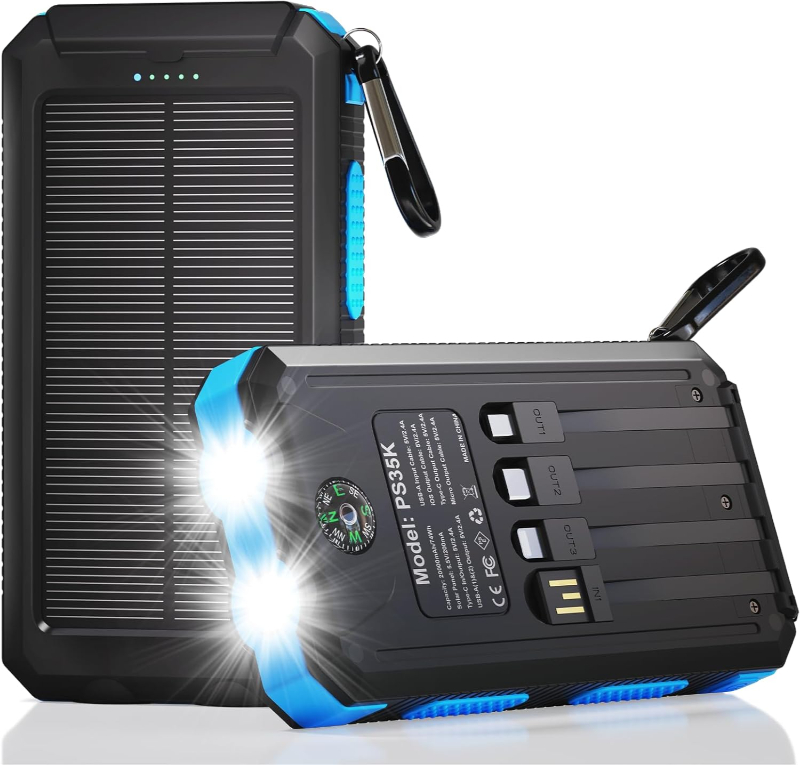
If you want a rugged, fuss-free way to keep your devices charged on the move—whether you’re flying or hiking—the Durecopow is a smart pick.
Pros
- Can charge up to six devices at once
- Built-in flashlight and cables—super convenient
- Tough, water-resistant build for rough use
Cons
- Solar charging is slow, really just for emergencies
- A bit bulky in a carry-on or backpack
- Flashlight button feels a little fiddly
Honestly, the best part about the Durecopow Solar Power Bank is the built-in cables for USB-C, Lightning, and Micro USB. No more panicked searches for the right cord at the bottom of your bag—just plug in and go.
The tough outer shell handles drops, splashes, and dust without flinching. I usually clip it to my backpack with the carabiner and forget about it, rain or shine. The 20,000 mAh battery falls within most airline limits, so you’re good to go for air travel (though it never hurts to double-check with your airline).
The solar panel is more of a “just in case” feature. For real-world use, charge it up at a wall outlet before your trip. Still, it’s comforting to know you’ve got that backup solar trick if you get stuck outside or face a long delay.
Buying Guide

Choosing a solar power bank for your flight isn’t as simple as grabbing the first one that looks cool or promises fast charging. There are a few details that really matter—and trust me, it’s easy to overlook something important.
Check the battery capacity first. You want to stay within airline rules. Most airlines allow power banks up to 100Wh (watt-hours) in your carry-on, sometimes up to 160Wh with approval. I always read the label, because it’s way too easy to miss those numbers when you’re rushing to pack.
Key features to keep in mind:
- Capacity (mAh or Wh)
- Multiple output ports
- Solar charging efficiency
- Durability—think water and dust resistance
- Weight and actual size
- Battery type (lithium-ion is the standard)
Here’s a quick table I wish someone had handed me before my first long-haul trip:
| Feature | Why It Matters |
|---|---|
| Battery Capacity | You need to meet airline guidelines |
| Charge Ports | Charge multiple devices at once |
| Solar Panel Size | Impacts how quickly it recharges |
| Weight | Matters if you’re packing light |
| Build Quality | Survives bumps, splashes, and dust |
Some power banks just feel awkward or heavy. If you can, hold one before you buy—it’s amazing how much a few extra ounces can annoy you after a day in airports.
Frequent travelers should go for at least two USB ports. That way, you’re not stuck swapping cords when you want to charge your headphones and phone at the same time. Little things like that make travel less of a headache.
See Related: Pack Wisely: Guidelines for Traveling with Tobacco Products
Frequently Asked Questions

Airlines can get pretty specific about what battery packs they’ll let you bring. If you fly a lot, knowing the rules—and how to spot a compliant power bank—makes airport security a lot less stressful.
What is the maximum capacity of a power bank permitted on a commercial flight?
Most airlines set the limit at 100Wh (watt-hours) per power bank in your carry-on, which is about 27,000mAh. I haven’t seen them allow anything bigger in checked bags. If your power bank is between 100Wh and 160Wh, you’ll need airline approval, which can be a pain.
How can I tell if my solar power bank complies with airline regulations?
Look at the label on your power bank. If it lists both mAh and voltage, you can calculate watt-hours: Wh = mAh × V ÷ 1000.
If you get 100 or less, you’re fine. Also, make sure the specs are printed clearly and the battery isn’t damaged.
Are there specific airline restrictions pertaining to solar power banks on international flights?
Some countries are stricter than others. For example, China and Australia have tougher checks.
Even the solar panel shouldn’t be oversized or easily removable. Honestly, always read up on your airline’s policy and the country’s aviation rules before you pack.
What should I consider when selecting a travel-friendly solar power bank?
Pick one that shows the battery capacity (Wh or mAh) right on the device. Stay under 100Wh if you want to avoid trouble.
Go for something compact—no one wants airport security eyeing your charger suspiciously. And if a brand has zero reviews or weird labeling, skip it.
How does the Federal Aviation Administration (FAA) categorize power banks for air travel?
The FAA treats power banks as “portable electronic devices with lithium batteries.” You have to carry them in your carry-on, never checked.
If your power bank is under 100Wh and labeled clearly, you shouldn’t have any issues. Anything above that, contact the airline before your trip.
Can solar power banks with a capacity over 20,000mAh be carried on airplanes?
Well, it really comes down to voltage. Some power banks get the green light, especially when the watt-hour (Wh) rating sits under 100.
I’ve actually had airport security pull me aside to inspect my larger power banks—so it’s not just a theoretical issue. If you’re carrying something between 20,000mAh and 27,000mAh, take a good look at the watt-hour label before you pack it.
Honestly, I’d expect a few extra questions at security. It’s not a guarantee, but why invite hassle? And for what it’s worth, I always keep mine in my carry-on, not checked luggage. That’s a detail a lot of travelers miss.
Book Your Dream Experience
More Travel Guides
Related Posts
