
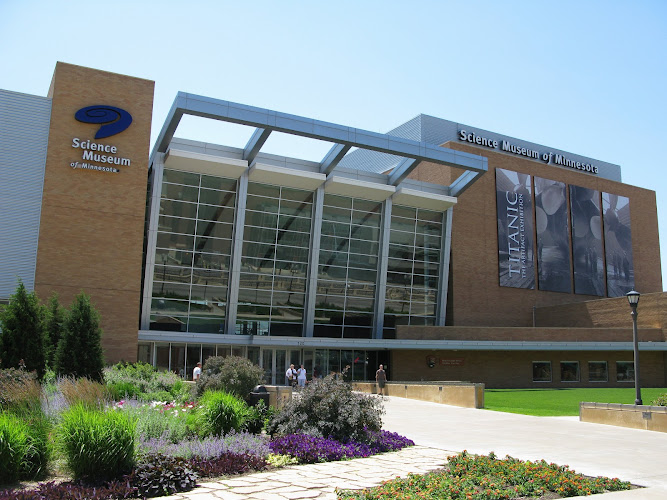
Science Museum of Minnesota
About Science Museum of Minnesota
Description
The Science Museum of Minnesota is a hands-on institution in Saint Paul that has invited curious visitors to poke, prod, and ponder the natural world since 1907. The museum balances old-school curiosity with modern presentation: think historic collections and live science demonstrations sitting shoulder-to-shoulder with an IMAX-style omnitheater, interactive exhibits, and rotating special exhibitions that can surprise even repeat visitors. It operates as a nonprofit educational institution and is widely known locally as SMM, though newcomers tend to just call it the science museum downtown.
Visitors arrive expecting displays, but what they usually get is an experience. Exhibits are designed to make scientific ideas tangible — not lectured at. Guests can follow the arc of life across the human body gallery, stand inches from a towering dinosaur skeleton, or trace the story of the Mississippi River through a gallery that connects geology, ecology, and urban life. It’s an effective blend: some things are contemplative and quiet, other things are loud and tactile. The museum knows how to switch gears quickly, which makes it ideal for families with mixed interests.
The omnitheater is a major draw. Not every city has a dome theater that completely surrounds your visual field, and the Science Museum’s large-format movies are especially immersive — educational and entertaining at once. Visitors report that the film programming adds depth to an afternoon visit, turning a simple exhibit tour into a full sensory engagement. Theater seating is comfortable; sound and visuals are the kind that make adults lean forward and kids gasp out loud. Expect to plan around showtimes if the omnitheater is a priority for the group.
Dinosaur fans, don’t skip the prehistoric displays. The museum preserves an impressive paleontological collection and presents it in a way that emphasizes science — how fossils are studied, what they tell us, and how interpretations change over time. The fossils are displayed with hands-on elements so kids (and adults with a secret childhood fossil obsession) can compare bone shapes, learn about ecosystems that once were, and get a feel for how scientists piece together extinct life. It’s show-and-tell, scaled up and backed by real research.
Accessibility and family amenities are clearly a priority. The museum advertises wheelchair-accessible entrances and restrooms, accessible parking, and supports families with changing tables and nursing rooms. These practical touches are not an afterthought; they’re built into the visitor flow and, for many, make the difference between a stressful outing and a relaxed day. The museum also provides paid parking nearby and a few slow EV charging stations, which is useful to know if someone in the party needs a top-up while exploring the galleries.
Programming extends beyond static displays. Live performances and science demonstrations are common, and they often pop up in the central atrium or gallery spaces. These presentations are short, high-energy, and meant to enhance learning without feeling like school. School groups and families benefit from guided tours and educational programs designed to match different grade levels and learning objectives. There is a quiet satisfaction when an experiment yields a visible result and a crowd — kids and adults — reacts. It’s the kind of communal science moment that sticks with people.
On the practical side, the facility also includes a cafe and a restaurant area for refueling between galleries, a gift shop with science-themed souvenirs and books, and Wi-Fi for those who like to share their museum moments in real time. Restrooms and seating areas are scattered thoughtfully. For planners: securing tickets in advance is recommended, particularly during weekends and school holidays. Admission is fee-based, and special exhibitions or films may carry supplemental charges. Staff are generally helpful with routing a visit to fit time constraints, but it’s worth checking schedules if a particular demonstration or film is the reason for the visit.
Less obvious are the behind-the-scenes functions that make the museum more than just displays. It houses research collections and supports conservation work; the curatorial and education teams collaborate on programs that reach into the community, from classroom outreach to public events. That community focus is one of the museum’s quieter strengths — the institution isn’t static, it evolves with new scientific findings and public interests, and it often partners with local organizations tied to river ecology, public parks, and Minnesota’s natural history.
The Science Museum’s approach to interactivity is deliberate. Rather than gimmicks, the interactive exhibits are often framed around inquiry-based learning: questions are posed, then visitors are invited to test hypotheses, compare results, and draw conclusions. That format works well for families — children get to try things in a safe, supervised environment, and adults can follow the logic without feeling talked down to. It’s informal education that actually educates. And for those who crave a deeper dive, occasional special exhibits or adult-focused events offer complex themes and new research that push beyond the typical family-visit fare.
No museum is without its imperfections. On busy days certain galleries can feel crowded, and standing-room-only moments at the omnitheater happen. Some travelers might find that the hands-on elements, while engaging, require an active supervision level that can be tiring for caregivers. But these are details; the larger picture is that the Science Museum of Minnesota aims to make science approachable and relevant to everyday life. For anyone curious about the world around them — ecosystems, human anatomy, engineering, space, or the story of the river that shaped the region — the museum offers a narrative thread that connects local geography to global scientific questions.
Location plays a subtle role in the experience. The museum’s proximity to the Mississippi River isn’t just geographic: the river gallery ties local history, environmental science, and urban planning to a broader context. The exhibit helps visitors understand how the river’s ecology affects communities, and how human activity in turn shapes river health. That kind of place-based storytelling is valuable for travelers wanting to understand why a city looks and behaves the way it does. For people who love to learn about a place by its landscape and waterways, that gallery provides meaningful context.
For visitors who appreciate variety, the museum’s schedule of special events is worth checking. There are evenings and special programming blocks aimed at adults, themed science nights, and community collaboration events. These offerings give the museum a life after typical family hours and show how it tries to appeal to multiple audiences without diluting its educational mission. In short: a visit can be a daytime family outing, a date-night enrichment activity, or a focused research-adjacent experience depending on what someone chooses.
Practical tips embedded in the experience: plan for at least two hours to see core exhibits and catch a short omnitheater film; longer if the group wants to linger, attend demonstrations, or see special exhibitions. The gift shop is strategically placed so people can pick up science-themed items on the way out, which is nice when kids need a tangible memento. Staff do a good job of helping route traffic so guests see high-interest displays efficiently, but independent planners will still want to get a map on arrival and prioritize interests to avoid exhaustion.
Finally, the museum projects a tone of inclusivity. It positions itself as family-friendly and affirming toward diverse communities, and that sensibility is visible in programming and visitor services. Those details — from staff training to restroom signage and inclusive events — provide an unspoken level of comfort to many guests, which can be especially important for travelers seeking welcoming public spaces away from home.
All told, the Science Museum of Minnesota offers a layered visitor experience: engaging, often hands-on, occasionally loud, frequently thought-provoking. It rewards curiosity, nudges people toward asking better questions, and does so in a way that often feels more playful than academic. Travelers who enjoy participatory learning and place-based stories will find it a satisfying stop in Saint Paul; those who prefer quiet contemplation will still find compelling exhibits, but might want to time their visit for off-peak hours.
And yes, people leave feeling a little smarter. Or at least they leave with a story about trying a science demo, seeing a dinosaur up close, or being surprised by the scale of the omnitheater. Those small moments are the museum’s real currency. They may sound simple, but they’re sticky. They’ll stay with travelers long after they’ve left — maybe enough to make someone plan a return trip. That, in a museum that’s been around since 1907, is a pretty good sign.
Key Features
More Details
Updated August 29, 2025
Description
The Science Museum of Minnesota is a hands-on institution in Saint Paul that has invited curious visitors to poke, prod, and ponder the natural world since 1907. The museum balances old-school curiosity with modern presentation: think historic collections and live science demonstrations sitting shoulder-to-shoulder with an IMAX-style omnitheater, interactive exhibits, and rotating special exhibitions that can surprise even repeat visitors. It operates as a nonprofit educational institution and is widely known locally as SMM, though newcomers tend to just call it the science museum downtown.
Visitors arrive expecting displays, but what they usually get is an experience. Exhibits are designed to make scientific ideas tangible — not lectured at. Guests can follow the arc of life across the human body gallery, stand inches from a towering dinosaur skeleton, or trace the story of the Mississippi River through a gallery that connects geology, ecology, and urban life. It’s an effective blend: some things are contemplative and quiet, other things are loud and tactile. The museum knows how to switch gears quickly, which makes it ideal for families with mixed interests.
The omnitheater is a major draw. Not every city has a dome theater that completely surrounds your visual field, and the Science Museum’s large-format movies are especially immersive — educational and entertaining at once. Visitors report that the film programming adds depth to an afternoon visit, turning a simple exhibit tour into a full sensory engagement. Theater seating is comfortable; sound and visuals are the kind that make adults lean forward and kids gasp out loud. Expect to plan around showtimes if the omnitheater is a priority for the group.
Dinosaur fans, don’t skip the prehistoric displays. The museum preserves an impressive paleontological collection and presents it in a way that emphasizes science — how fossils are studied, what they tell us, and how interpretations change over time. The fossils are displayed with hands-on elements so kids (and adults with a secret childhood fossil obsession) can compare bone shapes, learn about ecosystems that once were, and get a feel for how scientists piece together extinct life. It’s show-and-tell, scaled up and backed by real research.
Accessibility and family amenities are clearly a priority. The museum advertises wheelchair-accessible entrances and restrooms, accessible parking, and supports families with changing tables and nursing rooms. These practical touches are not an afterthought; they’re built into the visitor flow and, for many, make the difference between a stressful outing and a relaxed day. The museum also provides paid parking nearby and a few slow EV charging stations, which is useful to know if someone in the party needs a top-up while exploring the galleries.
Programming extends beyond static displays. Live performances and science demonstrations are common, and they often pop up in the central atrium or gallery spaces. These presentations are short, high-energy, and meant to enhance learning without feeling like school. School groups and families benefit from guided tours and educational programs designed to match different grade levels and learning objectives. There is a quiet satisfaction when an experiment yields a visible result and a crowd — kids and adults — reacts. It’s the kind of communal science moment that sticks with people.
On the practical side, the facility also includes a cafe and a restaurant area for refueling between galleries, a gift shop with science-themed souvenirs and books, and Wi-Fi for those who like to share their museum moments in real time. Restrooms and seating areas are scattered thoughtfully. For planners: securing tickets in advance is recommended, particularly during weekends and school holidays. Admission is fee-based, and special exhibitions or films may carry supplemental charges. Staff are generally helpful with routing a visit to fit time constraints, but it’s worth checking schedules if a particular demonstration or film is the reason for the visit.
Less obvious are the behind-the-scenes functions that make the museum more than just displays. It houses research collections and supports conservation work; the curatorial and education teams collaborate on programs that reach into the community, from classroom outreach to public events. That community focus is one of the museum’s quieter strengths — the institution isn’t static, it evolves with new scientific findings and public interests, and it often partners with local organizations tied to river ecology, public parks, and Minnesota’s natural history.
The Science Museum’s approach to interactivity is deliberate. Rather than gimmicks, the interactive exhibits are often framed around inquiry-based learning: questions are posed, then visitors are invited to test hypotheses, compare results, and draw conclusions. That format works well for families — children get to try things in a safe, supervised environment, and adults can follow the logic without feeling talked down to. It’s informal education that actually educates. And for those who crave a deeper dive, occasional special exhibits or adult-focused events offer complex themes and new research that push beyond the typical family-visit fare.
No museum is without its imperfections. On busy days certain galleries can feel crowded, and standing-room-only moments at the omnitheater happen. Some travelers might find that the hands-on elements, while engaging, require an active supervision level that can be tiring for caregivers. But these are details; the larger picture is that the Science Museum of Minnesota aims to make science approachable and relevant to everyday life. For anyone curious about the world around them — ecosystems, human anatomy, engineering, space, or the story of the river that shaped the region — the museum offers a narrative thread that connects local geography to global scientific questions.
Location plays a subtle role in the experience. The museum’s proximity to the Mississippi River isn’t just geographic: the river gallery ties local history, environmental science, and urban planning to a broader context. The exhibit helps visitors understand how the river’s ecology affects communities, and how human activity in turn shapes river health. That kind of place-based storytelling is valuable for travelers wanting to understand why a city looks and behaves the way it does. For people who love to learn about a place by its landscape and waterways, that gallery provides meaningful context.
For visitors who appreciate variety, the museum’s schedule of special events is worth checking. There are evenings and special programming blocks aimed at adults, themed science nights, and community collaboration events. These offerings give the museum a life after typical family hours and show how it tries to appeal to multiple audiences without diluting its educational mission. In short: a visit can be a daytime family outing, a date-night enrichment activity, or a focused research-adjacent experience depending on what someone chooses.
Practical tips embedded in the experience: plan for at least two hours to see core exhibits and catch a short omnitheater film; longer if the group wants to linger, attend demonstrations, or see special exhibitions. The gift shop is strategically placed so people can pick up science-themed items on the way out, which is nice when kids need a tangible memento. Staff do a good job of helping route traffic so guests see high-interest displays efficiently, but independent planners will still want to get a map on arrival and prioritize interests to avoid exhaustion.
Finally, the museum projects a tone of inclusivity. It positions itself as family-friendly and affirming toward diverse communities, and that sensibility is visible in programming and visitor services. Those details — from staff training to restroom signage and inclusive events — provide an unspoken level of comfort to many guests, which can be especially important for travelers seeking welcoming public spaces away from home.
All told, the Science Museum of Minnesota offers a layered visitor experience: engaging, often hands-on, occasionally loud, frequently thought-provoking. It rewards curiosity, nudges people toward asking better questions, and does so in a way that often feels more playful than academic. Travelers who enjoy participatory learning and place-based stories will find it a satisfying stop in Saint Paul; those who prefer quiet contemplation will still find compelling exhibits, but might want to time their visit for off-peak hours.
And yes, people leave feeling a little smarter. Or at least they leave with a story about trying a science demo, seeing a dinosaur up close, or being surprised by the scale of the omnitheater. Those small moments are the museum’s real currency. They may sound simple, but they’re sticky. They’ll stay with travelers long after they’ve left — maybe enough to make someone plan a return trip. That, in a museum that’s been around since 1907, is a pretty good sign.
Key Highlights
Science Museum of Minnesota
Location
Places to Stay Near Science Museum of Minnesota
Find and Book a Tour
Explore More Travel Guides
No reviews found! Be the first to review!
Traveler Reviews for Science Museum of Minnesota
There are no reviews yet. Be the first one to write one.
Have you visited Science Museum of Minnesota? Help other travelers by sharing your review.
You Might Also Like

Minnesota State Capitol
Crosby Farm Regional Park

Landmark Plaza
Find Accommodations Nearby
Recommended Tours & Activities
Visitor Reviews
There are no reviews yet. Be the first one to write one.
Share Your Experience
Have you visited Science Museum of Minnesota? Help other travelers by leaving a review.