
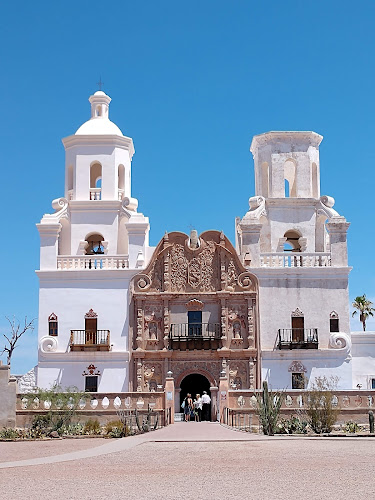
San Xavier del Bac Mission
About San Xavier del Bac Mission
Description
San Xavier del Bac Mission is often called the “White Dove of the Desert,” and when you see it rising against the Arizona sky, you’ll understand why. Built between 1783 and 1797, this Catholic mission is a rare surviving example of Spanish Colonial architecture in the United States. Its whitewashed façade, ornate baroque details, and richly painted interior make it one of the most photographed landmarks in the Southwest. And while it’s undeniably beautiful, what makes it truly special is the way it continues to serve as both a place of worship and a gathering point for the Tohono O’odham community.
Walking through its heavy wooden doors feels like stepping back in time. Inside, you’ll find hand-carved statues, colorful murals, and altars that have been carefully preserved for centuries. Some visitors are instantly struck by the artistry, while others linger in the quiet corners, soaking in the sense of peace that seems to hang in the air. Of course, like any historic site, not every traveler has the same reaction—some expect a bigger museum-like experience and are surprised by the mission’s simplicity. But for many, that simplicity is exactly what makes the place so moving.
What’s interesting is that this mission isn’t just frozen in history—it’s alive. Services are still held here, and you might catch the sound of church bells or even a wedding if you’re lucky. The surrounding grounds, with their desert plants and small gift shop, add to the charm. It’s not a flashy attraction, but it’s one that leaves a lasting impression if you’re open to slowing down and appreciating it. Personally, I find that every time I visit, I notice some new detail—a faded paint stroke on a saint’s robe, a tiny carving tucked into a corner—that I somehow missed before. That’s the beauty of it.
Key Features
- Stunning Spanish Colonial baroque architecture completed in 1797
- Intricate interior artwork with hand-painted murals and statues
- Active Catholic parish with ongoing services and community events
- Wheelchair accessible entrances, restrooms, and parking
- Onsite gift shop with handmade crafts and religious items
- Peaceful desert setting on the San Xavier Indian Reservation
- Historic landmark status and over two centuries of continuous use
Best Time to Visit
If you’re planning a trip, timing matters more than you might think. The Arizona desert can be unforgiving in the summer, with temperatures soaring well above 100°F. Visiting in the cooler months—late fall through early spring—makes wandering the grounds much more pleasant. I personally love going in the morning when the light is softer, and the mission almost glows against the blue sky. Afternoons can get crowded, especially on weekends, so if you want a quieter experience, try a weekday visit.
Another tip: check the calendar for feast days or cultural events. These times can be busier, but they also give you a chance to see the mission alive with music, food, and tradition. It’s a completely different atmosphere compared to a regular weekday, and worth experiencing at least once.
How to Get There
Reaching the mission is straightforward if you’re staying in Tucson—it’s only a short drive south of the city. You’ll follow a main road that eventually winds through desert scenery, and suddenly, the mission appears on the horizon like a mirage. There’s parking available onsite, including accessible spaces, so you won’t need to stress about that.
For those without a car, rideshare services like Uber or Lyft are an easy option, and some guided tours of Tucson include a stop here as well. I’ve done both—driving myself and joining a tour—and honestly, each has its perks. Driving gives you flexibility to linger, while a tour often adds context and history you might not learn otherwise.
Tips for Visiting
Here’s where I’ll get a bit personal, because after visiting multiple times, I’ve picked up a few tricks that can make your experience smoother. First, bring water. It sounds obvious, but the desert heat can sneak up on you, even in cooler months. Second, dress with respect—it’s an active church, so modest clothing is appreciated, especially if you’re planning to step inside during a service.
Photography is allowed, but try to be mindful if a mass is in progress. I once saw a tourist snapping photos during a baptism, and let’s just say it didn’t go over well. If you want the best photos, go early in the day when the light is golden and fewer people are around.
Take your time exploring the interior. Don’t just glance at the main altar and leave—look up at the ceiling, notice the small niches, and really study the artwork. The details are where the magic lives. And don’t skip the small museum-like exhibits and the gift shop. The shop has local crafts, and buying something there supports the community directly.
Finally, give yourself space to just sit. I like to find a bench outside and watch the way the sun shifts over the mission’s white walls. It’s a moment of quiet that’s hard to find in everyday life, and it’s one of the reasons I keep coming back.
Key Features
- Stunning Spanish Colonial baroque architecture completed in 1797
- Intricate interior artwork with hand-painted murals and statues
- Active Catholic parish with ongoing services and community events
- Wheelchair accessible entrances, restrooms, and parking
- Onsite gift shop with handmade crafts and religious items
- Peaceful desert setting on the San Xavier Indian Reservation
- Historic landmark status and over two centuries of continuous use
More Details
Updated September 24, 2025
Table of Contents
Description
San Xavier del Bac Mission is often called the “White Dove of the Desert,” and when you see it rising against the Arizona sky, you’ll understand why. Built between 1783 and 1797, this Catholic mission is a rare surviving example of Spanish Colonial architecture in the United States. Its whitewashed façade, ornate baroque details, and richly painted interior make it one of the most photographed landmarks in the Southwest. And while it’s undeniably beautiful, what makes it truly special is the way it continues to serve as both a place of worship and a gathering point for the Tohono O’odham community.
Walking through its heavy wooden doors feels like stepping back in time. Inside, you’ll find hand-carved statues, colorful murals, and altars that have been carefully preserved for centuries. Some visitors are instantly struck by the artistry, while others linger in the quiet corners, soaking in the sense of peace that seems to hang in the air. Of course, like any historic site, not every traveler has the same reaction—some expect a bigger museum-like experience and are surprised by the mission’s simplicity. But for many, that simplicity is exactly what makes the place so moving.
What’s interesting is that this mission isn’t just frozen in history—it’s alive. Services are still held here, and you might catch the sound of church bells or even a wedding if you’re lucky. The surrounding grounds, with their desert plants and small gift shop, add to the charm. It’s not a flashy attraction, but it’s one that leaves a lasting impression if you’re open to slowing down and appreciating it. Personally, I find that every time I visit, I notice some new detail—a faded paint stroke on a saint’s robe, a tiny carving tucked into a corner—that I somehow missed before. That’s the beauty of it.
Key Features
- Stunning Spanish Colonial baroque architecture completed in 1797
- Intricate interior artwork with hand-painted murals and statues
- Active Catholic parish with ongoing services and community events
- Wheelchair accessible entrances, restrooms, and parking
- Onsite gift shop with handmade crafts and religious items
- Peaceful desert setting on the San Xavier Indian Reservation
- Historic landmark status and over two centuries of continuous use
Best Time to Visit
If you’re planning a trip, timing matters more than you might think. The Arizona desert can be unforgiving in the summer, with temperatures soaring well above 100°F. Visiting in the cooler months—late fall through early spring—makes wandering the grounds much more pleasant. I personally love going in the morning when the light is softer, and the mission almost glows against the blue sky. Afternoons can get crowded, especially on weekends, so if you want a quieter experience, try a weekday visit.
Another tip: check the calendar for feast days or cultural events. These times can be busier, but they also give you a chance to see the mission alive with music, food, and tradition. It’s a completely different atmosphere compared to a regular weekday, and worth experiencing at least once.
How to Get There
Reaching the mission is straightforward if you’re staying in Tucson—it’s only a short drive south of the city. You’ll follow a main road that eventually winds through desert scenery, and suddenly, the mission appears on the horizon like a mirage. There’s parking available onsite, including accessible spaces, so you won’t need to stress about that.
For those without a car, rideshare services like Uber or Lyft are an easy option, and some guided tours of Tucson include a stop here as well. I’ve done both—driving myself and joining a tour—and honestly, each has its perks. Driving gives you flexibility to linger, while a tour often adds context and history you might not learn otherwise.
Tips for Visiting
Here’s where I’ll get a bit personal, because after visiting multiple times, I’ve picked up a few tricks that can make your experience smoother. First, bring water. It sounds obvious, but the desert heat can sneak up on you, even in cooler months. Second, dress with respect—it’s an active church, so modest clothing is appreciated, especially if you’re planning to step inside during a service.
Photography is allowed, but try to be mindful if a mass is in progress. I once saw a tourist snapping photos during a baptism, and let’s just say it didn’t go over well. If you want the best photos, go early in the day when the light is golden and fewer people are around.
Take your time exploring the interior. Don’t just glance at the main altar and leave—look up at the ceiling, notice the small niches, and really study the artwork. The details are where the magic lives. And don’t skip the small museum-like exhibits and the gift shop. The shop has local crafts, and buying something there supports the community directly.
Finally, give yourself space to just sit. I like to find a bench outside and watch the way the sun shifts over the mission’s white walls. It’s a moment of quiet that’s hard to find in everyday life, and it’s one of the reasons I keep coming back.
Key Highlights
- Stunning Spanish Colonial baroque architecture completed in 1797
- Intricate interior artwork with hand-painted murals and statues
- Active Catholic parish with ongoing services and community events
- Wheelchair accessible entrances, restrooms, and parking
- Onsite gift shop with handmade crafts and religious items
- Peaceful desert setting on the San Xavier Indian Reservation
- Historic landmark status and over two centuries of continuous use
Location
Places to Stay Near San Xavier del Bac Mission
Find and Book a Tour
Explore More Travel Guides
No reviews found! Be the first to review!
Traveler Reviews for San Xavier del Bac Mission
There are no reviews yet. Be the first one to write one.
Have you visited San Xavier del Bac Mission? Help other travelers by sharing your review.
You Might Also Like

University of Arizona Museum of Art

Sosa-Carrillo House

Southern Arizona Transportation Museum
Find Accommodations Nearby
Recommended Tours & Activities
Visitor Reviews
There are no reviews yet. Be the first one to write one.
Share Your Experience
Have you visited San Xavier del Bac Mission? Help other travelers by leaving a review.