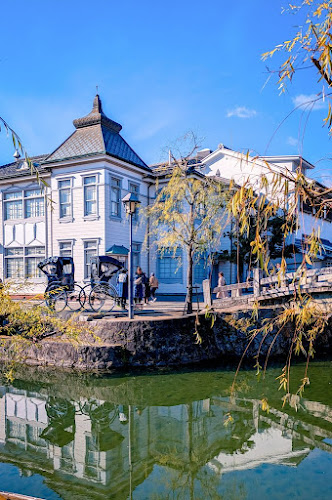
The Kurashikikan Information Center is a historic Taisho-era wooden landmark located along the willow-lined canal of the Kurashiki Bikan Historical Quarter in Okayama Prefecture, Japan. Built in 1917 as Kurashiki’s Town Hall and designated a Registered Tangible Cultural Property, the building serves as the primary visitor welcome center and ticketing office for canal boat cruises.
Highlights & Key Features
Taisho-Era Western Wooden Landmark: Beautiful 1917 Western-style wooden municipal building designated as a national Tangible Cultural Property.
Canal Boat Ticketing Hub: Exclusive authorized ticket counter for the traditional wooden punting boat tours along the Kurashiki River canal.
Central Canal-Side Rest Center: Complimentary visitor rest facility offering multilingual maps, sightseeing advice, luggage coin lockers, and rest amenities.
Architectural Symmetry: Distinctive two-story timber facade featuring classical sash windows, a decorative hip roof, and views of the willow-lined canal.
Visitor Guide & Information
Overview of Kurashikikan Information Center
The Kurashikikan Tourist Information Center (*Kurashiki-kan Kankō Annaijo*) is one of the most prominent architectural and civic landmarks within the celebrated Kurashiki Bikan Historical Quarter (*Kurashiki Bikan Chiku*) in Okayama Prefecture, Japan. Positioned directly along the willow-draped stone banks of the Kurashiki River canal, the two-story building stands out immediately for its distinctive Western-style wooden architecture, contrasting elegantly with the surrounding Edo-period white-walled storehouses (*kura*) and black tiled roofs.
Constructed in 1917 during the Taisho era to serve as the official Town Hall of Kurashiki (*Kurashiki Machiyakuba*), the building symbolizes Japan’s dynamic early twentieth-century modernization period, when Western architectural forms were eagerly harmonized with domestic craftsmanship. On October 18, 1998, the building was formally designated as a Nationally Registered Tangible Cultural Property (*Yūkei Bunkazai*) of Japan in recognition of its historical and architectural integrity. Today, Kurashikikan serves as the primary welcome and orientation hub for millions of international and domestic travelers exploring the historic district.
Architecture and Heritage of the 1917 Town Hall
During the Taisho period (1912–1926), Japanese civic architecture embraced democratic and Western design motifs:
– Design Features: Built entirely of wood, Kurashikikan features a bilaterally symmetrical facade with a classical central entrance porch supported by timber pillars. The exterior is finished with horizontal wooden lap siding painted in light beige and cream tones, punctuated by large double-hung glass sash windows that flood the interior with natural canal-side light.
– Roof Design: The building is crowned by an intricate multi-tiered hip-and-gable roof adorned with traditional Japanese ceramic ridge tiles, exemplifying the *Giyōfū* (pseudo-Western) style that characterized progressive Japanese architecture at the turn of the century.
– Interior Conservation: Following extensive seismic retrofitting and restoration completed in 2019, the building’s interior retains its original polished wood flooring, high plaster ceilings, period brass lighting fixtures, and the open grand staircase that historically led to the town council chambers.
Visitor Services and Canal Boat Ticketing
Beyond its architectural appeal, Kurashikikan functions as the indispensable operational hub for touring the Bikan Quarter:
– **Canal Boat Ticket Office (*Tenryō-bune*): Kurashikikan is the only official ticket counter** for the celebrated traditional wooden canal boat rides along the Kurashiki River. Passengers board flat-bottomed wooden punts propelled by traditional bamboo poles and oar strokes, floating gently beneath arched stone bridges while listening to historical commentary.
– *Booking Rule:* Tickets can only be purchased in person at Kurashikikan on the day of the tour on a first-come, first-served basis starting at 9:00 AM. Advance phone or online reservations are not accepted. Because daily allocations consistently sell out by mid-morning on weekends and holidays, arriving at Kurashikikan by 8:45 AM is essential to secure a morning or afternoon timeslot.
– Multilingual Tourist Services: Friendly multilingual staff provide complimentary sightseeing maps, seasonal festival guides, and accommodation assistance in English, Japanese, Mandarin, and Korean.
– Civic Rest Facilities: The building offers an open public rest lounge with comfortable bench seating, vending machines, modern clean restrooms, and electronic coin lockers where travelers can securely store luggage while exploring the pedestrianized streets.
Exploring the Surrounding Kurashiki Bikan Quarter
Exiting Kurashikikan places visitors in the exact physical heart of one of Japan’s most picturesque historical preservation districts:
– The Ohara Museum of Art: Located directly across the canal bridge, the Ohara Museum was established in 1930 as Japan’s first private museum of Western art. Housed in an imposing Greco-Roman temple-style stone building, the collection features masterpieces by El Greco (*The Annunciation*), Claude Monet (*Water Lilies*), Pablo Picasso, Paul Gauguin, and Auguste Rodin.
– **Historic Rice Storehouses (*Kura*):** Along the canal banks stand dozens of seventeenth-century storehouses with white plaster walls, black diagonal namako-wall tiles, and black glazed roofs. During the Edo period, Kurashiki served as an imperial *Tenryō* territory directly under the control of the Tokugawa shogunate, where rice from the surrounding fertile plains was gathered and shipped by canal barges to Osaka and Edo. Today, these storehouses house boutique denim shops, Bizen pottery galleries, and craft washi-tape showrooms.
– Achi Shrine (Achi Jinja): A stone stairway located behind the historic quarter leads up Mount Tsurugata to Achi Shrine, an ancient Shinto shrine dating back over 1,700 years. The elevated temple precinct provides views over the black tiled roofs and canals of the town below.
– Kurashiki Ivy Square: Situated two blocks behind Kurashikikan stands Kurashiki Ivy Square, an expansive cultural complex occupying the ivy-covered red-brick factory buildings of the 1889 Kurashiki Spinning Mill (Kurabo). The site features the Memorial Hall of Kurabo spinning heritage, artisanal pottery workshops where visitors can try their hands at clay throwing, and tranquil landscaped interior brick courtyards.
– Museum of Folkcraft and Archaeological Museum: Nearby canal-side storehouses hold the Kurashiki Museum of Folkcraft (showcasing traditional Mingei ceramics, textiles, and woodwork championing beauty in everyday utility) and the Kurashiki Archaeological Museum, which preserves ancient Kofun period bronze mirrors, clay haniwa figures, and iron weapons excavated from Okayama burial mounds.
Transit and Access
Kurashiki is located in western Okayama Prefecture, easily accessible from major Kansai transit hubs:
– From Okayama Station: Take the JR Sanyō Main Line or Hakubi Line train to JR Kurashiki Station (a fast 15-to-17-minute journey).
– From Hiroshima or Shin-Osaka: Take the Sanyō Shinkansen to Okayama Station, then transfer to the local train to Kurashiki.
– Walking from Kurashiki Station: From the South Exit of JR Kurashiki Station, walk straight south along Motomachi Street or through the covered Ebisu-dori shopping arcade for approximately 10 to 12 minutes to arrive at the canal bridge fronting Kurashikikan.
Community & Insider Notes
Last modified March 30, 2026
## Overview of Kurashikikan Information Center
The **Kurashikikan Tourist Information Center** (*Kurashiki-kan Kankō Annaijo*) is one of the most prominent architectural and civic landmarks within the celebrated **Kurashiki Bikan Historical Quarter** (*Kurashiki Bikan Chiku*) in Okayama Prefecture, Japan. Positioned directly along the willow-draped stone banks of the Kurashiki River canal, the two-story building stands out immediately for its distinctive Western-style wooden architecture, contrasting elegantly with the surrounding Edo-period white-walled storehouses (*kura*) and black tiled roofs.
Constructed in 1917 during the Taisho era to serve as the official Town Hall of Kurashiki (*Kurashiki Machiyakuba*), the building symbolizes Japan’s dynamic early twentieth-century modernization period, when Western architectural forms were eagerly harmonized with domestic craftsmanship. On October 18, 1998, the building was formally designated as a **Nationally Registered Tangible Cultural Property** (*Yūkei Bunkazai*) of Japan in recognition of its historical and architectural integrity. Today, Kurashikikan serves as the primary welcome and orientation hub for millions of international and domestic travelers exploring the historic district.
## Architecture and Heritage of the 1917 Town Hall
During the Taisho period (1912–1926), Japanese civic architecture embraced democratic and Western design motifs:
– **Design Features:** Built entirely of wood, Kurashikikan features a bilaterally symmetrical facade with a classical central entrance porch supported by timber pillars. The exterior is finished with horizontal wooden lap siding painted in light beige and cream tones, punctuated by large double-hung glass sash windows that flood the interior with natural canal-side light.
– **Roof Design:** The building is crowned by an intricate multi-tiered hip-and-gable roof adorned with traditional Japanese ceramic ridge tiles, exemplifying the *Giyōfū* (pseudo-Western) style that characterized progressive Japanese architecture at the turn of the century.
– **Interior Conservation:** Following extensive seismic retrofitting and restoration completed in 2019, the building’s interior retains its original polished wood flooring, high plaster ceilings, period brass lighting fixtures, and the open grand staircase that historically led to the town council chambers.
## Visitor Services and Canal Boat Ticketing
Beyond its architectural appeal, Kurashikikan functions as the indispensable operational hub for touring the Bikan Quarter:
– **Canal Boat Ticket Office (*Tenryō-bune*):** Kurashikikan is the **only official ticket counter** for the celebrated traditional wooden canal boat rides along the Kurashiki River. Passengers board flat-bottomed wooden punts propelled by traditional bamboo poles and oar strokes, floating gently beneath arched stone bridges while listening to historical commentary.
– *Booking Rule:* Tickets can only be purchased in person at Kurashikikan on the day of the tour on a first-come, first-served basis starting at 9:00 AM. Advance phone or online reservations are not accepted. Because daily allocations consistently sell out by mid-morning on weekends and holidays, arriving at Kurashikikan by 8:45 AM is essential to secure a morning or afternoon timeslot.
– **Multilingual Tourist Services:** Friendly multilingual staff provide complimentary sightseeing maps, seasonal festival guides, and accommodation assistance in English, Japanese, Mandarin, and Korean.
– **Civic Rest Facilities:** The building offers an open public rest lounge with comfortable bench seating, vending machines, modern clean restrooms, and electronic coin lockers where travelers can securely store luggage while exploring the pedestrianized streets.
## Exploring the Surrounding Kurashiki Bikan Quarter
Exiting Kurashikikan places visitors in the exact physical heart of one of Japan’s most picturesque historical preservation districts:
– **The Ohara Museum of Art:** Located directly across the canal bridge, the Ohara Museum was established in 1930 as Japan’s first private museum of Western art. Housed in an imposing Greco-Roman temple-style stone building, the collection features masterpieces by El Greco (*The Annunciation*), Claude Monet (*Water Lilies*), Pablo Picasso, Paul Gauguin, and Auguste Rodin.
– **Historic Rice Storehouses (*Kura*):** Along the canal banks stand dozens of seventeenth-century storehouses with white plaster walls, black diagonal namako-wall tiles, and black glazed roofs. During the Edo period, Kurashiki served as an imperial *Tenryō* territory directly under the control of the Tokugawa shogunate, where rice from the surrounding fertile plains was gathered and shipped by canal barges to Osaka and Edo. Today, these storehouses house boutique denim shops, Bizen pottery galleries, and craft washi-tape showrooms.
– **Achi Shrine (Achi Jinja):** A stone stairway located behind the historic quarter leads up Mount Tsurugata to Achi Shrine, an ancient Shinto shrine dating back over 1,700 years. The elevated temple precinct provides views over the black tiled roofs and canals of the town below.
– **Kurashiki Ivy Square:** Situated two blocks behind Kurashikikan stands Kurashiki Ivy Square, an expansive cultural complex occupying the ivy-covered red-brick factory buildings of the 1889 Kurashiki Spinning Mill (Kurabo). The site features the Memorial Hall of Kurabo spinning heritage, artisanal pottery workshops where visitors can try their hands at clay throwing, and tranquil landscaped interior brick courtyards.
– **Museum of Folkcraft and Archaeological Museum:** Nearby canal-side storehouses hold the Kurashiki Museum of Folkcraft (showcasing traditional Mingei ceramics, textiles, and woodwork championing beauty in everyday utility) and the Kurashiki Archaeological Museum, which preserves ancient Kofun period bronze mirrors, clay haniwa figures, and iron weapons excavated from Okayama burial mounds.
## Transit and Access
Kurashiki is located in western Okayama Prefecture, easily accessible from major Kansai transit hubs:
– **From Okayama Station:** Take the JR Sanyō Main Line or Hakubi Line train to **JR Kurashiki Station** (a fast 15-to-17-minute journey).
– **From Hiroshima or Shin-Osaka:** Take the Sanyō Shinkansen to Okayama Station, then transfer to the local train to Kurashiki.
– **Walking from Kurashiki Station:** From the South Exit of JR Kurashiki Station, walk straight south along Motomachi Street or through the covered Ebisu-dori shopping arcade for approximately 10 to 12 minutes to arrive at the canal bridge fronting Kurashikikan.
Taisho-Era Western Wooden Landmark: Beautiful 1917 Western-style wooden municipal building designated as a national Tangible Cultural Property.
Canal Boat Ticketing Hub: Exclusive authorized ticket counter for the traditional wooden punting boat tours along the Kurashiki River canal.
Central Canal-Side Rest Center: Complimentary visitor rest facility offering multilingual maps, sightseeing advice, luggage coin lockers, and rest amenities.
Architectural Symmetry: Distinctive two-story timber facade featuring classical sash windows, a decorative hip roof, and views of the willow-lined canal.
Location
Places to Stay Near Kurashikikan Information Center
Stay22 provides this accommodation search. We may earn a commission if you book through it; verify current prices and terms with the provider.
🗺️
Interactive accommodation map requires marketing cookies to display live rates.
Recommended Experiences & Activities
GetYourGuide provides this tour inventory. We may earn a commission if you book through it; verify current availability, prices, and terms with the provider.
Top Viator Experiences & Guided Tours in Kurashiki
We may earn a commission if you book through links on this page at no extra cost to you. All tours feature verified customer reviews and flexible cancellation options.
 Real Journey Travels