
Dorut Tilovat
About Dorut Tilovat
Key Features
More Details
Updated October 20, 2025
Dorut Tilovat in Shahrisabz is the ruined complex of a 14th–15th century Sufi lodge and madrasa established by local spiritual leaders linked to the Timurid era, notable for its monumental brickwork and surviving arcade fragments. Visitors can examine intricately patterned terracotta tiles, carved stone pillars, and the remnants of an octagonal mausoleum platform that illustrate medieval Central Asian architectural techniques. Set against the low hills outside Shahrisabz’s UNESCO-listed historic core, the site offers a quieter, less-restored glimpse of regional religious life and craftsmanship from the Timurids’ cultural peak.
Table of Contents
Key Highlights
Shamsiddin Kulal Mausoleum: A focal point of the complex, this is the resting place of Timur’s spiritual teacher, revered Sufi master Shamsiddin Kulal. The marble cenotaph sits beneath a modest dome, while the actual burial chamber lies below. Look for the fine inscriptions and the subtle geometric motifs on the gravestone—details that reward a slow, careful look.
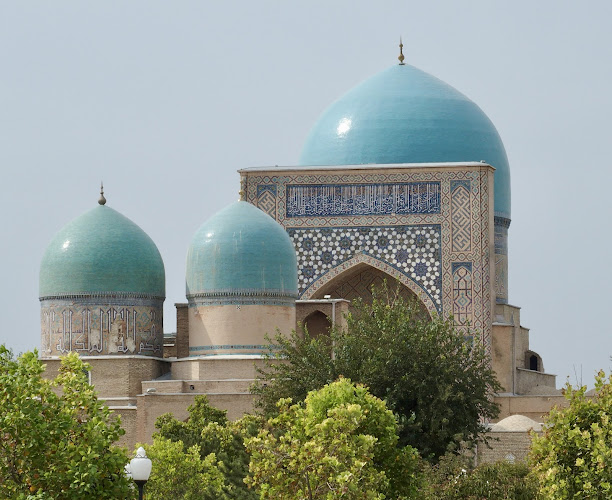
Kok Gumbaz Mosque (1435): Commissioned by Ulugh Beg—astronomer, mathematician, and ruler—the “Blue Dome” mosque anchors the ensemble. The dome’s cool hue stands out against the pale brick, and inside you’ll find fragments of original painted decoration, a refined mihrab, and acoustics that carry a soft whisper. Ulugh Beg dedicated the mosque in honor of his father, Shah Rukh, and it still functions as a place of prayer.
Gumbazi Seyidan: Often translated as the “Dome of the Sayyids,” this smaller mausoleum was intended for descendants of the Prophet. It complements the Kok Gumbaz with quieter lines and delicate tile accents, and together they form a symbolic axis of learning and lineage.
Timurid calligraphy and tilework: The Dorut-Tilavat Ensemble showcases a transition in Timurid decorative arts—from bold Kufic bands to elegant cursive scripts. The palette is classic: turquoise, cobalt, and white, with touches of terracotta. The best details are at eye level: look near doorways and on the lower sections of portals.
Working memorial complex: This isn’t just an open-air museum. People come to recite, to pay respects, and to take a quiet moment out of the day. You’ll likely see caretakers tending the grounds and locals moving through for midday prayers.
Accessible approach: The entrance and adjacent parking area are wheelchair accessible, and the main paths are broad and mostly level. Some thresholds are slightly raised, so a companion can be helpful, but the overall access is better than at many historic sites in the region.
Atmospheric courtyards: Low shade and the sound of birds give the courtyards a tranquil feel even when the city is hot. I found the morning light particularly kind to the brickwork and the inscriptions.
Location
Places to Stay Near Dorut Tilovat
Find and Book a Tour
Explore More Travel Guides
No reviews found! Be the first to review!
Description
On my first walk through Shahrisabz, I followed the long, open esplanade toward an oasis of pale brick and cool shade. That’s where Dorut Tilovat sits—the “Place of Recitation”—a Timurid-era memorial complex that still feels contemplative despite the city’s modern facelift. If you’re tracing the story of Central Asia through its architecture, this is where the threads of faith, scholarship, and power are woven together in stone, tile, and script.
Dorut Tilovat is part of the Historic Centre of Shahrisabz, a UNESCO World Heritage area in Uzbekistan’s Qashqadaryo Region. The ensemble brings together sacred structures from the 14th and 15th centuries: the Mausoleum of Shamsiddin Kulal (the Sufi mentor of Timur, also known as Tamerlane), the Gumbazi Seyidan mausoleum, and the Kok Gumbaz Mosque, commissioned by Ulugh Beg in 1435. It’s an intimate counterpart to the grander Dorus Saodat complex nearby, and it tells the quieter, devotional side of the Timurid story.
Walk through the gates and you’ll notice the balance of scale: nothing shouts, but everything is deliberate. The tilework, though more restrained than in Samarkand, glows with soft turquoise and deep lapis. Quranic inscriptions thread across portals, and the domes rise like cool blue orbs above compact courtyards. I found it easy to linger—watching sunlight move across carved marble tombstones, listening to the muted rhythm of footsteps, and hearing a gentle echo inside the main prayer hall.
The name really does match the atmosphere. Dorut Tilovat was intended as a center for religious learning and recitation, and you feel that continuity today. Locals still stop by to pray, sit quietly, or greet the caretakers. As a traveler, you’re a guest in an active memorial complex, and that lends the visit a special weight that no amount of tilework alone can create.
Key Features
- Shamsiddin Kulal Mausoleum: A focal point of the complex, this is the resting place of Timur’s spiritual teacher, revered Sufi master Shamsiddin Kulal. The marble cenotaph sits beneath a modest dome, while the actual burial chamber lies below. Look for the fine inscriptions and the subtle geometric motifs on the gravestone—details that reward a slow, careful look.
- Kok Gumbaz Mosque (1435): Commissioned by Ulugh Beg—astronomer, mathematician, and ruler—the “Blue Dome” mosque anchors the ensemble. The dome’s cool hue stands out against the pale brick, and inside you’ll find fragments of original painted decoration, a refined mihrab, and acoustics that carry a soft whisper. Ulugh Beg dedicated the mosque in honor of his father, Shah Rukh, and it still functions as a place of prayer.
- Gumbazi Seyidan: Often translated as the “Dome of the Sayyids,” this smaller mausoleum was intended for descendants of the Prophet. It complements the Kok Gumbaz with quieter lines and delicate tile accents, and together they form a symbolic axis of learning and lineage.
- Timurid calligraphy and tilework: The Dorut-Tilavat Ensemble showcases a transition in Timurid decorative arts—from bold Kufic bands to elegant cursive scripts. The palette is classic: turquoise, cobalt, and white, with touches of terracotta. The best details are at eye level: look near doorways and on the lower sections of portals.
- Working memorial complex: This isn’t just an open-air museum. People come to recite, to pay respects, and to take a quiet moment out of the day. You’ll likely see caretakers tending the grounds and locals moving through for midday prayers.
- Accessible approach: The entrance and adjacent parking area are wheelchair accessible, and the main paths are broad and mostly level. Some thresholds are slightly raised, so a companion can be helpful, but the overall access is better than at many historic sites in the region.
- Atmospheric courtyards: Low shade and the sound of birds give the courtyards a tranquil feel even when the city is hot. I found the morning light particularly kind to the brickwork and the inscriptions.
Best Time to Visit
Shahrisabz follows the classic Central Asian rhythm: hot summers, cold winters, and shoulder seasons that feel tailor-made for sightseeing. For Dorut Tilovat, the sweet spots are:
- April–May: Temperatures settle into the 20–25°C range, the mountains around the city are green, and the light is gentle. I visited in May and could comfortably linger in the courtyards without racing for shade.
- September–October: Clear skies and warm-but-not-scorching days. In autumn, the blue dome photographs richly against sharper light, and evenings are perfect for strolling the pedestrian avenues of the historic center.
If you’re traveling in summer (June–August), go early morning or late afternoon. Midday heat can be fierce, and the sun washes out the tilework in photos. Winter has its own mood—quiet, crystalline light—but the nearby mountain pass can be affected by snow, so plan your route carefully.
For a peaceful visit any time of year, aim for early morning, before tour groups appear, or step in after the noon prayer when the courtyards settle again. Fridays are busier due to Jumu’ah; it’s a meaningful time to witness local practice, but expect more activity.
How to Get There
Shahrisabz lies about 90 kilometers south of Samarkand, and most travelers visit Dorut Tilovat on a day trip. The complex itself is centrally located—use the plus code 2RXH+R2V if you’re navigating by phone. Here are the most practical options:
- From Samarkand by taxi: The most straightforward route. A private taxi typically takes 2–2.5 hours each way, passing through the Takhta-Karacha mountain area. The drive is scenic, with switchbacks and broad views; in bad weather, it can slow. Drivers in Samarkand are familiar with “Shahrisabz, Kok Gumbaz” as a destination.
- Shared taxis and marshrutkas: Budget-friendly and frequent from Samarkand’s transport hubs to Kitob (Kitab) or Shahrisabz. You’ll often switch vehicles in Kitob for the final 10–15 minutes. The total time is a bit longer than a private hire but easy enough if you’re used to Central Asian transit.
- From Qarshi (Karshi): Qarshi is about 80–90 kilometers southwest. A direct taxi or marshrutka takes around 1.5–2 hours on flatter roads than the mountain route.
- Self-drive: If you’re renting a car, check pass conditions in winter. The mountain road can be restricted after snowfall or heavy rain. There’s a convenient parking area near the entrance, and the lot has accessible spaces.
Once you’re in the historic center, Dorut Tilovat is an easy walk along the main pedestrian area. Signage in Uzbek and sometimes English points to “Kok Gumbaz” and “Dorut Tilovat.” I like to pair it with the Dorus Saodat complex; they’re close enough to visit back-to-back with a coffee break in between.
Tips for Visiting
- Expect a small entry fee: There’s usually a modest admission—paid in Uzbek som—collected at the gate or by a nearby kiosk. Bring small notes; card payments aren’t always available at heritage sites.
- Dress respectfully: Shoulders and knees covered is a good rule. You’ll remove shoes before stepping into prayer spaces; socks are handy in summer when floors can be warm. A headscarf for women is appreciated in the mosque, and caretakers may offer one if needed.
- Photography etiquette: Photography is typically allowed in the courtyards and exteriors. Be discreet inside the mosque, especially during prayer times, and avoid flash. If you’re carrying a tripod, check with the attendant; permission can vary.
- Look for the details: The grand, blue dome of Kok Gumbaz draws the eye, but the real poetry is lower down—marble grave markers with subtle carving, fine plasterwork edging the mihrab, and bands of Naskh script that run like ribbons across the portals. I found the northwest corner of the courtyard best for capturing the script in angled light.
- Hire a local guide: A short, informal tour can unlock stories you might miss—why Ulugh Beg chose 1435 for the mosque, the symbolism behind certain floral motifs, and how the complex fits into Timurid Shahrisabz as a whole. Guides often wait near the entrance; agree on a fee beforehand.
- Time your visit for light: Early morning gives soft, even illumination on the tiles. Late afternoon brings strong contrast that emphasizes brick textures and makes the dome’s color pop. Midday is harsh and washes out blues in photos.
- Combine with nearby sights: Pair Dorut Tilovat with the Ak-Saray Palace ruins and the Dorus Saodat complex to trace the arc of Timur’s power and piety. It makes a satisfying half-day loop through Shahrisabz’s historical core.
- Accessibility notes: The entrance and adjacent parking are wheelchair friendly, and the main pathways are wide and relatively smooth. Some thresholds into interior spaces are raised; a lightweight ramp or assistance helps. Benches in the courtyard offer rest points, and I found staff happy to help when asked.
- Respect the rhythm of worship: This is a living memorial and mosque. Step aside during the call to prayer, keep voices low, and follow cues from locals. The calm here is part of the experience; leaning into it makes your visit better.
- Stay hydrated and sun-aware: Even in spring, Shahrisabz can feel warmer than Samarkand. Bring water and a hat; shade is decent in the courtyards but limited on the walk between sites.
- Cash for donations: Small voluntary donations are sometimes welcomed at mausoleums. If you appreciate the caretaking and cleanliness, a few som go a long way.
- Safety and common sense: The historic center is straightforward to navigate. Watch for low steps and uneven brickwork, especially when moving from bright sunlight into dim interiors where your eyes need a second to adjust.
Dorut Tilovat doesn’t overwhelm with size; it resonates with intention. You can trace a line from Shamsiddin Kulal’s spiritual influence to Timur’s empire and to Ulugh Beg’s scientific curiosity, all within a few quiet courtyards. If you’re building an Uzbekistan itinerary around Timurid architecture, this is where the story breathes. Give it an unhurried hour, listen to your footsteps in the mosque, and let the blue dome anchor your memory of Shahrisabz.
Traveler Reviews for Dorut Tilovat
There are no reviews yet. Be the first one to write one.
Have you visited Dorut Tilovat? Help other travelers by sharing your review.
You Might Also Like
Caravanserai Koba
Bibi-Khanym Mosque

Polish War Cemetery in Shahrisabz
Find Accommodations Nearby
Recommended Tours & Activities
Visitor Reviews
There are no reviews yet. Be the first one to write one.
Share Your Experience
Have you visited Dorut Tilovat? Help other travelers by leaving a review.