

Ak Saray Palace
About Ak Saray Palace
Ak Saray Palace is a highly acclaimed 역사적 명소 located in Shahrisabz, Uzbekistan. With a rating of 4.6 out of 5, it stands out as one of the top-rated 역사적 명소s in the area.
Location
You can find Ak Saray Palace at 3R6H+8RF, Shahrisabz, Qashqadaryo Region, Uzbekistan.
Visiting Ak Saray Palace
Located in Shahrisabz, Uzbekistan, Ak Saray Palace is a 역사적 명소 that visitors to the area may find worth exploring.
Planning Your Visit
The 역사적 명소 is located at 3R6H+8RF, Shahrisabz, Qashqadaryo Region, Uzbekistan. GPS coordinates: 39.060803, 66.829556. Check locally for current opening hours and any admission fees before visiting.
Key Features
More Details
Updated June 4, 2026
Ak Saray Palace is a highly acclaimed 역사적 명소 located in Shahrisabz, Uzbekistan. With a rating of 4.6 out of 5, it stands out as one of the top-rated 역사적 명소s in the area.
Table of Contents
- Location
- Visiting Ak Saray Palace
- Planning Your Visit
- Key Highlights
- Location
- Places to Stay Near Ak Saray Palace
- Find and Book a Tour
- Explore More Travel Guides
- Description
- Key Features
- Best Time to Visit
- How to Get There
- Tips for Visiting
- Nearby Places You Might Like
- Traveler Reviews for Ak Saray Palace
- Share Your Experience
Location
You can find Ak Saray Palace at 3R6H+8RF, Shahrisabz, Qashqadaryo Region, Uzbekistan.
Visiting Ak Saray Palace
Located in Shahrisabz, Uzbekistan, Ak Saray Palace is a 역사적 명소 that visitors to the area may find worth exploring.
Planning Your Visit
The 역사적 명소 is located at 3R6H+8RF, Shahrisabz, Qashqadaryo Region, Uzbekistan. GPS coordinates: 39.060803, 66.829556. Check locally for current opening hours and any admission fees before visiting.
Key Highlights
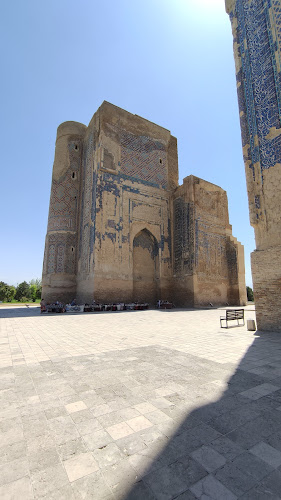
Monumental portal: The surviving entrance once framed an arch reaching roughly 65 meters, among the tallest of its kind in Central Asia.
Timurid tilework: Cobalt and turquoise mosaics in star patterns, with Arabic inscriptions in Kufic and Thuluth scripts, created using the banai technique.
Historic pedigree: Commissioned by Timur (Tamerlane) starting in 1380 as his Shahrisabz summer and ceremonial palace.
UNESCO context: Part of the Historic Centre of Shahrisabz World Heritage site, giving insight into Timurid urban planning and ceremonial spaces.
Open park setting: Landscaped avenues, fountains, and clear sightlines let you appreciate the scale from multiple vantage points.
Amir Timur statue: A strong photographic anchor facing the portal, popular with wedding groups and families.
Interpretive signage: On-site panels outline construction history, architectural features, and restoration work.
Accessibility: Wheelchair-accessible entrance and parking, with flat, broad paths suitable for mobility devices and strollers.
Family-friendly: Kids can explore safely in the car-free park area and enjoy the fountains and open space.
Evening illumination: Subtle lighting after sunset accentuates the brick relief and tile bands for atmospheric photos.
Location
Places to Stay Near Ak Saray Palace
Find and Book a Tour
Explore More Travel Guides
No reviews found! Be the first to review!
Description
Walk into Shahrisabz and you can’t miss the jagged silhouette of the Ak Saray Palace portal dominating the skyline. Even in ruins, it’s colossal. This was Timur’s summer palace, started in 1380 when the conqueror decided his hometown deserved a statement piece. Only the entrance remains, but that ruined gateway tells you everything about Timurid ambition: height, color, geometry, and a sense that ceremony happened here on a grand scale.
Locals call it Ak Saray—“White Palace.” In Turkic tradition, “white” can mean “noble,” not literally white. The surviving bricks are anything but monochrome. When you get close, you’ll see a skin of glazed tiles—cobalt, turquoise, white, and traces of gold—arranged in shimmering patterns. Stand beneath the portal and look up; it’s dizzying. The arch once soared to around 65 meters, and the two flanking pylons still rise dramatically. When I last visited, I watched people instinctively stop talking as they stepped under the shadow of those walls. The scale does that to you.
Shahrisabz’s historic center is on the UNESCO World Heritage list, and the palace is its headline sight. The surrounding area has been transformed into a landscaped park with fountains and wide pedestrian paths. It makes the approach easy, though history buffs will note the modern overhaul changed the old-town feel. Still, the site is thoughtfully signposted, and the space around the portal gives you room to absorb it from multiple angles. You can’t climb the structure (please don’t try), but walking the perimeter gives you different views of the brickwork and tile bands, including Arabic inscriptions in elegant scripts. One famous Timurid phrase tied to this site says, “If you doubt our might—look at our buildings.” You’ll understand what they meant.
Timur used Ak Saray for ceremonies and audiences when he was in Shahrisabz, while the main court life centered on Samarkand. Craftsmen from across Central Asia and Persia worked on the palace using the banai technique—baked brick combined with glazed tiles to create complex patterns. The portal’s blue mosaic starbursts and Kufic bands feel both mathematical and playful. If you see tiny holes in the brickwork, they’re not damage from conflict; many were part of the original scaffolding system and tile-setting methods.
Today, the palace grounds are livelier than you might expect for a ruin. Families stroll in the evenings, teenagers practice dance routines near the fountains, and wedding parties drift in for photos beneath the proud statue of Amir Timur. I like coming at day’s end, when the light softens and the tiles wake up. After rain, the colors deepen and reflections in the shallow pools add a second layer to your photos. If you’re into architectural photography, bring a short telephoto lens; details pop better than with a wide angle alone.
Another practical note: Ak Saray is remarkably accessible. The entrance is level, pathways are wide, and there’s wheelchair-friendly parking right by the park. I’ve walked the site with a stroller; it was straightforward. Shahrisabz can be hot, though, and shade is limited on the plaza, so bring a hat and water if you’re visiting in the middle of the day.
Key Features
- Monumental portal: The surviving entrance once framed an arch reaching roughly 65 meters, among the tallest of its kind in Central Asia.
- Timurid tilework: Cobalt and turquoise mosaics in star patterns, with Arabic inscriptions in Kufic and Thuluth scripts, created using the banai technique.
- Historic pedigree: Commissioned by Timur (Tamerlane) starting in 1380 as his Shahrisabz summer and ceremonial palace.
- UNESCO context: Part of the Historic Centre of Shahrisabz World Heritage site, giving insight into Timurid urban planning and ceremonial spaces.
- Open park setting: Landscaped avenues, fountains, and clear sightlines let you appreciate the scale from multiple vantage points.
- Amir Timur statue: A strong photographic anchor facing the portal, popular with wedding groups and families.
- Interpretive signage: On-site panels outline construction history, architectural features, and restoration work.
- Accessibility: Wheelchair-accessible entrance and parking, with flat, broad paths suitable for mobility devices and strollers.
- Family-friendly: Kids can explore safely in the car-free park area and enjoy the fountains and open space.
- Evening illumination: Subtle lighting after sunset accentuates the brick relief and tile bands for atmospheric photos.
Best Time to Visit
Spring (April–May) and autumn (September–October) are prime months for Ak Saray. Daytime temperatures are comfortable, the air is clear, and the pass from Samarkand is typically open. In spring, the Qashqadaryo hills are green, which makes the earth-toned bricks and blue tiles look even richer in contrast.
Summer can be scorching, especially midday. If you’re traveling June to August, aim for early morning or late afternoon. I love the golden hour here: long shadows carve texture into the brickwork, and the mosaics catch the last warm light. Sunset usually draws more locals, which adds energy and people-watching opportunities. If you want the site quieter, come right when it opens.
Winter brings fewer crowds, and the air can be wonderfully crisp for photography. However, snow or icy conditions sometimes close or slow traffic over the Takhtakaracha Pass between Samarkand and Shahrisabz. If you’re planning a winter visit, check road conditions beforehand or consider the longer route via Karshi.
Weekdays are calmer than weekends. Fridays after midday prayers can be busier, and you’ll see more wedding parties on weekends, especially in the late afternoon. They’re part of the local rhythm—just allow extra time if you want unobstructed shots in front of the portal.
How to Get There
Ak Saray Palace sits at 3R6H+8RF, Shahrisabz, in Uzbekistan’s Qashqadaryo Region. The site anchors the northern end of the pedestrianized historic zone, so once you arrive in town you can walk straight into the park.
From Samarkand (about 90 km):
- By car: Plan on 1.5–2.5 hours depending on traffic and the Takhtakaracha Pass. The drive itself is a highlight, winding through mountain scenery before dropping into the fertile valley around Shahrisabz.
- Shared taxi or marshrutka: Head to Samarkand’s main taxi stands and ask for Shahrisabz. Vehicles leave when full; it’s typically faster than buses and reasonably priced.
From Karshi (about 90 km):
- By car or shared taxi: Roughly 1.5 hours on mostly flat roads. This route can be a good fallback in winter if the pass from Samarkand is closed.
Public transport within Shahrisabz is straightforward. Most drivers know “Aksaray” or “Oqsaroy,” and the palace park has obvious drop-off points. If you’re self-driving, look for the designated parking areas near the pedestrian zone; signage is clear, and there are accessible spots close to the entrance.
As an easy day trip, combine Ak Saray with other Shahrisabz sights: the Dorut Tilovat ensemble and Kok Gumbaz Mosque to the south, and the Dorus Saodat complex with the Jahongir Mausoleum. They’re all within walking distance through the park corridor.
Tips for Visiting
- Time your photos: For the richest color on the tiles, aim for early morning or just before sunset. After rain, reflections in the fountains can double your composition.
- Look for inscriptions: On the inner faces of the portal, search for Arabic script bands; some are blessings, others celebrate the ruler. The calligraphy reveals as much artistry as the geometric patterns.
- Notice construction details: Those small holes and recesses in the brickwork aren’t random damage—they relate to scaffolding and tile-setting. It’s a hands-on reminder of 14th-century building methods.
- Bring shade and water: The plaza is mostly open. A hat, sunscreen, and a refillable bottle make summer visits far more pleasant.
- Accessibility: The main approach is flat and paved, with wheelchair-accessible entrances and nearby parking. If you’re using a mobility aid, you’ll find the site practical and uncluttered.
- Consider a local guide: On-site guides can decode tile patterns, point out Quranic verses, and explain how Ak Saray fit into Timurid court ceremony. It adds depth to what can otherwise feel like “just a big gate.”
- Mind the boundaries: Don’t climb the masonry. The remaining brick faces are fragile, and the best angles are achievable from ground level anyway.
- Cash for tickets: Admission is collected at the gate. Have small-denomination Uzbek soum ready. Photography is generally fine; if you bring a tripod, keep it low-key and follow staff instructions.
- Evening ambiance: After dark, the lighting scheme outlines the brick relief, and local families come out to stroll. It’s safe and relaxed, but watch for wet pavement near fountains.
- Combine with Shahrisabz crafts: Around the park, you’ll see stalls selling textiles and woodwork. Prices are gentler than in larger cities, and artisans are often happy to chat about patterns and techniques.
- Seasonal travel note: In winter, verify whether the Takhtakaracha Pass is open. If conditions look dicey, route via Karshi and approach from the south.
- Context helps: Read a bit about Timur and Timurid architecture before you go. Understanding why this portal needed to be this tall—and how it related to gardens, audience halls, and water channels—turns a ruin into a palace in your mind.
Standing under the Ak Saray portal, it’s easy to imagine the rest: courtyards alive with ceremony, water running through channeled gardens, and the clang of metalwork from distant workshops. Shahrisabz isn’t a museum piece; it’s a living town around a ruin that still commands respect. If you’re tracing a Timurid route through Uzbekistan—Samarkand, Shahrisabz, maybe Bukhara after—this stop gives you the origin story. You see where a local boy became a ruler who reshaped a region and stamped his ambition into fired brick and blue glaze. And you get to walk right up to it.
Traveler Reviews for Ak Saray Palace
There are no reviews yet. Be the first one to write one.
Have you visited Ak Saray Palace? Help other travelers by sharing your review.
Nearby Attractions
You Might Also Like
Shakhrisabz
Bibi-Khanym Mosque

Kok Gumbaz Mosque
Find Accommodations Nearby
Recommended Tours & Activities
Visitor Reviews
There are no reviews yet. Be the first one to write one.
Share Your Experience
Have you visited Ak Saray Palace? Help other travelers by leaving a review.