
Coventry Cathedral
About Coventry Cathedral
Description
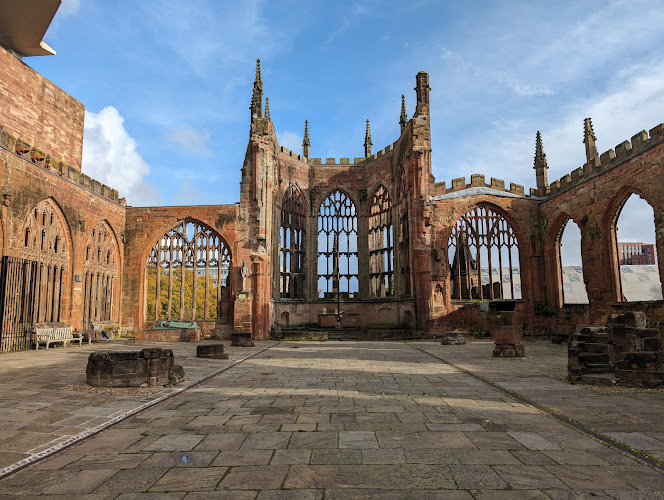
Coventry Cathedral is one of those places that quietly rearranges how you feel about history, faith, and modern Britain. It’s not just a cathedral; it’s two, side by side, having a long conversation across centuries. On one hand, there are the medieval ruins, roofless and open to the sky, left exactly as they were after the bombing of Coventry in November 1940. On the other, there’s the bold 20th-century Cathedral of St Michael, completed in 1962, all clean lines, modern art, and a kind of stubborn hope built in stone and glass.
The ruins hit first. They always do. Walking through them, you’re exposed to the weather, the city sounds drifting in, and that feels intentional. The old walls stand like witnesses. Charred stones. Empty window frames. And yet it’s not gloomy in a depressing way. It’s reflective, maybe even calming, which surprised me the first time I visited. I remember thinking I’d rush through, snap a few photos, and move on. Instead, I sat down on one of the benches and just… stayed. There’s a raw honesty in leaving destruction visible rather than covering it up.
Then you step into the modern cathedral, and the mood shifts. It’s brighter. Taller. Purposeful. The interior doesn’t whisper; it speaks clearly. Some people love it instantly, others need time. I was in the second camp. The art is striking and sometimes challenging, from the enormous tapestry behind the altar to the abstract stained glass that plays with light instead of telling literal stories. But after a while, it clicks. This building isn’t trying to imitate the past. It’s saying, we’ve been through something terrible, and we’re still here.
For travelers, Coventry Cathedral offers more than architecture. It’s a crash course in 20th-century British history, reconciliation, and resilience. It’s also very much alive. Services still happen. School groups wander through with notebooks. Locals pop in during lunch breaks. You don’t feel like you’re intruding on a museum; you feel like you’re visiting a working place with a complicated soul.
There’s also a strong theme of peace and reconciliation that runs through everything. The cathedral has international connections, especially with cities affected by war. That global outlook gives the place a relevance that goes beyond Coventry or even the UK. And honestly, that’s what makes it memorable. Plenty of cathedrals are beautiful. This one is meaningful.
Key Features
- The preserved medieval ruins, left roofless as a memorial to the Coventry Blitz
- The modern Cathedral of St Michael, a landmark of 20th-century church architecture
- Powerful artworks, including a massive tapestry and distinctive stained glass windows
- A strong focus on peace, reconciliation, and post-war healing
- Accessible facilities, including wheelchair-friendly entrances and restrooms
- Onsite amenities that make longer visits comfortable and unhurried
- Regular services, events, and exhibitions that keep the space active
Best Time to Visit
Coventry Cathedral is open year-round, but timing does shape the experience. Late spring and early autumn are sweet spots. The weather is mild, which matters more than you’d think because the ruins are outdoors. Standing among stone walls with blue sky above feels very different from doing the same thing under grey drizzle. Not bad in winter, just different. More introspective, maybe.
Mornings tend to be quieter, especially on weekdays. If you like having space to think, to sit, to wander without feeling rushed, aim for earlier in the day. Afternoons can bring in school groups and tour buses, which adds energy but also noise. I don’t mind it, personally. There’s something fitting about young voices echoing in a place shaped by war. But if silence is your thing, mornings win.
Special services and commemorative events, particularly around November, can be incredibly moving. They also mean larger crowds. If you’re traveling specifically for history and remembrance, that might be exactly what you want. But if you’re more focused on architecture and atmosphere, check timings so you’re not surprised.
And a small, practical note: light matters here. The modern cathedral was designed with light in mind, and on sunny days the interior really comes alive. The colors shift as the sun moves, which sounds poetic because it is. Cloudy days are fine, but bright ones are something else.
How to Get There
Coventry is well connected, and the cathedral sits right in the city center, which makes things easy even if you’re not a fan of complicated travel days. Trains from major cities arrive regularly, and from the station it’s a walk through the heart of Coventry. Not a boring walk either. You pass shops, cafés, bits of old and new stitched together, which kind of mirrors the cathedral itself.
If you’re driving, the city has multiple parking options nearby, including accessible parking. Just be aware that city center traffic can be unpredictable, especially during peak hours. Give yourself extra time and you’ll be fine. Rushing is the wrong energy for this place anyway.
Buses also serve the area well, and local signage is clear. Once you’re close, you can’t really miss it. The spire of the modern cathedral and the open outline of the ruins act like landmarks. I’ve watched first-time visitors slow down without realizing it as they approach. It has that effect.
Tips for Visiting
First tip, and I say this as someone who’s guilty of doing the opposite: don’t rush. Coventry Cathedral rewards lingering. Sit in the ruins for a bit. Walk the perimeter. Notice how the old and new buildings talk to each other. If you treat it like a quick tick on a sightseeing list, you’ll miss the point.
Dress for the weather, even if you think you won’t need to. The outdoor ruins are a big part of the experience, and British weather has opinions of its own. Layers help. Comfortable shoes too, because you’ll be on stone surfaces more than once.
Photography is allowed in many areas, but be respectful. This is still a place of worship. I’ve seen people get so focused on the perfect shot that they forget where they are. Pause, look, then lift the camera. You’ll get a better photo anyway.
If you’re traveling with kids, don’t worry. There’s enough visual drama to keep them interested, especially in the ruins. Explaining that the building was bombed during WWII often sparks good questions. I once overheard a child ask why they didn’t just rebuild it the same. The answer to that question is basically the heart of the whole site.
Accessibility is well considered here, which matters. Wheelchair users can navigate the main areas comfortably, and facilities are designed with inclusion in mind. It’s not an afterthought, and that shows.
Finally, give yourself permission to feel whatever comes up. Some people feel peaceful. Others feel heavy. I’ve felt both on different visits. Coventry Cathedral doesn’t tell you what to think. It just lays everything out, cracked stones and soaring lines alike, and lets you decide. That’s rare. And honestly, that’s why it stays with you long after you leave.
Key Features
- The preserved medieval ruins, left roofless as a memorial to the Coventry Blitz
- The modern Cathedral of St Michael, a landmark of 20th-century church architecture
- Powerful artworks, including a massive tapestry and distinctive stained glass windows
- A strong focus on peace, reconciliation, and post-war healing
- Accessible facilities, including wheelchair-friendly entrances and restrooms
- Onsite amenities that make longer visits comfortable and unhurried
- Regular services, events, and exhibitions that keep the space active
More Details
Updated December 31, 2025
Table of Contents
Description
Coventry Cathedral is one of those places that quietly rearranges how you feel about history, faith, and modern Britain. It’s not just a cathedral; it’s two, side by side, having a long conversation across centuries. On one hand, there are the medieval ruins, roofless and open to the sky, left exactly as they were after the bombing of Coventry in November 1940. On the other, there’s the bold 20th-century Cathedral of St Michael, completed in 1962, all clean lines, modern art, and a kind of stubborn hope built in stone and glass.
The ruins hit first. They always do. Walking through them, you’re exposed to the weather, the city sounds drifting in, and that feels intentional. The old walls stand like witnesses. Charred stones. Empty window frames. And yet it’s not gloomy in a depressing way. It’s reflective, maybe even calming, which surprised me the first time I visited. I remember thinking I’d rush through, snap a few photos, and move on. Instead, I sat down on one of the benches and just… stayed. There’s a raw honesty in leaving destruction visible rather than covering it up.
Then you step into the modern cathedral, and the mood shifts. It’s brighter. Taller. Purposeful. The interior doesn’t whisper; it speaks clearly. Some people love it instantly, others need time. I was in the second camp. The art is striking and sometimes challenging, from the enormous tapestry behind the altar to the abstract stained glass that plays with light instead of telling literal stories. But after a while, it clicks. This building isn’t trying to imitate the past. It’s saying, we’ve been through something terrible, and we’re still here.
For travelers, Coventry Cathedral offers more than architecture. It’s a crash course in 20th-century British history, reconciliation, and resilience. It’s also very much alive. Services still happen. School groups wander through with notebooks. Locals pop in during lunch breaks. You don’t feel like you’re intruding on a museum; you feel like you’re visiting a working place with a complicated soul.
There’s also a strong theme of peace and reconciliation that runs through everything. The cathedral has international connections, especially with cities affected by war. That global outlook gives the place a relevance that goes beyond Coventry or even the UK. And honestly, that’s what makes it memorable. Plenty of cathedrals are beautiful. This one is meaningful.
Key Features
- The preserved medieval ruins, left roofless as a memorial to the Coventry Blitz
- The modern Cathedral of St Michael, a landmark of 20th-century church architecture
- Powerful artworks, including a massive tapestry and distinctive stained glass windows
- A strong focus on peace, reconciliation, and post-war healing
- Accessible facilities, including wheelchair-friendly entrances and restrooms
- Onsite amenities that make longer visits comfortable and unhurried
- Regular services, events, and exhibitions that keep the space active
Best Time to Visit
Coventry Cathedral is open year-round, but timing does shape the experience. Late spring and early autumn are sweet spots. The weather is mild, which matters more than you’d think because the ruins are outdoors. Standing among stone walls with blue sky above feels very different from doing the same thing under grey drizzle. Not bad in winter, just different. More introspective, maybe.
Mornings tend to be quieter, especially on weekdays. If you like having space to think, to sit, to wander without feeling rushed, aim for earlier in the day. Afternoons can bring in school groups and tour buses, which adds energy but also noise. I don’t mind it, personally. There’s something fitting about young voices echoing in a place shaped by war. But if silence is your thing, mornings win.
Special services and commemorative events, particularly around November, can be incredibly moving. They also mean larger crowds. If you’re traveling specifically for history and remembrance, that might be exactly what you want. But if you’re more focused on architecture and atmosphere, check timings so you’re not surprised.
And a small, practical note: light matters here. The modern cathedral was designed with light in mind, and on sunny days the interior really comes alive. The colors shift as the sun moves, which sounds poetic because it is. Cloudy days are fine, but bright ones are something else.
How to Get There
Coventry is well connected, and the cathedral sits right in the city center, which makes things easy even if you’re not a fan of complicated travel days. Trains from major cities arrive regularly, and from the station it’s a walk through the heart of Coventry. Not a boring walk either. You pass shops, cafés, bits of old and new stitched together, which kind of mirrors the cathedral itself.
If you’re driving, the city has multiple parking options nearby, including accessible parking. Just be aware that city center traffic can be unpredictable, especially during peak hours. Give yourself extra time and you’ll be fine. Rushing is the wrong energy for this place anyway.
Buses also serve the area well, and local signage is clear. Once you’re close, you can’t really miss it. The spire of the modern cathedral and the open outline of the ruins act like landmarks. I’ve watched first-time visitors slow down without realizing it as they approach. It has that effect.
Tips for Visiting
First tip, and I say this as someone who’s guilty of doing the opposite: don’t rush. Coventry Cathedral rewards lingering. Sit in the ruins for a bit. Walk the perimeter. Notice how the old and new buildings talk to each other. If you treat it like a quick tick on a sightseeing list, you’ll miss the point.
Dress for the weather, even if you think you won’t need to. The outdoor ruins are a big part of the experience, and British weather has opinions of its own. Layers help. Comfortable shoes too, because you’ll be on stone surfaces more than once.
Photography is allowed in many areas, but be respectful. This is still a place of worship. I’ve seen people get so focused on the perfect shot that they forget where they are. Pause, look, then lift the camera. You’ll get a better photo anyway.
If you’re traveling with kids, don’t worry. There’s enough visual drama to keep them interested, especially in the ruins. Explaining that the building was bombed during WWII often sparks good questions. I once overheard a child ask why they didn’t just rebuild it the same. The answer to that question is basically the heart of the whole site.
Accessibility is well considered here, which matters. Wheelchair users can navigate the main areas comfortably, and facilities are designed with inclusion in mind. It’s not an afterthought, and that shows.
Finally, give yourself permission to feel whatever comes up. Some people feel peaceful. Others feel heavy. I’ve felt both on different visits. Coventry Cathedral doesn’t tell you what to think. It just lays everything out, cracked stones and soaring lines alike, and lets you decide. That’s rare. And honestly, that’s why it stays with you long after you leave.
Key Highlights
- The preserved medieval ruins, left roofless as a memorial to the Coventry Blitz
- The modern Cathedral of St Michael, a landmark of 20th-century church architecture
- Powerful artworks, including a massive tapestry and distinctive stained glass windows
- A strong focus on peace, reconciliation, and post-war healing
- Accessible facilities, including wheelchair-friendly entrances and restrooms
- Onsite amenities that make longer visits comfortable and unhurried
- Regular services, events, and exhibitions that keep the space active
Location
Places to Stay Near Coventry Cathedral
Find and Book a Tour
Explore More Travel Guides
No reviews found! Be the first to review!
Traveler Reviews for Coventry Cathedral
There are no reviews yet. Be the first one to write one.
Have you visited Coventry Cathedral? Help other travelers by sharing your review.
You Might Also Like
Coventry Canal Basin
Lady Herbert's Gardens
Hawkesbury Junction
Find Accommodations Nearby
Recommended Tours & Activities
Visitor Reviews
There are no reviews yet. Be the first one to write one.
Share Your Experience
Have you visited Coventry Cathedral? Help other travelers by leaving a review.