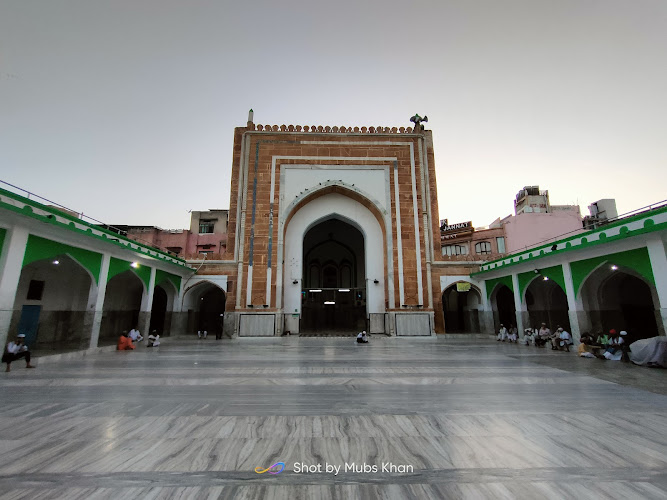
Perched within the hallowed precincts of Ajmer Sharif Dargah, the Akbari Masjid is a graceful Mughal-era mosque built by Emperor Akbar in 1571 as an offering of gratitude. Walking into its courtyard, you encounter the warm patina of red sandstone contrasted with white and green marble inlays, elegant minarets framing the skyline, and a calm, devotional atmosphere sustained by centuries of pilgrims. The mosque’s history is inseparable from the Sufi legacy of Khwaja Moinuddin Chishti and Akbar’s personal devotion; it was erected after the birth of his son, reflecting a royal blend of faith and gratitude. What makes this mosque special is its intimate scale within a major pilgrimage complex — it feels both architecturally refined and deeply lived-in, with Quranic schools and daily prayers keeping its traditions vibrant. Visit to appreciate Mughal craftsmanship up close, to witness living devotional practices, and to experience Ajmer’s layered spiritual heritage just steps from the famed Dargah.
Highlights & Key Features
Built by Emperor Akbar in 1571 — Mughal-era architecture
Constructed of red sandstone with white and green marble accents
Located inside the Ajmer Sharif Dargah complex — high devotional significance
Flanked by tall minarets and a spacious courtyard suitable for quiet reflection
Houses Quranic educational facilities and remains a working mosque
Visitor Guide & Information
Description
The Akbari Masjid stands as one of those religious monuments that somehow manages to captivate both the spiritually inclined and history buffs alike. I’ve always found that the best mosques aren’t just places of worship—they’re living museums that tell stories spanning centuries, and this particular structure fits that description perfectly.
Built during the Mughal era, this architectural marvel showcases the distinct Indo-Islamic design principles that defined that golden period of Indian history. The mosque gets its name from Emperor Akbar, though the exact origins and construction timeline have some fascinating debates among historians. What’s undeniable is the craftsmanship on display here. Every arch, every minaret, every intricate carving speaks to a time when buildings weren’t just functional spaces but artistic statements.
The mosque sits in a location that’s become increasingly popular with tourists exploring the region’s spiritual heritage. And honestly, it deserves more recognition than it sometimes gets. While many travelers flock to the more famous religious sites nearby, those who take the time to visit Akbari Masjid often find themselves pleasantly surprised by its serene atmosphere and stunning details.
The prayer hall features traditional Mughal architectural elements—you’ll notice the characteristic domes, the precise symmetry, and the way natural light filters through the structure. There’s something about the acoustics inside too; even whispers seem to carry a certain weight and dignity. The courtyard provides a peaceful space for reflection, and during non-prayer times, it’s relatively quiet, making it an excellent spot for contemplation or just taking a breather from the usual tourist crowds.
What struck me most when researching this place was how it maintains its primary function as an active house of worship while welcoming visitors from all backgrounds. That balance isn’t always easy to achieve, but the mosque manages it with grace.
Key Features
The Akbari Masjid offers several distinguishing characteristics that make it worth your travel time:
Mughal Architecture: The mosque displays quintessential features of Mughal design including pointed arches, ornate minarets, and symmetrical layouts that exemplify the empire’s architectural philosophy
Historical Significance: Connected to the reign of Emperor Akbar, this structure represents an important chapter in India’s religious and cultural history
Wheelchair Accessible Entrance: The mosque provides accessible entry points, making it welcoming for visitors with mobility challenges—a feature that’s still unfortunately rare in many historical religious sites
Restroom Facilities: Practical amenities are available on-site, which any seasoned traveler knows makes a huge difference during day-long explorations
Active Place of Worship: Unlike some historical sites that function purely as museums, this remains a working mosque where daily prayers take place, offering visitors an authentic cultural experience
Intricate Stone Carvings: The detailed craftsmanship visible in the walls and pillars demonstrates the skill level of Mughal-era artisans
Peaceful Courtyard: The open space provides a tranquil environment for visitors to rest and absorb the atmosphere
Proximity to Other Attractions: The location makes it convenient to include in a broader itinerary of the region’s spiritual sites
Photography Opportunities: The architectural details and lighting conditions create excellent conditions for photography enthusiasts, though always be respectful of worshippers and prayer times
Best Time to Visit
Timing your visit to Akbari Masjid can really make or break your experience, and I’ve learned this lesson the hard way at too many religious sites to count.
The ideal months for visiting fall between October and March when the weather is considerably more forgiving. Indian summers can be brutal, and trust me, you don’t want to be exploring outdoor courtyards and sun-baked stone structures when temperatures soar above 40°C. The cooler winter months offer comfortable conditions for walking around and truly appreciating the architecture without feeling like you’re melting.
Within your chosen day, early mornings present the best window for visitors. Arriving around sunrise or shortly after offers multiple advantages—the light is gorgeous for photography, temperatures are manageable, and you’ll encounter fewer crowds. Plus, there’s something special about experiencing these ancient spaces in the morning quiet. The faithful come for dawn prayers, and observing that devotion (respectfully, from a distance) adds depth to your visit.
Friday afternoons should probably be avoided unless you specifically want to witness the congregational prayers. While this can be culturally enriching, the mosque becomes quite crowded, and it’s not the ideal time for casual exploration or photography. The same goes for major Islamic festivals and holidays when the site sees significantly increased attendance.
Mid-afternoon visits during summer are basically asking for heatstroke. But if that’s your only option, bring water, wear a hat, and plan for a shorter visit focused on the shaded interior spaces.
Monsoon season (July through September) brings its own considerations. Rain can create beautiful atmospheric conditions for photography, and the washed stone takes on different colors. However, slippery surfaces and potential flooding in courtyards might limit access to certain areas.
Evening visits just before sunset can be magical, with golden hour lighting transforming the stone structures. However, evening prayer times mean you’ll need to be more mindful about where you stand and how you conduct yourself.
How to Get There
Getting to Akbari Masjid requires some planning, but it’s definitely manageable even for first-time visitors to the region.
The nearest major transportation hub serves as your primary gateway. Most travelers will arrive by train, as rail connections in this part of India are generally reliable and extensive. From the railway station, you’ve got several options for covering the remaining distance to the mosque.
Auto-rickshaws are probably your most convenient choice for short distances. These three-wheeled vehicles are everywhere, and drivers generally know the mosque’s location. Just make sure to negotiate the fare before starting your journey or insist on using the meter. In my experience, agreeing on a price upfront prevents those awkward arguments at your destination. Expect to pay a reasonable fare depending on your starting point and traffic conditions.
Cycle-rickshaws offer a slower but more environmentally friendly alternative, and they’re great if you’re not in a rush and want to soak in the street scenes along the way.
For those who prefer more comfort or are traveling in groups, hiring a taxi or booking through ride-sharing apps (where available) makes sense. The cost gets split among passengers, and you’ll have air conditioning—a genuine blessing during hot months.
If you’re the adventurous type and familiar with driving in India, renting a vehicle is possible. But fair warning: traffic patterns here can be challenging for newcomers. The seemingly chaotic flow actually follows unspoken rules that take time to understand.
Some visitors choose to walk from nearby accommodations or other tourist sites. This works well if you’re staying close by and the weather cooperates. Walking lets you discover unexpected shops, street food vendors, and local life that you’d miss from inside a vehicle.
Public buses serve the area too, though routes and schedules can confuse visitors unfamiliar with the local transport system. If you’re budget-conscious and don’t mind a bit of adventure, buses are certainly an option.
Tips for Visiting
Here’s where I share the practical wisdom that’ll make your Akbari Masjid visit smoother and more meaningful.
First off, dress codes matter at religious sites, and mosques have specific expectations. Both men and women should wear modest clothing covering shoulders, arms, and legs. Women will typically need to cover their heads with a scarf—bring your own as it’s more comfortable than borrowing one that hundreds of strangers have used. Loose-fitting, breathable fabrics work best, especially in warm weather.
You’ll need to remove your shoes before entering the main prayer areas. The mosque provides designated areas for footwear storage, but I always recommend keeping an eye on where you left them. Wearing socks makes this process more hygienic and comfortable, particularly if the stone floors are hot from sun exposure.
Respect prayer times, seriously. When the faithful are performing their devotions, stay quiet, don’t walk in front of people who are praying, and definitely don’t start posing for selfies. It’s just basic courtesy. If you’re unsure about what’s appropriate, observe what others are doing or ask politely.
Photography policies vary, so check current rules before visiting. Generally, exterior shots are fine, but flash photography inside prayer halls disrupts worshippers and damages the contemplative atmosphere. Some areas might prohibit photography entirely, so respect those boundaries.
Bring drinking water, especially during warmer months. Dehydration sneaks up on you when you’re absorbed in exploring. And while restroom facilities exist, they’re basic—set your expectations accordingly.
A local guide can dramatically enrich your experience. The historical and architectural details that make Akbari Masjid special aren’t always obvious to casual observers. A knowledgeable guide points out design elements, explains symbolism, and shares stories that bring the stones to life. Many guides wait near the entrance, but arranging one through your hotel beforehand often gets you better quality for similar prices.
If you’re not Muslim, you’re still welcome to visit, but understand you’re a guest in someone’s place of worship. Act accordingly. That means speaking quietly, not pointing or laughing, and refraining from public displays of affection.
Plan to spend about an hour exploring thoroughly, though you could easily stay longer if you’re particularly interested in architecture or photography. Rushing through defeats the purpose.
Small donations are appreciated, though not mandatory. If someone helps you with information or assists in any way, a small tip is customary.
Be aware of potential touts or unofficial “guides” who might pressure you for money. Polite but firm refusal works best. The actual entrance area is generally well-managed, but surrounding streets sometimes attract people looking to take advantage of tourists.
During your visit, take time to just sit and observe. Some of my most memorable travel moments have come from simply being present in beautiful spaces, watching light move across ancient walls, hearing the call to prayer echo through chambers built centuries ago. Akbari Masjid offers those moments if you give it the chance.
Finally, visit with an open mind and respectful heart. Religious sites across India welcome visitors from all backgrounds, but they’re sacred spaces first and tourist attractions second. That distinction matters.
Key Highlights
Built by Emperor Akbar in 1571 — Mughal-era architecture
Constructed of red sandstone with white and green marble accents
Located inside the Ajmer Sharif Dargah complex — high devotional significance
Flanked by tall minarets and a spacious courtyard suitable for quiet reflection
Houses Quranic educational facilities and remains a working mosque
Akbari Masjid, Ajmer: A Practical Guide to a Mughal-era Landmark
Akbari Masjid sits inside the wider Ajmer Sharif Dargah complex and is closely tied to the Mughal presence in Rajasthan. Multiple government and local sources attribute the mosque to Emperor Akbar and date it to the 1570–1571 CE period, placing it among the Dargah’s oldest surviving Mughal structures.Incredible India
Why it matters
Direct Mughal patronage: Built under Akbar, the mosque embodies the political–spiritual nexus that drew the emperor repeatedly to Ajmer, home to the shrine of Khwaja Moinuddin Chishti.Incredible India
Part of a living complex: Akbari Masjid functions within a dense sacred precinct that also includes later additions such as the Shahjahani Gate and the Mehfil Khana (royal assembly hall, 1888).tripuntold.com
Continuing educational role: Several contemporary descriptions note a madarsa (Darul-Uloom) operating within/adjacent to the mosque premises, a reminder that this is an active religious and learning space, not a static monument.NativePlanet
Fast facts (verify on the day)
Dating & patron: 1570–1571 CE; patronage of Emperor Akbar.Ajmer Gharib Nawaz
Material & look: Predominantly red sandstone with white and green marble detailing; four minaret-like turrets frame the façade in many images/descriptions.Holidify
Where exactly: Within the Ajmer Sharif Dargah circulation, commonly described between the Shahjahani Gate and the Buland Darwaza on Ander Kote Road (you’ll likely pass it en route to the main sanctum).Holidify
Hours: Some travel listings report “open 24 hours” for the mosque; however, the Dargah complex manages access and crowd flow, and times can vary during festivals or security checks—confirm locally at the Dargah office on arrival. (Reason for caution: hours on private travel sites are often inconsistent.)TripHobo
Architecture & layout: what to notice
Mughal stylistic mix: Expect a compact Mughal prayer hall in red sandstone, with decorative white/green marble highlights that mirror wider Dargah aesthetics. This color palette recurs across nearby period buildings, making the mosque easy to spot once you’re inside the complex.Holidify
Gate sequence orientation: If you enter through Nizam Gate → Shahjahani Gate → Buland Darwaza, Akbari Masjid appears along the flow toward the sanctum, situating it literally and symbolically along the main devotional axis.tripuntold.com
Historic layering around it: The precinct’s later Mehfil Khana (1888), used for gatherings and qawwali, anchors the late-19th-century layer nearby, underscoring centuries of continuous patronage.Wikipedia
Visiting essentials (respectful, smooth, and safe)
Dress & etiquette
– Wear modest clothing (shoulders/knees covered). Remove footwear in designated areas. Photography norms vary—ask the caretakers before shooting in prayer spaces or during services. (General etiquette in an active mosque; confirm locally.)
Security context
– The Ajmer Dargah conducts periodic security checks. In September 2025, India’s National Security Guard (NSG) undertook an inspection of the Dargah’s gates and prayer areas to review CCTV, entry/exit points, and crowd management—routine for a high-footfall site. Expect bag checks during peak hours or festival periods.The Times of India
Complex conditions
– Community bodies have recently called for structural safety audits across the wider Dargah complex after weather-related damage reports. This does not specifically single out Akbari Masjid, but it’s prudent to follow on-site guidance and avoid cordoned areas if any maintenance is underway.The Times of India
Accessibility & flow
– Narrow lanes and devotional crowds can be intense, especially on Thursdays and during Urs. Arrive early morning or late evening for calmer conditions, and budget time to navigate one-way flows between gates. (Gate sequence documented by official/authoritative overviews.)Incredible India
How to fit Akbari Masjid into your Ajmer day
Start at the Gates: Enter via Nizam Gate → Shahjahani Gate → Buland Darwaza; pause at Akbari Masjid en route to the sanctum. This path gives you the best sense of historical layering.tripuntold.com
Pair with the Fort-Museum: After the Dargah, head to Akbari Fort & Museum (Akbar’s Palace), founded by Akbar in 1570 and later used by Prince Salim (Jahangir). It houses Mughal/Rajput arms and sculpture and anchors Ajmer’s secular Mughal narrative.Wikipedia
Stay flexible: Festival days can affect access around the mosque; check notices posted at the gates or with the Dargah office on arrival.The Times of India
Practical planning notes
Wayfinding: Ask volunteers or custodians for “Akbari Masjid” once you pass Shahjahani Gate; many will point you toward the short stretch before Buland Darwaza. The Ander Kote Road reference is useful if you’re arriving from the bazaar side.Holidify
Footwear & storage: Shoe racks may be available but fill quickly during peak hours; bring a simple shoe bag.
Photography: Respect prayer times and requests from caretakers; regulations can change without notice.
Women travelers: The precinct is busy and well-patrolled during the day; consider daylight visits for easiest navigation and bring a headscarf if you prefer added coverage inside prayer areas (personal choice; not uniformly enforced).
Heat & hydration: Summers are punishing. Carry water (sealed bottles) and plan shade breaks; the lanes are mostly paved stone with limited cover.
What’s confidently known—and what to double-check
Solid facts you can rely on:
– Akbari Masjid belongs to the Ajmer Sharif Dargah complex, dates to Akbar’s reign (c. 1570–1571 CE), and is commonly described between Shahjahani Gate and Buland Darwaza.Ajmer Gharib Nawaz
– The mosque’s red sandstone with white/green marble accents is consistently noted across reputable overviews.Holidify
– A madarsa/Darul-Uloom operates on site, reflecting ongoing educational use.NativePlanet
– The wider Dargah has recent security reviews and public discussions about structural audits (complex-level), which can affect access routes or crowd management.The Times of India
Items to verify locally (can change):
– Opening hours and photography rules inside prayer spaces; third-party sites sometimes list “24 hours,” but the Dargah’s operational controls and festival schedules can override that.TripHobo
Nearby deep-dives for context (helpful references)
Ajmer Sharif Dargah – Official/authoritative overviews outlining gates and constituent buildings.Incredible India
Akbari Fort & Museum – Background on Akbar’s Ajmer base and the collection you’ll see today.Wikipedia
Bottom line
Visit Akbari Masjid for its early-Mughal fabric, still-active religious life, and prime position along the Dargah’s main approach. Build a morning itinerary that threads the gates, pauses at the mosque, and then explores Akbar’s city-level imprint at the Akbari Fort & Museum—a concise arc that makes the history legible in half a day. Keep an eye out for security advisories or festival reroutes, and confirm access rules on arrival for a smooth experience.Holidify
Note on accuracy: This guide uses government or institution-level sources where available; where only travel listings exist (hours, on-the-ground logistics), they are explicitly flagged for same-day verification.Incredible India
Explore verified points of interest within walking or short transit distance.
No neighboring places mapped within 5 km yet.
Find Places to Stay Nearby
Stay22 provides this accommodation search. We may earn a commission if you book through it; verify current prices and terms with the provider.
🗺️
Interactive accommodation map requires marketing cookies to display live rates.
Recommended Experiences & Activities
GetYourGuide provides this tour inventory. We may earn a commission if you book through it; verify current availability, prices, and terms with the provider.
Top Viator Experiences & Guided Tours in Ajmer
We may earn a commission if you book through links on this page at no extra cost to you. All tours feature verified customer reviews and flexible cancellation options.
 Real Journey Travels