Ancient Meets Modern Walking Tour of Zadar vs Private Morning History Walking Tour of Zadar’s Old Town: Which Tour Is Better?
Updated June 5, 2026
You stand at a crossroads in Zadar, Croatia, facing two distinct ways to understand this Adriatic city. One path explores the dialogue between its ancient stone and contemporary installations. The other focuses intently on the dense, layered history contained within the Old Town walls.
Both promise to reveal Zadar’s character, but they do so with different paces, narratives, and areas of focus. Your choice depends on what you want from your visit: a broad artistic conversation or a deep historical immersion. This comparison breaks down the specifics of each tour to help you decide which walk aligns with your interests and schedule.
Table of Contents
- Defining the Two Tour Experiences
- Route and Key Sites Covered
- Ancient Meets Modern Tour Route
- Old Town History Tour Route
- Duration, Group Size, and Pace
- Historical Depth vs. Contemporary Context
- Ideal Visitor For Each Tour
- Practical Booking and Preparation Tips
- Book Your Dream Experience
- More Travel Guides
- Explore These Destinations
Defining the Two Tour Experiences

The Ancient Meets Modern walking tour is a thematic journey. It connects Zadar’s oldest monuments with its 20th and 21st-century artistic interventions.
You will cover more ground, physically and conceptually, moving from Roman forums to architectural projects like the Sea Organ and the Greeting to the Sun. This tour frames Zadar as a living city where history continuously informs modern creativity.
In contrast, the Private Morning History Walking Tour of Zadar’s Old Town is a concentrated study. It operates within the compact peninsula of the historic center, a area less than half a square mile. The focus is exclusively on the centuries of history visible in the stonework, from Roman and medieval times up to the Venetian period.
This tour is for those who want to understand the chronological layers that built the city, often spending more time at individual sites like Saint Donatus Church or the Cathedral of St. Anastasia to unpack their significance.
Route and Key Sites Covered
Ancient Meets Modern Tour Route
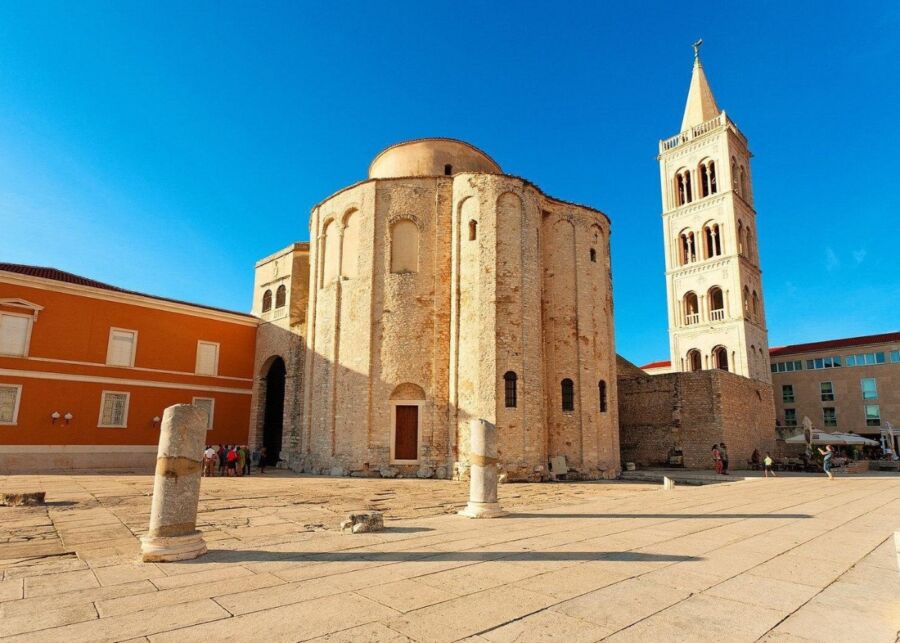
This tour typically starts at the Roman Forum, dating to the 1st century BC, and the adjacent St. Donatus Church from the 9th century. It then moves toward the seaward edge of the peninsula.
The key modern stops are the Sea Organ, an architectural sound art object that plays music via sea waves, and the Greeting to the Sun, a solar-powered light installation. The route often includes views of contemporary architecture along the Riva (waterfront promenade) and may reference the city’s rebuilding after World War II.
Old Town History Tour Route
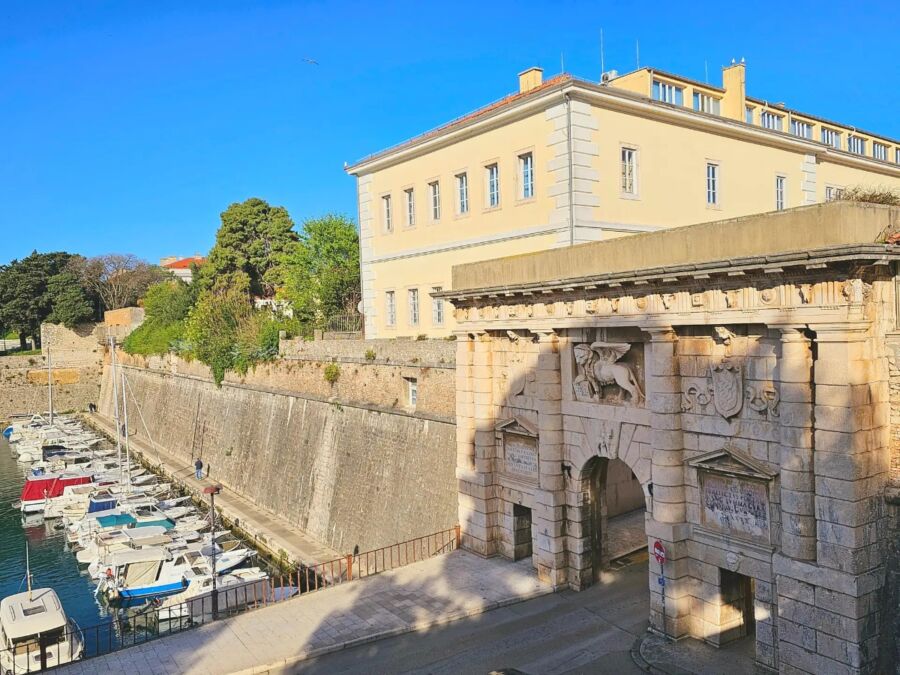
This tour remains almost entirely within the confines of the Old Town walls. It is a detailed circuit that includes:
- The Land Gate, the main historic entrance built by the Venetians in 1543.
- The Five Wells Square, a Renaissance-era reservoir system.
- Saint Simeon’s Church and its famous silver sarcophagus.
- The Roman Forum and St. Donatus Church.
- The Cathedral of St. Anastasia and its bell tower.
- Various Venetian and medieval structures along the narrow Kalelarga street.
The narrative ties these sites directly to the rulers and events that shaped them, from Rome to Venice.
See Related: Hidden Gem Towns Along the Croatia Coast: Seaside Escapes Locals Love
Duration, Group Size, and Pace

The Ancient Meets Modern tour is often a group tour, with sizes that can range from 10 to 20 people. It lasts approximately 1.5 to 2 hours. The pace is generally steady, as the route covers a greater linear distance from the forum to the western tip of the peninsula. There is more walking between stops, but the terrain is flat and paved.
The Private Morning History Tour is, by definition, a private experience for you and your party. This allows for a customizable pace.
The tour typically lasts 2 to 3 hours, reflecting the deeper level of detail and the ability to linger at sites that interest you most. The walking is more stop-and-start, with significant time spent stationary while discussing the history of a specific square, church, or artifact. The entire tour occurs on flat, pedestrianized streets.
Historical Depth vs. Contemporary Context

The Private History tour offers greater historical depth. Guides provide detailed accounts of specific eras, such as the Roman foundation as a colonia, the Byzantine influence, the long period of Venetian rule, and the damage sustained during the Croatian War of Independence.
You learn about specific dates, architectural styles, and key figures. The context is strictly historical.
The Ancient Meets Modern tour provides a different kind of context: the contemporary. It explains how Zadar has chosen to incorporate art and innovative design into its urban fabric, especially in its postwar and post-Yugoslav identity.
You learn why the Sea Organ was built in 2005 and what the light sequences of the Greeting to the Sun represent. The history is used as a foundation to discuss the city’s present and future.
Ideal Visitor For Each Tour

Choose the Private Morning History Walking Tour if you are a history enthusiast who prefers a detailed, academic approach. It suits visitors who want to ask in-depth questions and focus on the chronology of events that shaped the Dalmatian coast.
Families with older children or travelers with a specific interest in medieval, Roman, or Venetian history will find this format rewarding. The private nature also makes it ideal for those who dislike crowds or have mobility concerns that require a slower, more flexible pace.
Choose the Ancient Meets Modern walking tour if you have a broader interest in culture, art, and architecture. It is excellent for first-time visitors who want a general overview of Zadar’s highlights.
The tour appeals to photographers and those who enjoy experiential art like the Sea Organ. It is also a better fit for travelers on a tighter schedule or those who prefer a more energetic, forward-moving walk. The group setting can be more social for solo travelers.
See Related: Where to Stay in Croatia: Top Destinations for an Unforgettable Vacation
Practical Booking and Preparation Tips

Both tours require advance booking, especially during the peak summer season from June to September. You can book online through local tour operator websites or major travel experience platforms.
The private tour is more expensive, often costing between 200 and 300 HRK (approximately 27-40 EUR) per group. The group Ancient Meets Modern tour is priced per person, usually between 80 and 150 HRK (approximately 11-20 EUR).
Wear comfortable walking shoes for either option. The terrain is flat but consists of stone pavements and streets. For the morning history tour, bring a bottle of water, as the focus on detail and longer duration can be demanding.
For the modern art tour, consider going in the late afternoon; this allows you to experience the Sea Organ at a time of day when more cruise ships have departed and you can conclude the tour at sunset to see the Greeting to the Sun light display. Check the meeting point carefully; the history tour often starts at the Land Gate, while the modern tour may begin at the Roman Forum.
Book Your Dream Experience
More Travel Guides
Explore These Destinations
Related Posts