
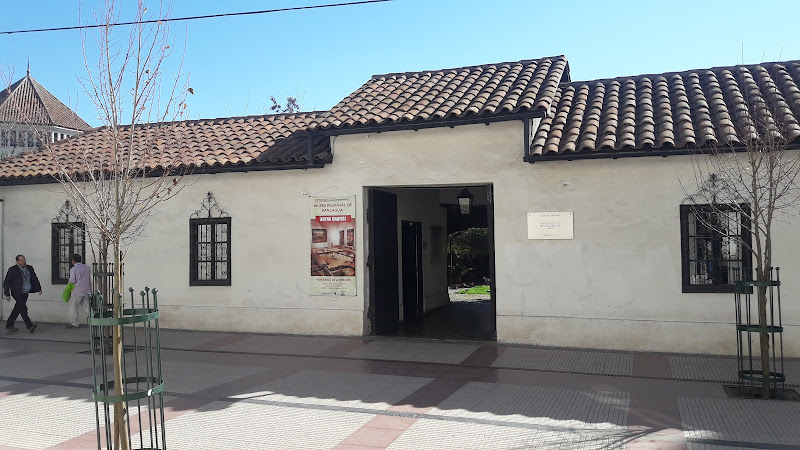
Regional Museum of Rancagua
About Regional Museum of Rancagua
Description
The Regional Museum of Rancagua sits inside two adjoining colonial mansions and feels, at first step, like stepping into a quiet conversation with the 19th century. The place does not shout. It whispers: polished wood floors, tall ceilings, glass-fronted cabinets that hum with old stories. For travelers curious about Chile beyond Santiago, the museum is a tidy, surprisingly rich compendium of regional history — not a blockbuster attraction, but the sort of spot where small discoveries add up and linger. Visitors will find rooms arranged with period furnishings, portraits, textiles, household items and tools that sketch daily life in central Chile across decades and decades.
Architecturally, the two mansions are the kind of buildings that make people slow their pace without meaning to. The façades keep a sober colonial silhouette; inside, each room is staged to represent a slice of life: a dining room with a heavy sideboard and porcelain, a bedroom that still smells faintly of cedar and old paper, a study with a well-worn armchair where one can almost imagine a local politician plotting municipal reforms. But it is not museum theater in a theme-park sense; rather, it is domestic history presented with restraint and an affection for detail. The furniture is original or painstakingly restored, and the arrangement gives a clear sense of how families in Rancagua lived, worked and entertained in the 1800s.
What often surprises visitors is the range. Beyond domestic rooms there are displays on agriculture, mining, traditional crafts and the social life of the O'Higgins region. Rancagua sits near important copper mining history and the museum touches on how extraction shaped landscapes and livelihoods. There are also artifacts linked to local civic life: banners, documents, maps and photographs that narrate the slow evolution of a city in central Chile. It’s these municipal artifacts — small, grainy photos of parades, or handwritten municipal decrees — that make the past feel immediate and, oddly, familiar.
Curators here favor narrative clarity over flashy installations. That means labels are straightforward, objects are sensibly grouped, and the walking route between the two mansions leads the visitor through a sequence that almost feels chronological. That said, signage can be a little terse at times. A seasoned traveler who likes deep context might wish for more comparative text or expanded English descriptions, though the basics are well-covered and helpful. In other words: history is presented accessibly, but inquisitive minds often leave with questions they want answered over an after-museum coffee.
The museum has earned a reputation among families and school groups because many exhibits are approachable for children. Hands-off displays are the rule, of course, but themes such as traditional games, local domestic life and crafts often engage younger visitors. Staff sometimes run educational activities, and the spatial layout — rooms that feel like real rooms rather than cavernous galleries — helps maintain attention. And parents appreciate the practicalities: there are restrooms and a wheelchair-accessible entrance and restroom, which makes it more convenient than some historic buildings of similar vintage.
For travelers who track architectural details, the mansions themselves are an attraction. Explore the moldings, the ironwork on windows, the way light falls through original panes — and if one cares about photography, morning light through the east-facing windows makes for pleasant, soft-lit shots. But a quick caveat: the interiors are preserved rather than staged for Instagram. If somebody expects dramatic sets or interactive tech, they will likely be underwhelmed. The museum leans into authenticity rather than spectacle. That choice gives the experience a calmer, more contemplative tone.
One of the lesser-known strengths is the museum’s permanent collection of 19th-century furnishings. These are not generic pieces; many belonged to notable local families and public figures. A careful read of the labels rewards a curious visitor: a desk used by a municipal leader, a sewing machine that traces a household’s link to wider economic networks, or a carved cradle that tells the story of childcare in another century. These intimate objects are small portals into stories of work, leisure and domestic economies — and they reveal how ordinary life and regional politics intersected.
Visitors who like to learn through objects rather than long essays will appreciate the museum’s restraint. Exhibits are compact, well-lit and arranged so the eye moves naturally. The museum also hosts rotating temporary exhibitions focused on regional themes: folk art, photography from local photographers, or thematic displays about harvests and festivals. Those rotating shows are sometimes where curators let their hair down a bit, introducing more contemporary voices and varied media. So while the permanent collection anchors the museum in the 19th century, the temporary exhibits can surprise with modern perspectives and fresh interpretations.
One practical aside: the site offers free Wi-Fi. That detail matters, because a lot of travelers want to fact-check, tag photos, or pull up historical context while standing inside a display room. Being able to quickly translate a label or look up a referenced event makes the visit feel more like an interactive research stroll than a passive viewing. Combine that with friendly staff and you get a welcoming atmosphere. Staff are typically helpful with directions and will happily point out lesser-known rooms if asked. And they sometimes share the sort of local stories that never make it into official labels — you know, the juicy small-town lore that brings a place to life.
Of course, no museum is perfect. Some repeat visitors mention that the collection could be better lit in certain corners, and that a few exhibits feel cramped because of the historic layout. But that same cramped intimacy is also what many people praise: it creates a sense of being allowed into private spaces of the past. Expect to spend between 45 minutes and two hours, depending on your pace and how much attention you pay to the temporary exhibitions. For the traveler balancing a day trip to nearby vineyards or the Andes foothills, the museum slots neatly into a half-day itinerary without feeling rushed.
Another thing that quietly sets the Regional Museum of Rancagua apart is its community orientation. This is not a museum that only curates for tourists. Local cultural programs, workshops and school visits are substantial parts of its calendar. The result is a living feel: a museum that connects the objects inside with the people outside. Visitors often notice school groups bustling through in the morning and a quieter, more reflective crowd in the afternoons. But sometimes they also catch a workshop where elders demonstrate traditional weaving or a local historian giving an impromptu talk — moments that are deliciously unplanned and make the place more than a static collection.
Travelers who have a taste for regional narratives will find the museum especially rewarding. It makes the broader sweep of Chilean history — the interplay of agriculture, mining, migration, and politics in central Chile — readable at human scale. One could say it is a place for those who prefer to connect with the past through objects that tell daily stories rather than through monumental national narratives. And for travelers who like to make small detours, the museum’s location in the city offers easy access to nearby plazas, cafés and quieter streets where one can sit afterward and let the museum’s fragments of history settle in.
To sum up, the Regional Museum of Rancagua is quietly satisfying. It rewards attention, invites conversations and helps travelers understand the O'Higgins region in ways that larger museums sometimes gloss over. It will not overwhelm with spectacle; instead, it offers the subtler pleasure of cultivated detail and narrative coherence. For those who pack an afternoon of curiosity into a trip through central Chile, it is a place that returns more than the time spent inside.
Key Features
More Details
Updated August 30, 2025
Description
The Regional Museum of Rancagua sits inside two adjoining colonial mansions and feels, at first step, like stepping into a quiet conversation with the 19th century. The place does not shout. It whispers: polished wood floors, tall ceilings, glass-fronted cabinets that hum with old stories. For travelers curious about Chile beyond Santiago, the museum is a tidy, surprisingly rich compendium of regional history — not a blockbuster attraction, but the sort of spot where small discoveries add up and linger. Visitors will find rooms arranged with period furnishings, portraits, textiles, household items and tools that sketch daily life in central Chile across decades and decades.
Architecturally, the two mansions are the kind of buildings that make people slow their pace without meaning to. The façades keep a sober colonial silhouette; inside, each room is staged to represent a slice of life: a dining room with a heavy sideboard and porcelain, a bedroom that still smells faintly of cedar and old paper, a study with a well-worn armchair where one can almost imagine a local politician plotting municipal reforms. But it is not museum theater in a theme-park sense; rather, it is domestic history presented with restraint and an affection for detail. The furniture is original or painstakingly restored, and the arrangement gives a clear sense of how families in Rancagua lived, worked and entertained in the 1800s.
What often surprises visitors is the range. Beyond domestic rooms there are displays on agriculture, mining, traditional crafts and the social life of the O’Higgins region. Rancagua sits near important copper mining history and the museum touches on how extraction shaped landscapes and livelihoods. There are also artifacts linked to local civic life: banners, documents, maps and photographs that narrate the slow evolution of a city in central Chile. It’s these municipal artifacts — small, grainy photos of parades, or handwritten municipal decrees — that make the past feel immediate and, oddly, familiar.
Curators here favor narrative clarity over flashy installations. That means labels are straightforward, objects are sensibly grouped, and the walking route between the two mansions leads the visitor through a sequence that almost feels chronological. That said, signage can be a little terse at times. A seasoned traveler who likes deep context might wish for more comparative text or expanded English descriptions, though the basics are well-covered and helpful. In other words: history is presented accessibly, but inquisitive minds often leave with questions they want answered over an after-museum coffee.
The museum has earned a reputation among families and school groups because many exhibits are approachable for children. Hands-off displays are the rule, of course, but themes such as traditional games, local domestic life and crafts often engage younger visitors. Staff sometimes run educational activities, and the spatial layout — rooms that feel like real rooms rather than cavernous galleries — helps maintain attention. And parents appreciate the practicalities: there are restrooms and a wheelchair-accessible entrance and restroom, which makes it more convenient than some historic buildings of similar vintage.
For travelers who track architectural details, the mansions themselves are an attraction. Explore the moldings, the ironwork on windows, the way light falls through original panes — and if one cares about photography, morning light through the east-facing windows makes for pleasant, soft-lit shots. But a quick caveat: the interiors are preserved rather than staged for Instagram. If somebody expects dramatic sets or interactive tech, they will likely be underwhelmed. The museum leans into authenticity rather than spectacle. That choice gives the experience a calmer, more contemplative tone.
One of the lesser-known strengths is the museum’s permanent collection of 19th-century furnishings. These are not generic pieces; many belonged to notable local families and public figures. A careful read of the labels rewards a curious visitor: a desk used by a municipal leader, a sewing machine that traces a household’s link to wider economic networks, or a carved cradle that tells the story of childcare in another century. These intimate objects are small portals into stories of work, leisure and domestic economies — and they reveal how ordinary life and regional politics intersected.
Visitors who like to learn through objects rather than long essays will appreciate the museum’s restraint. Exhibits are compact, well-lit and arranged so the eye moves naturally. The museum also hosts rotating temporary exhibitions focused on regional themes: folk art, photography from local photographers, or thematic displays about harvests and festivals. Those rotating shows are sometimes where curators let their hair down a bit, introducing more contemporary voices and varied media. So while the permanent collection anchors the museum in the 19th century, the temporary exhibits can surprise with modern perspectives and fresh interpretations.
One practical aside: the site offers free Wi-Fi. That detail matters, because a lot of travelers want to fact-check, tag photos, or pull up historical context while standing inside a display room. Being able to quickly translate a label or look up a referenced event makes the visit feel more like an interactive research stroll than a passive viewing. Combine that with friendly staff and you get a welcoming atmosphere. Staff are typically helpful with directions and will happily point out lesser-known rooms if asked. And they sometimes share the sort of local stories that never make it into official labels — you know, the juicy small-town lore that brings a place to life.
Of course, no museum is perfect. Some repeat visitors mention that the collection could be better lit in certain corners, and that a few exhibits feel cramped because of the historic layout. But that same cramped intimacy is also what many people praise: it creates a sense of being allowed into private spaces of the past. Expect to spend between 45 minutes and two hours, depending on your pace and how much attention you pay to the temporary exhibitions. For the traveler balancing a day trip to nearby vineyards or the Andes foothills, the museum slots neatly into a half-day itinerary without feeling rushed.
Another thing that quietly sets the Regional Museum of Rancagua apart is its community orientation. This is not a museum that only curates for tourists. Local cultural programs, workshops and school visits are substantial parts of its calendar. The result is a living feel: a museum that connects the objects inside with the people outside. Visitors often notice school groups bustling through in the morning and a quieter, more reflective crowd in the afternoons. But sometimes they also catch a workshop where elders demonstrate traditional weaving or a local historian giving an impromptu talk — moments that are deliciously unplanned and make the place more than a static collection.
Travelers who have a taste for regional narratives will find the museum especially rewarding. It makes the broader sweep of Chilean history — the interplay of agriculture, mining, migration, and politics in central Chile — readable at human scale. One could say it is a place for those who prefer to connect with the past through objects that tell daily stories rather than through monumental national narratives. And for travelers who like to make small detours, the museum’s location in the city offers easy access to nearby plazas, cafés and quieter streets where one can sit afterward and let the museum’s fragments of history settle in.
To sum up, the Regional Museum of Rancagua is quietly satisfying. It rewards attention, invites conversations and helps travelers understand the O’Higgins region in ways that larger museums sometimes gloss over. It will not overwhelm with spectacle; instead, it offers the subtler pleasure of cultivated detail and narrative coherence. For those who pack an afternoon of curiosity into a trip through central Chile, it is a place that returns more than the time spent inside.
Key Highlights
Regional Museum of Rancagua
Location
Places to Stay Near Regional Museum of Rancagua
Find and Book a Tour
Explore More Travel Guides
No reviews found! Be the first to review!
Traveler Reviews for Regional Museum of Rancagua
There are no reviews yet. Be the first one to write one.
Have you visited Regional Museum of Rancagua? Help other travelers by sharing your review.
You Might Also Like
Estadio Municipal de Rancagua

Chile Safari Park
Estadio Marista
Find Accommodations Nearby
Recommended Tours & Activities
Visitor Reviews
There are no reviews yet. Be the first one to write one.
Share Your Experience
Have you visited Regional Museum of Rancagua? Help other travelers by leaving a review.