
The Mustangs of Las Colinas Sculpture and Museum and Visitors Center
About The Mustangs of Las Colinas Sculpture and Museum and Visitors Center
Description
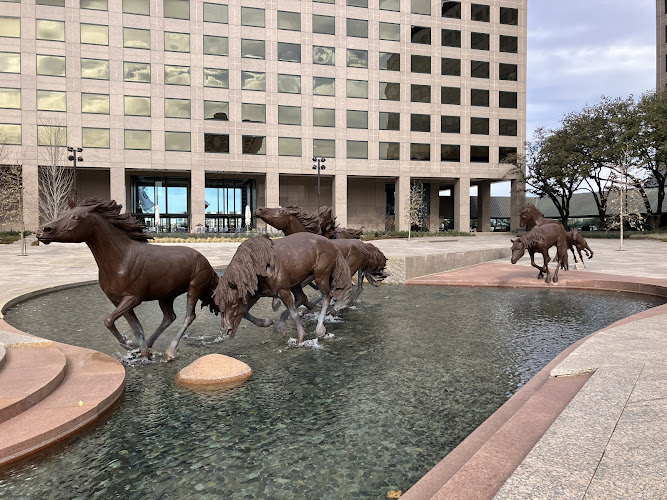
The Mustangs of Las Colinas sculpture and its small but thoughtful museum and visitors center present a striking study in motion, scale, and public art. Commissioned as a focal point for Las Colinas in Irving, Texas, the installation features nine bronze mustangs that appear to gallop through a shallow stream across Williams Square plaza. Up close, the horses are not tame decorative pieces; they are full of intent and energy, captured in mid-stride with splashes of water at their hooves. People who stroll the plaza often stop and stand a while, not because there is a sign that says to, but because the scene has a way of pulling attention—there is sound, light, physics, and a kind of stubborn life in bronze.
The museum adjacent to the plaza is compact and focused. It offers a short film and several exhibits about the sculptor and the process behind creating the nine life-like mustangs. The material on display explores how the artist studied anatomy and movement, the casting process for large bronze forms, and how public art interacts with urban design. For travelers who enjoy the behind-the-scenes angle, the museum gives context that makes the sculptures feel less like a postcard moment and more like the end result of an ambitious creative experiment.
Accessibility is well considered. The visitors center and museum provide a wheelchair accessible entrance and accessible parking, making it possible for a wider range of people to experience the artwork without awkward detours. The plaza itself has gentle ramps and paved areas around the water features; still, those with mobility concerns will want to note that some vantage points require short walks over granite surfaces that can be uneven in spots.
There is a tactile quality to the whole place. The sound of water amplifies the illusion of gallop. Sunlight and clouds change the bronze from burnished gold to a darker, more introspective tone, and evenings bring an altogether different personality when lights catch the curves of muscle and mane. Families like to time visits so toddlers can splash at the edges while adults sip coffee from nearby cafes. Photographers—both serious and casual—return repeatedly because every hour produces a new tone and a slightly different composition.
Not everything is perfect. At peak times the plaza can get crowded, and that does put a damper on contemplative moments; the human energy competes with the wild energy the sculptures try to convey. Signage is helpful but sometimes minimal for first-time visitors who want detailed historical background without sitting through the film. Parking in the immediate area is generally fine but occasionally tight, especially around big events in Las Colinas. Still, those little frustrations rarely outweigh the overall experience; many travelers say it is worth rearranging a schedule to include the visit.
For people who enjoy public art that interacts with its environment, the Mustangs of Las Colinas offers something distinctly memorable. The artist’s attention to anatomical detail and dramatic composition means the horses look believable at any distance. Children will name their favorites and adults will argue about which horse is mid-jump. A longtime North Texas resident remembers the first time he saw the installation and being surprised by how much it resembled a living herd—he walked away thinking about motion as a sculpture more than he had before. That memory illustrates why the site keeps drawing repeat visitors; it rewards time and attention.
Practical considerations are part of the texture here. The museum’s film is short but worth watching for context; it helps viewers appreciate why the horses were designed the way they were and how the artist worked with engineers and local planners. Information panels in the visitors center summarize key facts about the sculptor, the bronze-casting process, and the plaza’s water system, which is a deliberate part of the composition. Seasonally, weather affects both comfort and visuals—brilliant blue skies make for high-contrast photos while overcast days emphasize the sculptural form without strong shadows.
Finally, it’s a place that rewards slowing down. Even if a traveler arrives with only a short gap between meetings or attractions, the plaza and museum provide a memorable, compact cultural stop that speaks to art, craft, and civic ambition. For those who like their sightseeing with texture and a hint of local pride, the Mustangs of Las Colinas is a stop that quietly insists on being noticed.
Key Features
More Details
Updated August 30, 2025
Table of Contents
- Description
- Key Highlights
- Location
- Places to Stay Near The Mustangs of Las Colinas Sculpture and Museum and Visitors Center
- Find and Book a Tour
- Explore More Travel Guides
- Nearby Places You Might Like
- Traveler Reviews for The Mustangs of Las Colinas Sculpture and Museum and Visitors Center
- Share Your Experience
Description
The Mustangs of Las Colinas sculpture and its small but thoughtful museum and visitors center present a striking study in motion, scale, and public art. Commissioned as a focal point for Las Colinas in Irving, Texas, the installation features nine bronze mustangs that appear to gallop through a shallow stream across Williams Square plaza. Up close, the horses are not tame decorative pieces; they are full of intent and energy, captured in mid-stride with splashes of water at their hooves. People who stroll the plaza often stop and stand a while, not because there is a sign that says to, but because the scene has a way of pulling attention—there is sound, light, physics, and a kind of stubborn life in bronze.
The museum adjacent to the plaza is compact and focused. It offers a short film and several exhibits about the sculptor and the process behind creating the nine life-like mustangs. The material on display explores how the artist studied anatomy and movement, the casting process for large bronze forms, and how public art interacts with urban design. For travelers who enjoy the behind-the-scenes angle, the museum gives context that makes the sculptures feel less like a postcard moment and more like the end result of an ambitious creative experiment.
Accessibility is well considered. The visitors center and museum provide a wheelchair accessible entrance and accessible parking, making it possible for a wider range of people to experience the artwork without awkward detours. The plaza itself has gentle ramps and paved areas around the water features; still, those with mobility concerns will want to note that some vantage points require short walks over granite surfaces that can be uneven in spots.
There is a tactile quality to the whole place. The sound of water amplifies the illusion of gallop. Sunlight and clouds change the bronze from burnished gold to a darker, more introspective tone, and evenings bring an altogether different personality when lights catch the curves of muscle and mane. Families like to time visits so toddlers can splash at the edges while adults sip coffee from nearby cafes. Photographers—both serious and casual—return repeatedly because every hour produces a new tone and a slightly different composition.
Not everything is perfect. At peak times the plaza can get crowded, and that does put a damper on contemplative moments; the human energy competes with the wild energy the sculptures try to convey. Signage is helpful but sometimes minimal for first-time visitors who want detailed historical background without sitting through the film. Parking in the immediate area is generally fine but occasionally tight, especially around big events in Las Colinas. Still, those little frustrations rarely outweigh the overall experience; many travelers say it is worth rearranging a schedule to include the visit.
For people who enjoy public art that interacts with its environment, the Mustangs of Las Colinas offers something distinctly memorable. The artist’s attention to anatomical detail and dramatic composition means the horses look believable at any distance. Children will name their favorites and adults will argue about which horse is mid-jump. A longtime North Texas resident remembers the first time he saw the installation and being surprised by how much it resembled a living herd—he walked away thinking about motion as a sculpture more than he had before. That memory illustrates why the site keeps drawing repeat visitors; it rewards time and attention.
Practical considerations are part of the texture here. The museum’s film is short but worth watching for context; it helps viewers appreciate why the horses were designed the way they were and how the artist worked with engineers and local planners. Information panels in the visitors center summarize key facts about the sculptor, the bronze-casting process, and the plaza’s water system, which is a deliberate part of the composition. Seasonally, weather affects both comfort and visuals—brilliant blue skies make for high-contrast photos while overcast days emphasize the sculptural form without strong shadows.
Finally, it’s a place that rewards slowing down. Even if a traveler arrives with only a short gap between meetings or attractions, the plaza and museum provide a memorable, compact cultural stop that speaks to art, craft, and civic ambition. For those who like their sightseeing with texture and a hint of local pride, the Mustangs of Las Colinas is a stop that quietly insists on being noticed.
Key Highlights
The Mustangs of Las Colinas Sculpture and Museum and Visitors Center
Location
Places to Stay Near The Mustangs of Las Colinas Sculpture and Museum and Visitors Center
Find and Book a Tour
Explore More Travel Guides
No reviews found! Be the first to review!
Traveler Reviews for The Mustangs of Las Colinas Sculpture and Museum and Visitors Center
There are no reviews yet. Be the first one to write one.
Have you visited The Mustangs of Las Colinas Sculpture and Museum and Visitors Center? Help other travelers by sharing your review.
You Might Also Like

Bombay Chowpatty
Gondola Adventures, Inc. - Irving
Irving Heritage House
Find Accommodations Nearby
Recommended Tours & Activities
Visitor Reviews
There are no reviews yet. Be the first one to write one.
Share Your Experience
Have you visited The Mustangs of Las Colinas Sculpture and Museum and Visitors Center? Help other travelers by leaving a review.