
Valley of Gangala
About Valley of Gangala
Description
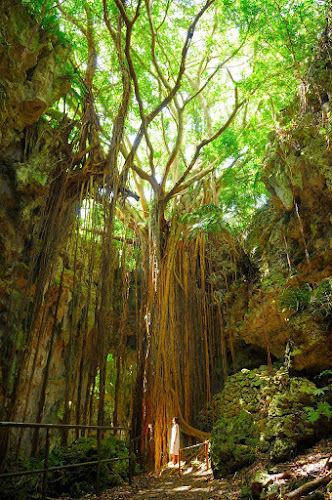
The Valley of Gangala is one of those places that quietly humbles you. It’s not the kind of spot that screams for attention, but rather whispers stories of ancient earth and time itself. Formed when a massive limestone cave collapsed hundreds of thousands of years ago, the valley now stretches as a lush subtropical forest, alive with banyan trees whose roots twist and curl like something out of a dream. It’s located in the southern part of Okinawa’s main island, just a short drive from Naha, but stepping into it feels like crossing into another world entirely.
Walking through the valley, you can almost feel the pulse of the island’s deep history. Archaeologists have found traces of prehistoric humans nearby, which makes sense—this place feels ancient, sacred even. The guided walking tour winds about a kilometer through the forest, taking roughly an hour and twenty minutes, but it’s not just a walk. It’s an experience that blends nature, culture, and a bit of mystery. The air is thick with humidity and the earthy scent of moss, and the light filters through the canopy in a way that makes everything glow softly green.
Now, I’ll be honest—this isn’t your typical tourist attraction. You can’t just wander in; you’ve got to book in advance because entry is only allowed with a guided tour. But that’s part of what makes it special. The guides are locals who genuinely care about the place, and they share stories that make the valley come alive. Some talk about the spiritual significance of the banyan trees, believed to house spirits in Okinawan folklore. Others point out fossils or rock formations that look like they’ve been sculpted by time itself.
And then there’s the cave café—yes, a café inside a limestone cave. It’s called the Cave Café, and it’s exactly as cool as it sounds. Sitting there with a cold drink, surrounded by ancient stone walls, you can’t help but feel small in the best way possible. It’s one of those rare places where nature and humanity coexist beautifully, each respecting the other’s space.
Key Features
- Guided tours through a subtropical forest formed from a collapsed limestone cave
- Home to ancient archaeological sites linked to early human habitation in Okinawa
- A scenic 1-kilometer walking trail with natural rock formations and banyan trees
- Cave Café located inside a natural limestone cavern
- Educational insights into Okinawan spirituality, geology, and ecology
- Family-friendly environment suitable for children
- Free parking and modern restrooms available on-site
- Payments accepted by credit card, PayPay, and Rakuten Pay
Best Time to Visit
If there’s one thing I’ve learned after a few trips to Okinawa, it’s that timing matters. The Valley of Gangala is open year-round, but the experience changes with the seasons. Spring (March to May) is probably the sweet spot—the weather’s warm but not too humid, and the forest is bursting with life. Summer, on the other hand, can be intense. The humidity can hit you like a wall, and the mosquitoes are relentless, but if you don’t mind sweating a little, the dense greenery is absolutely stunning.
Autumn (September to November) is another great time, especially if you want fewer crowds. The air feels fresher, and the golden light filtering through the trees makes for perfect photos. Winter is mild here—it rarely gets cold enough for jackets—so it’s still worth visiting if you’re escaping colder climates. Just keep in mind that Okinawa’s rainy season runs from May to June, and while the showers make the valley look extra lush, some trails can get slippery.
Personally, I’d say go early in the morning. The tours are smaller, the air’s cooler, and there’s something magical about hearing the forest wake up around you. The birds, the rustling leaves, the soft drip of water echoing off stone—it’s unforgettable.
How to Get There
Getting to the Valley of Gangala is pretty straightforward. It’s about a 30-minute drive from Naha Airport, and the route takes you through some of Okinawa’s most scenic countryside. If you’re driving, you’ll be happy to know there’s a free parking lot on-site, which is a huge plus. The roads are well-marked, and most rental cars in Okinawa come with GPS that recognizes the location easily.
Public transportation is possible but a bit trickier. You can take a bus from Naha toward Nanjo City and get off near Gyokusendo Cave at Okinawa World, which is right across the road from the Valley of Gangala. From there, it’s just a short walk. Still, if you’re traveling in a group or with kids, renting a car is definitely the easiest and most flexible option.
When you arrive, you’ll check in at the Cave Café area, which doubles as the reception. The staff are friendly and helpful, and even if your Japanese is limited, they’ll make sure you’re taken care of. Tours are conducted in Japanese, but English audio guides are available, and honestly, the visuals speak for themselves.
Tips for Visiting
Alright, here’s the part where I tell you what I wish someone had told me before my first visit. First off, wear good shoes. The trail isn’t particularly hard, but it’s uneven and can get slippery after rain. Sneakers or hiking sandals are perfect. Forget the flip-flops—trust me on this one.
Second, bring water. It’s a guided tour, and while it’s not strenuous, the humidity can sneak up on you. There’s a small shop near the entrance where you can grab a drink, but it’s always smart to carry your own bottle. Oh, and bug spray—don’t even think about skipping it. The forest is beautiful, but the mosquitoes are part of the deal.
Photography is allowed, and honestly, you’ll want to take a lot of pictures. The light filtering through the trees, the massive roots wrapping around boulders—it’s all incredibly photogenic. But try to take a few moments to just look around without your camera. There’s something grounding about being surrounded by so much ancient life.
One more thing: make your reservation early. The tours are limited to small groups, and they fill up fast, especially on weekends and holidays. You can book online or call ahead, and it’s worth doing so at least a few days in advance. They also accept digital payments like PayPay and Rakuten Pay, which is super convenient if you’re traveling cash-light.
And if you’re traveling with kids, don’t hesitate to bring them along. The valley is surprisingly family-friendly, and children often love the sense of adventure that comes with walking through a real cave and forest. Just keep an eye on them, as there are some steep sections.
After your tour, take a break at the Cave Café. The iced coffee there hits differently after an hour of walking in the Okinawan heat. Sometimes they even host live music events inside the cave, which turns the whole place into a natural concert hall. I caught one once—just a local guitarist playing soft tunes that echoed beautifully off the stone walls. It’s the kind of simple, magical moment that sticks with you long after you’ve left.
So, if you’re planning a trip to Okinawa and want to experience something that feels both ancient and alive, the Valley of Gangala should absolutely be on your list. It’s a place where nature, history, and spirituality intertwine, and where every step feels like walking through a story written by the earth itself. Take your time, breathe deeply, and let the valley show you what patience and time can create.
Key Features
- Guided tours through a subtropical forest formed from a collapsed limestone cave
- Home to ancient archaeological sites linked to early human habitation in Okinawa
- A scenic 1-kilometer walking trail with natural rock formations and banyan trees
- Cave Café located inside a natural limestone cavern
- Educational insights into Okinawan spirituality, geology, and ecology
- Family-friendly environment suitable for children
- Free parking and modern restrooms available on-site
- Payments accepted by credit card, PayPay, and Rakuten Pay
More Details
Updated December 1, 2025
Table of Contents
Description
The Valley of Gangala is one of those places that quietly humbles you. It’s not the kind of spot that screams for attention, but rather whispers stories of ancient earth and time itself. Formed when a massive limestone cave collapsed hundreds of thousands of years ago, the valley now stretches as a lush subtropical forest, alive with banyan trees whose roots twist and curl like something out of a dream. It’s located in the southern part of Okinawa’s main island, just a short drive from Naha, but stepping into it feels like crossing into another world entirely.
Walking through the valley, you can almost feel the pulse of the island’s deep history. Archaeologists have found traces of prehistoric humans nearby, which makes sense—this place feels ancient, sacred even. The guided walking tour winds about a kilometer through the forest, taking roughly an hour and twenty minutes, but it’s not just a walk. It’s an experience that blends nature, culture, and a bit of mystery. The air is thick with humidity and the earthy scent of moss, and the light filters through the canopy in a way that makes everything glow softly green.
Now, I’ll be honest—this isn’t your typical tourist attraction. You can’t just wander in; you’ve got to book in advance because entry is only allowed with a guided tour. But that’s part of what makes it special. The guides are locals who genuinely care about the place, and they share stories that make the valley come alive. Some talk about the spiritual significance of the banyan trees, believed to house spirits in Okinawan folklore. Others point out fossils or rock formations that look like they’ve been sculpted by time itself.
And then there’s the cave café—yes, a café inside a limestone cave. It’s called the Cave Café, and it’s exactly as cool as it sounds. Sitting there with a cold drink, surrounded by ancient stone walls, you can’t help but feel small in the best way possible. It’s one of those rare places where nature and humanity coexist beautifully, each respecting the other’s space.
Key Features
- Guided tours through a subtropical forest formed from a collapsed limestone cave
- Home to ancient archaeological sites linked to early human habitation in Okinawa
- A scenic 1-kilometer walking trail with natural rock formations and banyan trees
- Cave Café located inside a natural limestone cavern
- Educational insights into Okinawan spirituality, geology, and ecology
- Family-friendly environment suitable for children
- Free parking and modern restrooms available on-site
- Payments accepted by credit card, PayPay, and Rakuten Pay
Best Time to Visit
If there’s one thing I’ve learned after a few trips to Okinawa, it’s that timing matters. The Valley of Gangala is open year-round, but the experience changes with the seasons. Spring (March to May) is probably the sweet spot—the weather’s warm but not too humid, and the forest is bursting with life. Summer, on the other hand, can be intense. The humidity can hit you like a wall, and the mosquitoes are relentless, but if you don’t mind sweating a little, the dense greenery is absolutely stunning.
Autumn (September to November) is another great time, especially if you want fewer crowds. The air feels fresher, and the golden light filtering through the trees makes for perfect photos. Winter is mild here—it rarely gets cold enough for jackets—so it’s still worth visiting if you’re escaping colder climates. Just keep in mind that Okinawa’s rainy season runs from May to June, and while the showers make the valley look extra lush, some trails can get slippery.
Personally, I’d say go early in the morning. The tours are smaller, the air’s cooler, and there’s something magical about hearing the forest wake up around you. The birds, the rustling leaves, the soft drip of water echoing off stone—it’s unforgettable.
How to Get There
Getting to the Valley of Gangala is pretty straightforward. It’s about a 30-minute drive from Naha Airport, and the route takes you through some of Okinawa’s most scenic countryside. If you’re driving, you’ll be happy to know there’s a free parking lot on-site, which is a huge plus. The roads are well-marked, and most rental cars in Okinawa come with GPS that recognizes the location easily.
Public transportation is possible but a bit trickier. You can take a bus from Naha toward Nanjo City and get off near Gyokusendo Cave at Okinawa World, which is right across the road from the Valley of Gangala. From there, it’s just a short walk. Still, if you’re traveling in a group or with kids, renting a car is definitely the easiest and most flexible option.
When you arrive, you’ll check in at the Cave Café area, which doubles as the reception. The staff are friendly and helpful, and even if your Japanese is limited, they’ll make sure you’re taken care of. Tours are conducted in Japanese, but English audio guides are available, and honestly, the visuals speak for themselves.
Tips for Visiting
Alright, here’s the part where I tell you what I wish someone had told me before my first visit. First off, wear good shoes. The trail isn’t particularly hard, but it’s uneven and can get slippery after rain. Sneakers or hiking sandals are perfect. Forget the flip-flops—trust me on this one.
Second, bring water. It’s a guided tour, and while it’s not strenuous, the humidity can sneak up on you. There’s a small shop near the entrance where you can grab a drink, but it’s always smart to carry your own bottle. Oh, and bug spray—don’t even think about skipping it. The forest is beautiful, but the mosquitoes are part of the deal.
Photography is allowed, and honestly, you’ll want to take a lot of pictures. The light filtering through the trees, the massive roots wrapping around boulders—it’s all incredibly photogenic. But try to take a few moments to just look around without your camera. There’s something grounding about being surrounded by so much ancient life.
One more thing: make your reservation early. The tours are limited to small groups, and they fill up fast, especially on weekends and holidays. You can book online or call ahead, and it’s worth doing so at least a few days in advance. They also accept digital payments like PayPay and Rakuten Pay, which is super convenient if you’re traveling cash-light.
And if you’re traveling with kids, don’t hesitate to bring them along. The valley is surprisingly family-friendly, and children often love the sense of adventure that comes with walking through a real cave and forest. Just keep an eye on them, as there are some steep sections.
After your tour, take a break at the Cave Café. The iced coffee there hits differently after an hour of walking in the Okinawan heat. Sometimes they even host live music events inside the cave, which turns the whole place into a natural concert hall. I caught one once—just a local guitarist playing soft tunes that echoed beautifully off the stone walls. It’s the kind of simple, magical moment that sticks with you long after you’ve left.
So, if you’re planning a trip to Okinawa and want to experience something that feels both ancient and alive, the Valley of Gangala should absolutely be on your list. It’s a place where nature, history, and spirituality intertwine, and where every step feels like walking through a story written by the earth itself. Take your time, breathe deeply, and let the valley show you what patience and time can create.
Key Highlights
- Guided tours through a subtropical forest formed from a collapsed limestone cave
- Home to ancient archaeological sites linked to early human habitation in Okinawa
- A scenic 1-kilometer walking trail with natural rock formations and banyan trees
- Cave Café located inside a natural limestone cavern
- Educational insights into Okinawan spirituality, geology, and ecology
- Family-friendly environment suitable for children
- Free parking and modern restrooms available on-site
- Payments accepted by credit card, PayPay, and Rakuten Pay
Location
Places to Stay Near Valley of Gangala
Find and Book a Tour
Explore More Travel Guides
No reviews found! Be the first to review!
Traveler Reviews for Valley of Gangala
There are no reviews yet. Be the first one to write one.
Have you visited Valley of Gangala? Help other travelers by sharing your review.
You Might Also Like
Okinawa World
Chinen Castle Ruins
Uwaga Jungle
Find Accommodations Nearby
Recommended Tours & Activities
Visitor Reviews
There are no reviews yet. Be the first one to write one.
Share Your Experience
Have you visited Valley of Gangala? Help other travelers by leaving a review.