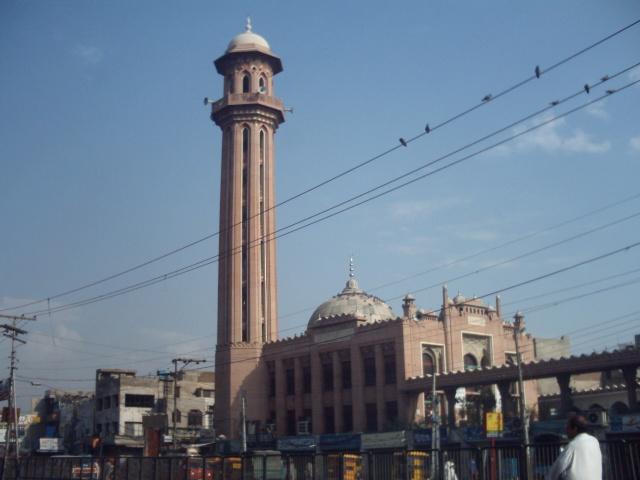
Lohari Gate is a historical landmark and one of the thirteen original entrances to the Walled City of Lahore, Pakistan.
Highlights & Key Features
Living Craft Heritage: Scores of workshops still shape wrought‑iron gates, brass hookah bases and hand‑chased copper trays—an echo of the blacksmith guilds that named the gate.
Neevin (Low) Mosque: A subterranean 1460 CE Lodi‑era mosque—descend 16 worn steps to a prayer hall permanently shaded and surprisingly resonant.
Lohari Mandi & Nageena Bazaar: A sensory overload—spices stacked like pyramids, gem traders evaluating Burmese rubies under a flashlight, and the perpetual whirr of antique sewing machines.
Culinary Street Theatre: Pre‑dawn nihari, mid‑morning halwa‑puri, and midnight goat‑kebab skewers; roadside chefs routinely invite curious travellers to stir the broth “for good luck.”
Historic Residences (Havelis): Crumbling wooden balconies with floral jharokas; one haveli allegedly housed legendary ghazal singer Mehdi Hasan during his youth.
Photographic Vantage: Late‑afternoon sun filtering through sandstone creates rich chiaroscuro—ideal for street‑photography buffs craving unfiltered humanity.
Gateway to Heritage Walk: Lohari forms stage one of the popular “13 Gates Trail,” linking Delhi Gate, Bhati Gate, and the iconic Badshahi Mosque.
Visitor Guide & Information
Lohari Gate is a historical landmark and one of the thirteen original entrances to the Walled City of Lahore, Pakistan.
What to Expect
You enter the old city through an iron gate into a dense, historic neighborhood. The area is defined by narrow lanes and the Lahori bazaar. You will see outstanding examples of ancient architecture, including wooden balconies and detailed carvings on doors and windows. The gate itself is a testament to Lahore’s Mughal, Sikh, and British colonial history. The surrounding area is a functioning residential and commercial locality.
Practical Information
The address is 227 Circular Rd in Lahore. You can join a guided tour, which gathers at Fort Road Food Street. A recent tour operated from 11:00 AM to 1:00 PM and cost 2000 Pakistani rupees, which included refreshments. For the most current tour information, you can contact the numbers 0302-4111511 or 0300-3443557.
History & Significance
Lohari Gate is considered one of the oldest gates of the old city. Some historians believe the name originates from the old city of Lahore being located near Ichhra, and this gate opened towards that side. The name also relates to “Lohar,” the Punjabi word for blacksmith. The gate and its surrounding structures have witnessed the city’s evolution through multiple historical periods.
Community & Insider Notes
Last modified June 4, 2026
Lohari Gate is a historical landmark and one of the thirteen original entrances to the Walled City of Lahore, Pakistan.
You enter the old city through an iron gate into a dense, historic neighborhood. The area is defined by narrow lanes and the Lahori bazaar. You will see outstanding examples of ancient architecture, including wooden balconies and detailed carvings on doors and windows. The gate itself is a testament to Lahore’s Mughal, Sikh, and British colonial history. The surrounding area is a functioning residential and commercial locality.
Practical Information
The address is 227 Circular Rd in Lahore. You can join a guided tour, which gathers at Fort Road Food Street. A recent tour operated from 11:00 AM to 1:00 PM and cost 2000 Pakistani rupees, which included refreshments. For the most current tour information, you can contact the numbers 0302-4111511 or 0300-3443557.
History & Significance
Lohari Gate is considered one of the oldest gates of the old city. Some historians believe the name originates from the old city of Lahore being located near Ichhra, and this gate opened towards that side. The name also relates to “Lohar,” the Punjabi word for blacksmith. The gate and its surrounding structures have witnessed the city’s evolution through multiple historical periods.
Key Highlights
Living Craft Heritage: Scores of workshops still shape wrought‑iron gates, brass hookah bases and hand‑chased copper trays—an echo of the blacksmith guilds that named the gate.
Neevin (Low) Mosque: A subterranean 1460 CE Lodi‑era mosque—descend 16 worn steps to a prayer hall permanently shaded and surprisingly resonant.
Lohari Mandi & Nageena Bazaar: A sensory overload—spices stacked like pyramids, gem traders evaluating Burmese rubies under a flashlight, and the perpetual whirr of antique sewing machines.
Culinary Street Theatre: Pre‑dawn nihari, mid‑morning halwa‑puri, and midnight goat‑kebab skewers; roadside chefs routinely invite curious travellers to stir the broth “for good luck.”
Historic Residences (Havelis): Crumbling wooden balconies with floral jharokas; one haveli allegedly housed legendary ghazal singer Mehdi Hasan during his youth.
Photographic Vantage: Late‑afternoon sun filtering through sandstone creates rich chiaroscuro—ideal for street‑photography buffs craving unfiltered humanity.
Gateway to Heritage Walk: Lohari forms stage one of the popular “13 Gates Trail,” linking Delhi Gate, Bhati Gate, and the iconic Badshahi Mosque.
Few portals evoke Lahore’s layered story quite like Lohari Gate. Standing on the southern edge of the Walled City, the present brick-and-lime arch dates to an 1864 rebuild under British lieutenant‑governor Sir Robert Montgomery. Yet its soul is far older. Chroniclers trace an 11th‑century timber gateway here on the road toward the then‑suburb of Lohawar / Ichhra, and the name probably nods to the community of skilled lohar (blacksmith) families who forged blades, ploughs, and the fabled Mughal-era armour that once armed imperial caravans. Today’s visitor still hears rhythmic hammering from tiny courtyards, but it mingles with scooter horns, chai gossip, and the sing‑song cries of vendors hawking pomegranate‑red bangles.
Stepping beneath the scalloped arch, travellers swap the broad 21st‑century boulevard for a human‑scaled maze of brick alleys no wider than two outstretched arms. Low sunlight ricochets off polished copperware; cardamom-laced steam curls from nihari cauldrons. Five minutes in and the gate’s reputation as one of the liveliest of Lahore’s thirteen historic portals feels earned—it is part museum, part living bazaar, part culinary playground. And there’s always a surprise. Last winter, a wandering college brass band filled Kucha Shami Hoqan with vintage film tunes, and an elderly shopkeeper clapped along while weighing gemstones in Nageena Bazaar. Moments like that don’t appear in guidebooks; they happen because Lohari Gate breathes.
Architecturally, the gateway melds Mughal influences—pointed arches, recessed panels—with colonial engineering. A marble plaque above the keystone lists the 19th‑century officials who financed the rebuild, while the inner façade shows faint scars from Sikh‑era cannonballs.
A short stroll north reveals the Neevin Mosque, a 15th-century Lodi-period marvel sunk 25 feet below street level; its prayer hall remains cool even in midsummer’s 42°C blaze. Just beyond, the warren opens into Lohari Mandi, reputedly South Asia’s oldest continuous market street. Here, British soldiers once quartered horses; now tailors stitch velvet bridal lehengas beside stalls of Himalayan pink salt lamps. Time, in other words, loops rather than marches.
Key Features
Living Craft Heritage: Scores of workshops still shape wrought‑iron gates, brass hookah bases and hand‑chased copper trays—an echo of the blacksmith guilds that named the gate.
Neevin (Low) Mosque: A subterranean 1460 CE Lodi‑era mosque—descend 16 worn steps to a prayer hall permanently shaded and surprisingly resonant.
Lohari Mandi & Nageena Bazaar: A sensory overload—spices stacked like pyramids, gem traders evaluating Burmese rubies under a flashlight, and the perpetual whirr of antique sewing machines.
Culinary Street Theatre: Pre‑dawn nihari, mid‑morning halwa‑puri, and midnight goat‑kebab skewers; roadside chefs routinely invite curious travellers to stir the broth “for good luck.”
Historic Residences (Havelis): Crumbling wooden balconies with floral jharokas; one haveli allegedly housed legendary ghazal singer Mehdi Hasan during his youth.
Photographic Vantage: Late‑afternoon sun filtering through sandstone creates rich chiaroscuro—ideal for street‑photography buffs craving unfiltered humanity.
Gateway to Heritage Walk: Lohari forms stage one of the popular “13 Gates Trail,” linking Delhi Gate, Bhati Gate, and the iconic Badshahi Mosque.
Winter (November–February) rewards travellers with crisp mornings around 12 °C and sunlit afternoons perfect for unhurried lane‑hopping. Shoulder months of October and March also shine: mango‑gold light, manageable crowds, and minimal smog. Avoid late‑June through August if high humidity saps your energy fast. That said, monsoon cloudbursts can drape the gate in cinematic sheen; photographers adore the mirror‑slick cobbles. Fridays brim with devotion-driven traffic heading to Juma prayers, so explorers preferring quieter wanderings might pick Tuesday or Wednesday mornings.
An aside: a certain writer once braved a July noon only because a local sweet‑maker swore his chilled falooda could “defeat the heat.” He was right… mostly. Yet the memory of slurping rose‑syrup noodles while sweat trickled down the spine remains oddly delightful. Moral? Even in the off‑season, Lohari Gate offers pay‑offs for curiosity‑led souls.
How to Get There
Most visitors start from Old Lahore’s Circular Road. The gate’s ochre arch rises roughly 1 km west of Delhi Gate, at GPS coordinates 31.5773° N, 74.3133° E. From Allama Iqbal International Airport, it’s a 40‑minute (traffic willing) rideshare. Solo adventurers often hop the Orange Line metro to Anarkali station, then negotiate a five‑minute autorickshaw ride—expect to pay the equivalent of USD 0.60; bargain with a grin, not a glare.
For a flavour‑dense approach, join the weekend heritage shuttle run by the Walled City of Lahore Authority (tickets usually sold near Fort Road Food Street). The bus drops groups right beside the gate’s outer portcullis grooves—one can still spot iron hinge markings where timber doors once swung shut during sieges.
Cyclists should note that secure bike parking sits across Circular Road, next to the police kiosk; bring your padlock. And, yes, pedestrian purists often stroll in from Bhati Chowk, tracing the old city wall contour; it’s an evocative 20‑minute walk if you relish weaving through fruit carts and the occasional goat procession.
Dress & Etiquette: Shoulders and knees covered means smoother smiles from shopkeepers and mosque custodians alike. Slip‑on shoes ease mosque entry; plastic bags for footwear are handed out near the Neevin Mosque’s staircase.
Timing the Feast: Breakfast crowds surge from 6 am to 9 am; by 10 am, the nihari cauldrons sell out. Late afternoon (3‑5 pm) showcases silversmith demos, and 8 pm onwards is prime kebab hour—save stomach space.
Bargaining 101: Quoted gem prices often start 20 % high; counter with a friendly laugh and a 30 % dip, settle around 15 % below first ask. Remember: a tiny conversation in Punjabi—“ki haal ae?” (“how are you?”)—melts ice faster than cash ever will.
Stay Orientated: Cell signal sometimes falters in the deepest lanes. Download an offline map or mentally bookmark waypoints: the domed Muslim Masjid, the bright‑blue façade of Mandir Nihal Chand, and the chili‑red signage of Sutar Mandi Bazaar all serve as handy visual compasses.
Mind the Rickshaws: The lanes may look pedestrian‑only, but nimble three‑wheelers still dart through. Stick to wall edges when you hear that unmistakable two‑stroke growl.
Photography Courtesy: Ask before shooting portraits—most artisans oblige, some even pose theatrically, but a quick nod of permission keeps the vibe respectful.
Hydration Hack: Pack a reusable water bottle; several public taps run filtered water near Pir Mubarik Ali’s shrine. Plastic waste, sadly, remains a city challenge—being part of the solution earns approving nods.
Beyond the Gate: If time permits, continue west to Bhati Gate for poet‑studded literary cafés, or east to Delhi Gate, where spice traders swirl cinnamon clouds into the air. Lohari Gate may feel self‑contained, but it’s also a hinge linking past, present, and the rest of Lahore’s enthralling labyrinth.
And that’s the magic in a nutshell—or perhaps in a centuries‑old iron hinge. One moment, the traveller is dodging rickshaws, the next she’s tracing the embossed Arabic calligraphy on a 400‑year‑old door, feeling unexpectedly small yet wonderfully plugged into humanity’s grand, messy timeline. Lohari Gate does that. It shrinks one’s ego and enlarges one’s curiosity in the same breath. So pack light, walk slow, and let the old blacksmiths’ gateway work its quiet alchemy.
Stay22 provides this accommodation search. We may earn a commission if you book through it; verify current prices and terms with the provider.
🗺️
Interactive accommodation map requires marketing cookies to display live rates.
Recommended Experiences & Activities
GetYourGuide provides this tour inventory. We may earn a commission if you book through it; verify current availability, prices, and terms with the provider.
Top Viator Experiences & Guided Tours in Lahore
We may earn a commission if you book through links on this page at no extra cost to you. All tours feature verified customer reviews and flexible cancellation options.