
Kapliczka
About Kapliczka
Key Features
More Details
Updated April 15, 2024
## Kapliczka (Wayside Shrine) in Bielsko-Biała: A Small Stop With Big Cultural Weight
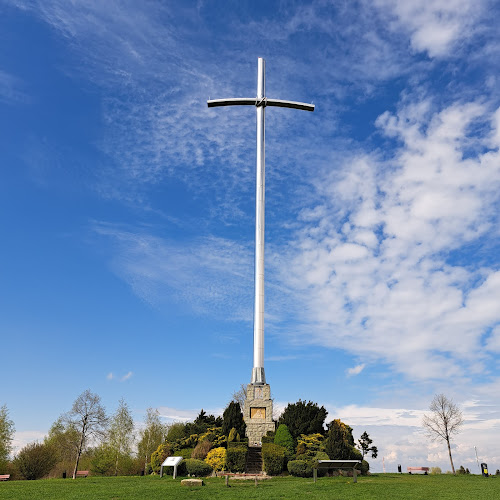
At 49.7857716, 19.0909918—on an unnamed road in Bielsko-Biała, Poland—you’ll find a place labeled simply “Kapliczka” (a small roadside shrine). It’s the kind of micro-landmark that won’t take much time, but can add real texture to a day in southern Poland: folk devotion, local memory, and the way religion has been woven into public space for centuries.
This is not the sort of attraction you “do” in the theme-park sense. It’s a pause. A clue. A living tradition that still shows up at field edges, lane bends, crossroads, and village boundaries—especially in historically Catholic regions of Central and Eastern Europe.
—
## What “Kapliczka” Means (and Why Poland Has So Many)
In Polish, kapliczka is a diminutive form related to kaplica (chapel), and in practice it commonly refers to a wayside/roadside shrine (przydrożna kapliczka).
A wayside shrine is typically a small structure or shelter that holds a religious image or figure and is placed near a road or path—sometimes in settlements, often out in the open.
### Why they exist (historically and socially)
Polish wayside shrines have layered meanings. Founders may build them to:
– express gratitude, penance, or request protection for the living
– commemorate an event seen as spiritually significant
– honor a patron figure within local devotional practice Folklife Center
They also function as cultural markers—quietly signaling where communities once began/ended, where travel felt risky, or where memory needed a physical anchor.
—
## Why This Matters Specifically in Bielsko-Biała
Bielsko-Biała sits in southern Poland, just north of the Beskid Mountains, and the broader area is strongly associated with outdoor routes and mountain foothill communities. Poland
A local write-up on the city’s shrines notes that Bielsko-Biała does not have a huge number of preserved kapliczki, and that many are found on the outer districts—areas that were once separate settlements (examples given include Straconka, Hałcnów, Komorowice, Wapienica).
So when you see a “Kapliczka” pinned on a quieter road here, you’re likely encountering a remnant of that older settlement pattern—small sacred objects persisting at the edges where daily life historically met fields, forest, and route networks.
—
## How to Visit Kapliczka (49.7857716, 19.0909918) Without Overthinking It
Because your listing data only provides an unnamed road and coordinates, treat this as a micro-stop you navigate to precisely.
### Practical navigation tips
– Use the coordinates (49.7857716, 19.0909918) rather than searching the name alone, since “Kapliczka” is a generic label used widely in Poland.
– Expect no formal entrance and no staffed presence (typical for wayside shrines).
– If you arrive and it feels like you’re near someone’s home or farmland access, treat the shrine as a view-from-the-road site—don’t cross fences or enter private land.
### Time budget
– Plan 5–15 minutes unless you’re photographing thoughtfully or pairing it with a longer walk/drive.
—
## What to Do Once You’re There
A kapliczka visit is less about “activities” and more about reading the landscape.
### Look for context clues
Even without knowing the shrine’s dedication (which varies widely), you can still observe:
– placement logic: bend, junction, boundary line, small rise in the road
– maintenance signals: fresh flowers, candles, seasonal decoration (often indicates active local care) Folklife Center
– material and form: niches, small roofed housings, masonry pillars—common patterns across Central European roadside shrines
### Photography that respects the site
– Keep shots wide first: shrine + road + surrounding terrain (this is where meaning often lives).
– Avoid close-ups that turn devotional objects into props—especially if there are signs of recent offerings. Folklife Center
—
## Etiquette and Inclusivity: Visiting a Living Religious Tradition
Even if you’re not religious, it’s smart to treat kapliczki as active cultural-religious spaces, not abandoned artifacts.
– Keep noise low; don’t climb on structures or move offerings. Folklife Center
– If locals are present, a simple respectful distance is usually the best move.
– Accessibility varies: many wayside shrines are roadside but may have uneven ground or no walkway. (If you need step-free access, plan to view from the road edge.)
This approach keeps the visit welcoming for everyone—religious, nonreligious, culturally curious—without forcing assumptions onto the place.
—
## Pair It With Nearby Bielsko-Biała Highlights (So the Stop Feels “Worth It”)
If you’re building a half-day or full-day plan in Bielsko-Biała, a kapliczka stop works best as contrast: tiny folk landmark + bigger city/mountain sights.
Consider pairing with:
– Szyndzielnia Cable Car / mountain access (a well-known local draw for views and trails)
– Bielsko-Biała Museum and Castle (popular cultural stop listed in mainstream guides)
– A walk-oriented look at the city’s character and history (the city has been known by its current combined name since January 1, 1951, when Bielsko and Biała merged) Poland
This combo makes the kapliczka feel like part of a coherent story: civic history + foothill landscape + intimate roadside spirituality. Poland
—
## Data Checks (What Could Be Outdated or Misleading)
A few things to treat as “verify before you go”:
– Star ratings for small landmarks can swing quickly due to low review counts; don’t over-weight a perfect score for a niche listing.
– “Tourist attraction” is often a platform category applied broadly—it doesn’t necessarily mean signage, facilities, or parking.
– If you’re relying on map pins for an unnamed road, confirm you have the right spot using coordinates and satellite view.
—
## Internal Link Opportunities for RealJourneyTravels.com
You asked for two internal links; I can’t verify what pages already exist on your site, so here are two contextual link targets you can wire up to existing (or planned) content:
– Bielsko-Biała travel guide (city overview + logistics + top sights like Szyndzielnia)
– Poland wayside shrines / cultural traditions guide (kapliczki, crosses, folk religion, photography etiquette) Folklife Center
If you want, I can format these as exact internal URLs once you share your Poland/Bielsko-Biała permalink pattern.
—
## Quick Reference
– Place: Kapliczka (wayside shrine)
– City: Bielsko-Biała, Poland
– Coordinates: 49.7857716, 19.0909918
– Best for: cultural texture, quiet photography, understanding local devotional landscapes
Table of Contents
Key Highlights
Kapliczka
Location
Places to Stay Near Kapliczka
Find and Book a Tour
Explore More Travel Guides
No reviews found! Be the first to review!
Traveler Reviews for Kapliczka
There are no reviews yet. Be the first one to write one.
Have you visited Kapliczka? Help other travelers by sharing your review.
You Might Also Like
Trzy Lipki
City Tourist Information Center

Park Cygański Las w Bielsku-Białej
Find Accommodations Nearby
Recommended Tours & Activities
Visitor Reviews
There are no reviews yet. Be the first one to write one.
Share Your Experience
Have you visited Kapliczka? Help other travelers by leaving a review.