
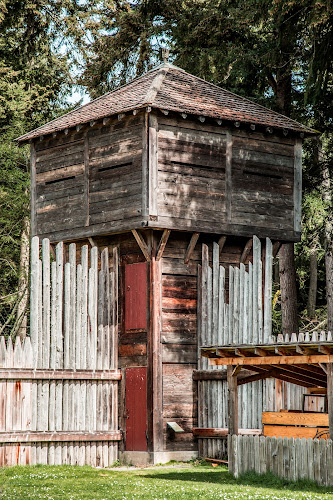
Fort Nisqually Living History Museum
About Fort Nisqually Living History Museum
Description
The Fort Nisqually Living History Museum recreates a slice of 19th century Puget Sound life with a focus on the Hudsons Bay Company fur trading outpost that once anchored the region. As a reconstructed fort combined with a handful of original structures, the site is designed to help travelers imagine life at the edge of colonial expansion, where trade, agriculture, and local Indigenous communities intersected. The presentation leans heavily on living history: costumed interpreters, hands-on demonstrations, and period-accurate craftwork that bring the trading post, granary, and residential buildings to life. It feels less like a static display and more like a short-time travel experiment — walk in and you can hear the imagined creak of a 19th century boardwalk, smell wood smoke, and watch a blacksmith at work.
Located close to the parklands of Point Defiance Park and the blue sweep of Puget Sound, the museum gives a sense of place that many indoor exhibits can't match. The grounds are compact, which is a mixed blessing: on one hand the small scale makes it easy to explore in a couple of hours and to follow the story through sequential spaces; on the other, some visitors arrive hoping for a sprawling park-level experience and leave feeling like they barely scratched the surface. Still, the site's size forces a kind of concentrated storytelling that works well for families and travelers with limited time.
Interpreters speak in character, demonstrating daily tasks such as grain processing, textile work, and trade negotiations that originally defined the fort's role in the region. These performances are not only theatrical; they are educational. For travelers who come curious about how the Hudsons Bay Company operated on the Pacific coast, or how settlers and local Indigenous groups exchanged goods and knowledge, the museum offers concrete examples and tangible artifacts to anchor abstract history. Visitors can ask questions, watch demonstrations, and in some programs, participate directly in chores and crafts. It is learning by doing — and by watching someone else do the hard work first.
There are two original buildings incorporated into the site, which adds authenticity that reconstructed walls alone cannot provide. These original structures are important to historians and casual visitors alike because they connect the re-creation to physical evidence from the past. Moreover, the reconstructed granary, trading post, and factor's house are arranged to suggest the rhythm of life during the fort's heyday: storage and trade at the center; domestic life and workshops surrounding it. The interpretation touches on trade routes across the Puget Sound, the agricultural experiments carried out by the Hudsons Bay Company, and the transition from a fur trade outpost to a more agrarian community as the 19th century progressed.
Accessibility is taken seriously at the museum. Entrances and parking are wheelchair accessible, restrooms are adapted, and the flat layout of the site makes it easier to move from building to building. Practical amenities include free on-site parking, a small gift shop, and restroom facilities — which, for travelers, is always a relief. There is no full-service restaurant on site, but picnic spots nearby and casual eateries in the Point Defiance area make it easy to pair a morning or afternoon visit with a meal.
Beyond the static displays, the Fort Nisqually Living History Museum runs events and live performances throughout the year. Special programming tends to cluster around summer and seasonal holidays, when volunteers and staff have more chances to stage larger demonstrations, reenactments, and family-focused activities. On some days, musket firings, period cooking, and children’s drills provide sensory highlights that make the history feel immediate. Those live moments are often the most memorable, because they transform the fort from a series of buildings into a shared experience between performer and audience.
For families traveling with children, the site is particularly well suited. Kid-friendly activities are regular features; children can try simple chores, handle reproduction tools under supervision, and engage with costumed interpreters who are practiced at explaining complex history in plain terms. The museum is careful to balance playful learning with respectful presentation of the past, including the difficult conversations around colonization and Indigenous displacement that are part of the fort's story. That balance doesn't always land perfectly — sometimes interpretation leans more heavily on settler narratives — but efforts to include diverse viewpoints have increased in recent programming.
The museum's interpretive angle focuses on several overlapping themes: the commercial power of the Hudsons Bay Company in the Puget Sound region, the everyday labor required to keep a remote outpost functioning, and the interconnected lives of people — Indigenous, British, British-Canadian, and early American settlers — whose communications and commerce shaped the 19th century Northwest. Visitors who are most satisfied tend to be those who arrive with curiosity and an appetite for detail: they read the plaques, speak to interpreters, and follow a conversation from the granary to the trading post.
Practicalities matter here. There is an admission fee, but the experience is compact enough that many travelers consider it good value, especially when special programs are included. The staff and volunteers are the beating heart of the place; their knowledge, passion, and occasional dry humor often elevate the visit. A friendly aside worth noting: people who love small museums will often say this one punches above its weight. Critics who want glossy high-tech displays may be less impressed; the museum intentionally keeps the presentation tactile and human-scale.
One small anecdote that circulates among visitors: on a rain-soaked afternoon, a tour group huddled under a lean-to as an interpreter demonstrated weaving. The weather amplified the feeling of authenticity — the sound of rain on wooden shingles, the smell of wet earth — and the guests later joked that they got the full historical package, including predictable Northwest weather. Little moments like that, mundane and authentic, frequently make the visit stick in memory more than the plainly curated exhibits.
From an SEO and traveler-planning perspective, the Fort Nisqually Living History Museum is often searched alongside Point Defiance Park and other Tacoma museum attractions. Visitors combining a park walk with a museum stop find it an efficient itinerary: explore coastal trails, visit the fort for a couple of hours, then refuel in nearby neighborhoods. The museum also serves as a compact primer on the Hudsons Bay Company's operations on Puget Sound, and for travelers with an interest in the wider Pacific Northwest fur trade, it provides a strong local case study.
There are a few things to keep in mind that casual readers might overlook. First, the museum lives and breathes through volunteers; schedules can vary and some activities are seasonal. Second, while the site is family-friendly and accessible, it is not a substitute for a full-scale living history park — plan expectations accordingly. Finally, because the museum emphasizes authenticity, expect some rough edges: gravel paths, the occasional muddy patch, and a deliberately low-tech presentation. For many travelers, these are not flaws but features; they contribute to an atmosphere that an over-polished exhibit would lose.
In short, the Fort Nisqually Living History Museum is a focused, well-crafted destination for travelers who want to understand a key chapter of Puget Sound history. It offers a tangible connection to the Hudsons Bay Company era, to trading post mechanics, and to the lived realities of people in the mid-19th century. For planners and curious visitors, the site is worth building into a Tacoma day that combines outdoor exploration and compact history, especially for those who prefer hands-on interpretation over high-tech displays. And yes, bring a light jacket. The Northwest does what it wants with the weather, and sometimes that adds to the experience rather than detracts from it.
Key Features
More Details
Updated August 30, 2025
Table of Contents
Description
The Fort Nisqually Living History Museum recreates a slice of 19th century Puget Sound life with a focus on the Hudsons Bay Company fur trading outpost that once anchored the region. As a reconstructed fort combined with a handful of original structures, the site is designed to help travelers imagine life at the edge of colonial expansion, where trade, agriculture, and local Indigenous communities intersected. The presentation leans heavily on living history: costumed interpreters, hands-on demonstrations, and period-accurate craftwork that bring the trading post, granary, and residential buildings to life. It feels less like a static display and more like a short-time travel experiment — walk in and you can hear the imagined creak of a 19th century boardwalk, smell wood smoke, and watch a blacksmith at work.
Located close to the parklands of Point Defiance Park and the blue sweep of Puget Sound, the museum gives a sense of place that many indoor exhibits can’t match. The grounds are compact, which is a mixed blessing: on one hand the small scale makes it easy to explore in a couple of hours and to follow the story through sequential spaces; on the other, some visitors arrive hoping for a sprawling park-level experience and leave feeling like they barely scratched the surface. Still, the site’s size forces a kind of concentrated storytelling that works well for families and travelers with limited time.
Interpreters speak in character, demonstrating daily tasks such as grain processing, textile work, and trade negotiations that originally defined the fort’s role in the region. These performances are not only theatrical; they are educational. For travelers who come curious about how the Hudsons Bay Company operated on the Pacific coast, or how settlers and local Indigenous groups exchanged goods and knowledge, the museum offers concrete examples and tangible artifacts to anchor abstract history. Visitors can ask questions, watch demonstrations, and in some programs, participate directly in chores and crafts. It is learning by doing — and by watching someone else do the hard work first.
There are two original buildings incorporated into the site, which adds authenticity that reconstructed walls alone cannot provide. These original structures are important to historians and casual visitors alike because they connect the re-creation to physical evidence from the past. Moreover, the reconstructed granary, trading post, and factor’s house are arranged to suggest the rhythm of life during the fort’s heyday: storage and trade at the center; domestic life and workshops surrounding it. The interpretation touches on trade routes across the Puget Sound, the agricultural experiments carried out by the Hudsons Bay Company, and the transition from a fur trade outpost to a more agrarian community as the 19th century progressed.
Accessibility is taken seriously at the museum. Entrances and parking are wheelchair accessible, restrooms are adapted, and the flat layout of the site makes it easier to move from building to building. Practical amenities include free on-site parking, a small gift shop, and restroom facilities — which, for travelers, is always a relief. There is no full-service restaurant on site, but picnic spots nearby and casual eateries in the Point Defiance area make it easy to pair a morning or afternoon visit with a meal.
Beyond the static displays, the Fort Nisqually Living History Museum runs events and live performances throughout the year. Special programming tends to cluster around summer and seasonal holidays, when volunteers and staff have more chances to stage larger demonstrations, reenactments, and family-focused activities. On some days, musket firings, period cooking, and children’s drills provide sensory highlights that make the history feel immediate. Those live moments are often the most memorable, because they transform the fort from a series of buildings into a shared experience between performer and audience.
For families traveling with children, the site is particularly well suited. Kid-friendly activities are regular features; children can try simple chores, handle reproduction tools under supervision, and engage with costumed interpreters who are practiced at explaining complex history in plain terms. The museum is careful to balance playful learning with respectful presentation of the past, including the difficult conversations around colonization and Indigenous displacement that are part of the fort’s story. That balance doesn’t always land perfectly — sometimes interpretation leans more heavily on settler narratives — but efforts to include diverse viewpoints have increased in recent programming.
The museum’s interpretive angle focuses on several overlapping themes: the commercial power of the Hudsons Bay Company in the Puget Sound region, the everyday labor required to keep a remote outpost functioning, and the interconnected lives of people — Indigenous, British, British-Canadian, and early American settlers — whose communications and commerce shaped the 19th century Northwest. Visitors who are most satisfied tend to be those who arrive with curiosity and an appetite for detail: they read the plaques, speak to interpreters, and follow a conversation from the granary to the trading post.
Practicalities matter here. There is an admission fee, but the experience is compact enough that many travelers consider it good value, especially when special programs are included. The staff and volunteers are the beating heart of the place; their knowledge, passion, and occasional dry humor often elevate the visit. A friendly aside worth noting: people who love small museums will often say this one punches above its weight. Critics who want glossy high-tech displays may be less impressed; the museum intentionally keeps the presentation tactile and human-scale.
One small anecdote that circulates among visitors: on a rain-soaked afternoon, a tour group huddled under a lean-to as an interpreter demonstrated weaving. The weather amplified the feeling of authenticity — the sound of rain on wooden shingles, the smell of wet earth — and the guests later joked that they got the full historical package, including predictable Northwest weather. Little moments like that, mundane and authentic, frequently make the visit stick in memory more than the plainly curated exhibits.
From an SEO and traveler-planning perspective, the Fort Nisqually Living History Museum is often searched alongside Point Defiance Park and other Tacoma museum attractions. Visitors combining a park walk with a museum stop find it an efficient itinerary: explore coastal trails, visit the fort for a couple of hours, then refuel in nearby neighborhoods. The museum also serves as a compact primer on the Hudsons Bay Company’s operations on Puget Sound, and for travelers with an interest in the wider Pacific Northwest fur trade, it provides a strong local case study.
There are a few things to keep in mind that casual readers might overlook. First, the museum lives and breathes through volunteers; schedules can vary and some activities are seasonal. Second, while the site is family-friendly and accessible, it is not a substitute for a full-scale living history park — plan expectations accordingly. Finally, because the museum emphasizes authenticity, expect some rough edges: gravel paths, the occasional muddy patch, and a deliberately low-tech presentation. For many travelers, these are not flaws but features; they contribute to an atmosphere that an over-polished exhibit would lose.
In short, the Fort Nisqually Living History Museum is a focused, well-crafted destination for travelers who want to understand a key chapter of Puget Sound history. It offers a tangible connection to the Hudsons Bay Company era, to trading post mechanics, and to the lived realities of people in the mid-19th century. For planners and curious visitors, the site is worth building into a Tacoma day that combines outdoor exploration and compact history, especially for those who prefer hands-on interpretation over high-tech displays. And yes, bring a light jacket. The Northwest does what it wants with the weather, and sometimes that adds to the experience rather than detracts from it.
Key Highlights
Fort Nisqually Living History Museum
Location
Places to Stay Near Fort Nisqually Living History Museum
Find and Book a Tour
Explore More Travel Guides
No reviews found! Be the first to review!
Traveler Reviews for Fort Nisqually Living History Museum
There are no reviews yet. Be the first one to write one.
Have you visited Fort Nisqually Living History Museum? Help other travelers by sharing your review.
You Might Also Like
Chihuly Bridge of Glass
Stanley & Seafort's
Kaiser Permanente Tacoma Hear Center and Eye Care
Find Accommodations Nearby
Recommended Tours & Activities
Visitor Reviews
There are no reviews yet. Be the first one to write one.
Share Your Experience
Have you visited Fort Nisqually Living History Museum? Help other travelers by leaving a review.