About Deir el-Bahari

Description

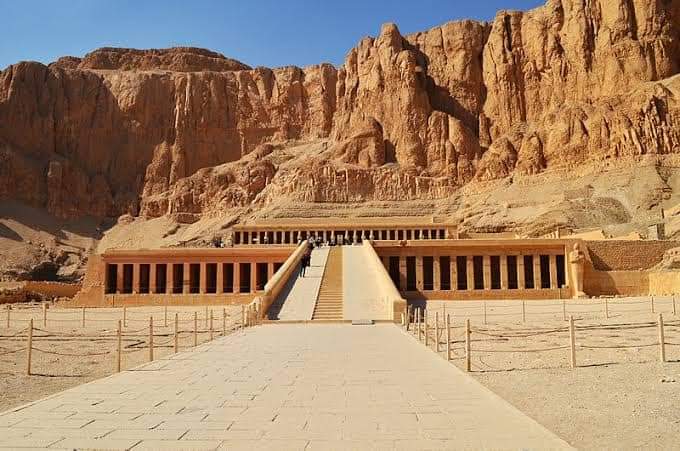
Deir el-Bahari is the kind of place that stops travelers mid-sentence. The cliffs themselves look like a theater curtain pulled back from the desert, revealing terraces, colonnades, chapels, and the remains of royal ambition in stone. On the West Bank of the Nile opposite the city of Luxor, this complex of mortuary temples sits in a natural bay of rock under the pyramid-shaped peak of el-Qurn, part of the Theban Necropolis. It is most famous for the mortuary temple of the female pharaoh Hatshepsut, yet its story starts many centuries earlier and runs like a timeline of Ancient Egypt carved into a mountainside.

The earliest monument here belonged to Mentuhotep II of the Eleventh Dynasty. His temple shifted royal architecture forward after the chaos of the First Intermediate Period, blending tomb and cult center in a way that set the stage for what came next. Fast forward to the New Kingdom, and Hatshepsut, a ruler of rare vision, chose this sacred spot—traditionally associated with Hathor—to build Djeser-Djeseru, the Holy of Holies. With three rising terraces linked by broad ramps, colonnades aligned to the cliffs, and a central axis piercing the mountain to Amun’s sanctuary, the temple of Hatshepsut still reads as clean, serene, and deliberately modern to a contemporary eye. Her chief steward and architect, Senenmut, designed a space that feels synchronized with the geology. And that harmony is no accident—religion, power, and landscape are perfectly braided here.

Visitors often come for the dramatic façade and leave talking about the details: the painted reliefs of Hatshepsut’s divine birth; the scenes of obelisks being hauled for Karnak; and the famous expedition to Punt, a trading journey that introduced exotic goods and imagery to Egypt’s court (look closely—there are myrrh trees and odd stilted houses carved with loving care). There is bold iconography everywhere: statues of Hatshepsut as Osiris clinging to columns; the elegant Chapel of Hathor with the goddess in cow form; and the Anubis chapel reminding everyone of the funerary purpose at the heart of the complex.

And beyond the big showpieces, there are quieter wonders. The sanctuary of Amun—excavated into the rock at the top terrace—marks the end of the temple’s axis, and on certain mornings near the winter solstice the sunrise beams straight along that line, a luminous reminder that ancient builders were astronomers as well as architects. The nearby remains of the mortuary temple of Thutmose III—heir, general, and builder in his own right—tell a subtler story: damage, reuse, and the long life of sacred ground. Meanwhile, excavations around Deir el-Bahari also uncovered the Royal Cache (TT320), a hidden collective tomb where priests protected the mummies of great kings like Seti I and Ramesses II from tomb robbers. This valley, in other words, didn’t just celebrate pharaohs in grandeur; it also sheltered them when times grew rough.

The on-site experience is very much hands-on history. Approaching along the causeway (today aided by a small electric shuttle from the visitor area), travelers step onto wide courtyards that feel ceremonial even now. Colonnades cast crisp shadows that are a gift for photographers. Children tend to be fascinated by animal figures and painted scenes—spotting the Hathor cow or the Punt reliefs turns into a game quickly. And although the site has an official, almost majestic air, the staff and guides keep it personable: there’s a gentle rhythm to the day, early sun followed by a few busy hours, then calmer afternoons where the temple seems to exhale.

Most visitors leave impressed—sometimes awestruck—by Hatshepsut’s terraces rising from the desert like a deliberate echo of the cliff behind them. A few note the obvious realities: the lack of shade at midday, the intensity of the sun, occasional scaffolding during conservation work, and the presence of vendors near the entrance. It’s fair feedback, and all solvable with timing, water, and a good hat. Deir el-Bahari rewards the curious who slow down, look closely at the reliefs, step to the side of the main flow, and let the conversations in stone—pharaohs, gods, and master craftsmen—speak.

Key Features

  • Temple of Hatshepsut (Djeser-Djeseru): Three grand terraces linked by ramps, with colonnades that mirror the cliffs; a central axis leading to Amun’s rock-cut sanctuary.
  • Middle Kingdom Roots: Remains of Mentuhotep II’s mortuary temple, the Eleventh Dynasty structure that reinvented royal mortuary architecture.
  • Thutmose III’s Temple: Fragmentary but evocative ruins of a New Kingdom mortuary complex, hinting at the site’s long, layered history.
  • Hathor and Anubis Chapels: A graceful Hathor chapel featuring the goddess in cow form, and an Anubis chapel emphasizing the site’s funerary role.
  • Punt Reliefs: Lively depictions of Egypt’s trade expedition—myrrh saplings, foreign architecture, and the bustle of exchange—rare glimpses of international life in the ancient world.
  • Osiride Statues: Powerful statues of Hatshepsut as Osiris embracing columns on the upper levels, linking rulership with divine transformation.
  • Solar and Festival Alignments: An axial plan associated with the winter solstice sunrise and processional links to Karnak during the Beautiful Festival of the Valley.
  • Cliff Amphitheater: A natural rock bay crowned by the pyramid-shaped peak of el-Qurn, a sacred horizon that guided temple placement.
  • Royal Cache Connection (TT320): Nearby cliffside tomb where priests reburied royal mummies to safeguard them—one of the most consequential archaeological finds in Upper Egypt.
  • Part of the Theban Necropolis: Close to the Valley of the Kings, the Ramesseum, Medinet Habu, and the Colossi of Memnon—easy to combine in a single West Bank day.
  • Onsite Services and Amenities: Visitor facilities, restrooms, shaded waiting areas, and an electric shuttle from the parking/visitor zone to the temple causeway.
  • Accessibility: Wheelchair-accessible parking and entrance; broad paved paths and ramps provide partial access to the lower and middle terraces.
  • Good for Kids: Open spaces for easy exploration, vivid carvings of animals and boats, and plenty of visual storytelling to keep younger visitors engaged.
  • Photography Heaven: Crisp light and shadow along the colonnades, sweeping terrace views, and backdrops that make phones and DSLRs equally happy.

Best Time to Visit

Luxor is sunny and dry year-round, with huge seasonal swings in temperature. The most comfortable months for touring Deir el-Bahari are roughly October through April. Daytime highs across this period typically sit in the low-to-mid 20s Celsius to high 20s (70s to low 80s Fahrenheit), making long outdoor visits pleasant. From May to September, heat is serious business: it’s common to see 38–42°C (100–108°F) in the afternoon. If traveling in summer, plan on sunrise or late afternoon to keep it enjoyable.

Timing within the day matters as much as the season. Arriving at opening hour delivers two wins: cooler air and gentler light across the terraces. The eastern sun strikes the façade beautifully in the morning, and you’ll photograph reliefs without harsh glare. Midday brings groups and stronger sun; a brimmed hat and water become non-negotiable. By late afternoon, the site quiets again, and the cliffs glow warm—an underrated moment for both wandering and wide-angle shots.

Those drawn to ancient sky lore sometimes aim for visits near the winter solstice (around late December), when sunrise light aligns more closely with the temple’s axis. It’s a subtle phenomenon, not a laser beam, but a meaningful one all the same. And if you’re planning a full West Bank itinerary—Valley of the Kings, Hatshepsut’s temple, Medinet Habu—consider spreading the highlights across morning and late-day windows, and using the hottest hours for an indoor museum stop or a leisurely lunch on the East Bank.

A quick weather sanity check: Luxor gets minimal rainfall. Winds can pick up in spring (khamsin season), stirring dust. Sunglasses, a scarf, and sunscreen go a long way to keeping the day comfortable. Even in winter, the sun is strong; that desert light does not play.

How to Get There

Deir el-Bahari is on the West Bank of the Nile opposite the city of Luxor. From the East Bank (where most hotels are), travelers can cross the river by local ferry and then take a short taxi or rides with a driver on the West Bank. Alternatively, book a private car or guided tour that handles door-to-door logistics, including the West Bank loop. There’s also a road bridge south of Luxor, so taxis and drivers can take you straight from your hotel without switching to the ferry.

Once on the West Bank, Deir el-Bahari is a straightforward stop on the classic circuit that includes the Valley of the Kings, the Colossi of Memnon, and often Medinet Habu. Drive times between major sites are short—often 10 to 20 minutes—so it’s easy to weave a custom route based on crowd patterns or light. Parking is available near the visitor area, and an electric shuttle typically runs between the parking/visitor facilities and the base of the temple’s causeway, saving energy for the terraces themselves.

Tickets are purchased at the official kiosk before entering the protected zone. Carry cash and keep your ticket handy for inspections along the way. Photography is allowed, though tripods commonly require separate permission and drones are not permitted. If you plan to hire a licensed guide, it’s smart to do so in Luxor or at the official guide desk—hearing the reliefs interpreted by a pro transforms what you see, especially in the Punt colonnade and the divine birth scenes.

Independent travelers sometimes bike the West Bank early in the morning; the distances are manageable, but heat and traffic can make it challenging by mid-morning. Scooters or e-bikes are an option some travelers try, but do weigh road conditions and local driving norms carefully before going that route. Most visitors stick with a taxi or private driver arranged by the hotel—simple, efficient, and not expensive compared to the time saved.

Tips for Visiting

  • Beat the heat and the groups: Aim to arrive at opening time. Morning light makes the colonnades pop, and you’ll have clearer views along the ramps and terraces.
  • Read the walls: The temple is a masterclass in storytelling—Hatshepsut’s divine birth, the expedition to Punt, obelisks bound for Karnak, rituals for Amun, Hathor, and Anubis. A guide or a good background primer is worth it.
  • Hydration and shade: There’s very little natural shade on-site. A wide-brim hat, sunscreen, and at least one liter of water per person will make or break your experience, especially in warmer months.
  • Footwear matters: Surfaces are broad and mostly even, but expect some steps and ramps between terraces. Closed-toe shoes with decent grip keep your focus on the reliefs—not on your footing.
  • Photography pointers: Early morning is best for color and contrast. Step to the side of main paths to frame columns with cliff faces. Zoom in on the Punt scenes, then pull back for the terraces and el-Qurn peak.
  • Accessibility: The entrance and parking are wheelchair accessible, with broad paved paths and ramps enabling partial access to lower and middle levels. The uppermost terrace may involve more stairs; consider a companion for assistance if needed.
  • Kid-friendly strategy: Turn it into a scavenger hunt—find the Hathor cow, spot the boats, count the Osiride statues. Keep breaks short and frequent; the electric shuttle helps save little legs for the fun parts.
  • Respect the site: Carvings are ancient and fragile. No touching the reliefs, no climbing onto ledges, and stay behind barriers even when an angle looks tempting for a photo.
  • Vendors and etiquette: Vendors often cluster near entrances. A polite “no, thank you” works if you’re not shopping. Carry small bills for small purchases or tips; agree on taxi prices before setting off.
  • No drones: Egypt’s antiquities zones restrict drone use. Leave the drone at the hotel and enjoy the natural aerial drama of the cliffs with your feet firmly on the terrace.
  • Plan a smart West Bank loop: Pair Deir el-Bahari with the Valley of the Kings in the cool early hours, take a midday break, then finish with Medinet Habu as afternoon light warms the reliefs. It’s a day that flows well and reduces backtracking.
  • Mind seasonal changes: Opening hours can shift seasonally and during Ramadan. Check times locally the day before to avoid surprises.
  • Context makes it click: The temple’s alignment across the Nile from Karnak, its links to the Beautiful Festival of the Valley, and its setting under el-Qurn all add meaning. Knowing the “why” behind the “wow” elevates the visit.

For travelers planning a broader Luxor itinerary, Deir el-Bahari brings the narrative of Ancient Egypt into vivid focus: the pivot from Middle to New Kingdom, the ingenuity of Egyptian architecture, and the daring of a female pharaoh who dared to inscribe her story in stone. It is easy to see why so many visitors leave singing its praises. And with a little strategy—early start, water, good shoes—you’ll do more than visit a monument. You’ll feel how the cliffs, the colonnades, and the desert light still conspire to stage one of history’s great performances.

Key Features

  • Mortuary Temple of Hatshepsut with triple terraces and colonnades
  • Rock-cut sanctuaries and Middle Kingdom mortuary remains
  • Cliff-face amphitheater setting with dramatic vistas
  • Relief fragments and chapels showing royal and religious iconography
  • Close proximity to other Theban necropolis sites and guided-visit potential

More Details

Updated November 2, 2025

Description

Deir el-Bahari is the kind of place that stops travelers mid-sentence. The cliffs themselves look like a theater curtain pulled back from the desert, revealing terraces, colonnades, chapels, and the remains of royal ambition in stone. On the West Bank of the Nile opposite the city of Luxor, this complex of mortuary temples sits in a natural bay of rock under the pyramid-shaped peak of el-Qurn, part of the Theban Necropolis. It is most famous for the mortuary temple of the female pharaoh Hatshepsut, yet its story starts many centuries earlier and runs like a timeline of Ancient Egypt carved into a mountainside.

The earliest monument here belonged to Mentuhotep II of the Eleventh Dynasty. His temple shifted royal architecture forward after the chaos of the First Intermediate Period, blending tomb and cult center in a way that set the stage for what came next. Fast forward to the New Kingdom, and Hatshepsut, a ruler of rare vision, chose this sacred spot—traditionally associated with Hathor—to build Djeser-Djeseru, the Holy of Holies. With three rising terraces linked by broad ramps, colonnades aligned to the cliffs, and a central axis piercing the mountain to Amun’s sanctuary, the temple of Hatshepsut still reads as clean, serene, and deliberately modern to a contemporary eye. Her chief steward and architect, Senenmut, designed a space that feels synchronized with the geology. And that harmony is no accident—religion, power, and landscape are perfectly braided here.

Visitors often come for the dramatic façade and leave talking about the details: the painted reliefs of Hatshepsut’s divine birth; the scenes of obelisks being hauled for Karnak; and the famous expedition to Punt, a trading journey that introduced exotic goods and imagery to Egypt’s court (look closely—there are myrrh trees and odd stilted houses carved with loving care). There is bold iconography everywhere: statues of Hatshepsut as Osiris clinging to columns; the elegant Chapel of Hathor with the goddess in cow form; and the Anubis chapel reminding everyone of the funerary purpose at the heart of the complex.

And beyond the big showpieces, there are quieter wonders. The sanctuary of Amun—excavated into the rock at the top terrace—marks the end of the temple’s axis, and on certain mornings near the winter solstice the sunrise beams straight along that line, a luminous reminder that ancient builders were astronomers as well as architects. The nearby remains of the mortuary temple of Thutmose III—heir, general, and builder in his own right—tell a subtler story: damage, reuse, and the long life of sacred ground. Meanwhile, excavations around Deir el-Bahari also uncovered the Royal Cache (TT320), a hidden collective tomb where priests protected the mummies of great kings like Seti I and Ramesses II from tomb robbers. This valley, in other words, didn’t just celebrate pharaohs in grandeur; it also sheltered them when times grew rough.

The on-site experience is very much hands-on history. Approaching along the causeway (today aided by a small electric shuttle from the visitor area), travelers step onto wide courtyards that feel ceremonial even now. Colonnades cast crisp shadows that are a gift for photographers. Children tend to be fascinated by animal figures and painted scenes—spotting the Hathor cow or the Punt reliefs turns into a game quickly. And although the site has an official, almost majestic air, the staff and guides keep it personable: there’s a gentle rhythm to the day, early sun followed by a few busy hours, then calmer afternoons where the temple seems to exhale.

Most visitors leave impressed—sometimes awestruck—by Hatshepsut’s terraces rising from the desert like a deliberate echo of the cliff behind them. A few note the obvious realities: the lack of shade at midday, the intensity of the sun, occasional scaffolding during conservation work, and the presence of vendors near the entrance. It’s fair feedback, and all solvable with timing, water, and a good hat. Deir el-Bahari rewards the curious who slow down, look closely at the reliefs, step to the side of the main flow, and let the conversations in stone—pharaohs, gods, and master craftsmen—speak.

Key Features

  • Temple of Hatshepsut (Djeser-Djeseru): Three grand terraces linked by ramps, with colonnades that mirror the cliffs; a central axis leading to Amun’s rock-cut sanctuary.
  • Middle Kingdom Roots: Remains of Mentuhotep II’s mortuary temple, the Eleventh Dynasty structure that reinvented royal mortuary architecture.
  • Thutmose III’s Temple: Fragmentary but evocative ruins of a New Kingdom mortuary complex, hinting at the site’s long, layered history.
  • Hathor and Anubis Chapels: A graceful Hathor chapel featuring the goddess in cow form, and an Anubis chapel emphasizing the site’s funerary role.
  • Punt Reliefs: Lively depictions of Egypt’s trade expedition—myrrh saplings, foreign architecture, and the bustle of exchange—rare glimpses of international life in the ancient world.
  • Osiride Statues: Powerful statues of Hatshepsut as Osiris embracing columns on the upper levels, linking rulership with divine transformation.
  • Solar and Festival Alignments: An axial plan associated with the winter solstice sunrise and processional links to Karnak during the Beautiful Festival of the Valley.
  • Cliff Amphitheater: A natural rock bay crowned by the pyramid-shaped peak of el-Qurn, a sacred horizon that guided temple placement.
  • Royal Cache Connection (TT320): Nearby cliffside tomb where priests reburied royal mummies to safeguard them—one of the most consequential archaeological finds in Upper Egypt.
  • Part of the Theban Necropolis: Close to the Valley of the Kings, the Ramesseum, Medinet Habu, and the Colossi of Memnon—easy to combine in a single West Bank day.
  • Onsite Services and Amenities: Visitor facilities, restrooms, shaded waiting areas, and an electric shuttle from the parking/visitor zone to the temple causeway.
  • Accessibility: Wheelchair-accessible parking and entrance; broad paved paths and ramps provide partial access to the lower and middle terraces.
  • Good for Kids: Open spaces for easy exploration, vivid carvings of animals and boats, and plenty of visual storytelling to keep younger visitors engaged.
  • Photography Heaven: Crisp light and shadow along the colonnades, sweeping terrace views, and backdrops that make phones and DSLRs equally happy.

Best Time to Visit

Luxor is sunny and dry year-round, with huge seasonal swings in temperature. The most comfortable months for touring Deir el-Bahari are roughly October through April. Daytime highs across this period typically sit in the low-to-mid 20s Celsius to high 20s (70s to low 80s Fahrenheit), making long outdoor visits pleasant. From May to September, heat is serious business: it’s common to see 38–42°C (100–108°F) in the afternoon. If traveling in summer, plan on sunrise or late afternoon to keep it enjoyable.

Timing within the day matters as much as the season. Arriving at opening hour delivers two wins: cooler air and gentler light across the terraces. The eastern sun strikes the façade beautifully in the morning, and you’ll photograph reliefs without harsh glare. Midday brings groups and stronger sun; a brimmed hat and water become non-negotiable. By late afternoon, the site quiets again, and the cliffs glow warm—an underrated moment for both wandering and wide-angle shots.

Those drawn to ancient sky lore sometimes aim for visits near the winter solstice (around late December), when sunrise light aligns more closely with the temple’s axis. It’s a subtle phenomenon, not a laser beam, but a meaningful one all the same. And if you’re planning a full West Bank itinerary—Valley of the Kings, Hatshepsut’s temple, Medinet Habu—consider spreading the highlights across morning and late-day windows, and using the hottest hours for an indoor museum stop or a leisurely lunch on the East Bank.

A quick weather sanity check: Luxor gets minimal rainfall. Winds can pick up in spring (khamsin season), stirring dust. Sunglasses, a scarf, and sunscreen go a long way to keeping the day comfortable. Even in winter, the sun is strong; that desert light does not play.

How to Get There

Deir el-Bahari is on the West Bank of the Nile opposite the city of Luxor. From the East Bank (where most hotels are), travelers can cross the river by local ferry and then take a short taxi or rides with a driver on the West Bank. Alternatively, book a private car or guided tour that handles door-to-door logistics, including the West Bank loop. There’s also a road bridge south of Luxor, so taxis and drivers can take you straight from your hotel without switching to the ferry.

Once on the West Bank, Deir el-Bahari is a straightforward stop on the classic circuit that includes the Valley of the Kings, the Colossi of Memnon, and often Medinet Habu. Drive times between major sites are short—often 10 to 20 minutes—so it’s easy to weave a custom route based on crowd patterns or light. Parking is available near the visitor area, and an electric shuttle typically runs between the parking/visitor facilities and the base of the temple’s causeway, saving energy for the terraces themselves.

Tickets are purchased at the official kiosk before entering the protected zone. Carry cash and keep your ticket handy for inspections along the way. Photography is allowed, though tripods commonly require separate permission and drones are not permitted. If you plan to hire a licensed guide, it’s smart to do so in Luxor or at the official guide desk—hearing the reliefs interpreted by a pro transforms what you see, especially in the Punt colonnade and the divine birth scenes.

Independent travelers sometimes bike the West Bank early in the morning; the distances are manageable, but heat and traffic can make it challenging by mid-morning. Scooters or e-bikes are an option some travelers try, but do weigh road conditions and local driving norms carefully before going that route. Most visitors stick with a taxi or private driver arranged by the hotel—simple, efficient, and not expensive compared to the time saved.

Tips for Visiting

  • Beat the heat and the groups: Aim to arrive at opening time. Morning light makes the colonnades pop, and you’ll have clearer views along the ramps and terraces.
  • Read the walls: The temple is a masterclass in storytelling—Hatshepsut’s divine birth, the expedition to Punt, obelisks bound for Karnak, rituals for Amun, Hathor, and Anubis. A guide or a good background primer is worth it.
  • Hydration and shade: There’s very little natural shade on-site. A wide-brim hat, sunscreen, and at least one liter of water per person will make or break your experience, especially in warmer months.
  • Footwear matters: Surfaces are broad and mostly even, but expect some steps and ramps between terraces. Closed-toe shoes with decent grip keep your focus on the reliefs—not on your footing.
  • Photography pointers: Early morning is best for color and contrast. Step to the side of main paths to frame columns with cliff faces. Zoom in on the Punt scenes, then pull back for the terraces and el-Qurn peak.
  • Accessibility: The entrance and parking are wheelchair accessible, with broad paved paths and ramps enabling partial access to lower and middle levels. The uppermost terrace may involve more stairs; consider a companion for assistance if needed.
  • Kid-friendly strategy: Turn it into a scavenger hunt—find the Hathor cow, spot the boats, count the Osiride statues. Keep breaks short and frequent; the electric shuttle helps save little legs for the fun parts.
  • Respect the site: Carvings are ancient and fragile. No touching the reliefs, no climbing onto ledges, and stay behind barriers even when an angle looks tempting for a photo.
  • Vendors and etiquette: Vendors often cluster near entrances. A polite “no, thank you” works if you’re not shopping. Carry small bills for small purchases or tips; agree on taxi prices before setting off.
  • No drones: Egypt’s antiquities zones restrict drone use. Leave the drone at the hotel and enjoy the natural aerial drama of the cliffs with your feet firmly on the terrace.
  • Plan a smart West Bank loop: Pair Deir el-Bahari with the Valley of the Kings in the cool early hours, take a midday break, then finish with Medinet Habu as afternoon light warms the reliefs. It’s a day that flows well and reduces backtracking.
  • Mind seasonal changes: Opening hours can shift seasonally and during Ramadan. Check times locally the day before to avoid surprises.
  • Context makes it click: The temple’s alignment across the Nile from Karnak, its links to the Beautiful Festival of the Valley, and its setting under el-Qurn all add meaning. Knowing the “why” behind the “wow” elevates the visit.

For travelers planning a broader Luxor itinerary, Deir el-Bahari brings the narrative of Ancient Egypt into vivid focus: the pivot from Middle to New Kingdom, the ingenuity of Egyptian architecture, and the daring of a female pharaoh who dared to inscribe her story in stone. It is easy to see why so many visitors leave singing its praises. And with a little strategy—early start, water, good shoes—you’ll do more than visit a monument. You’ll feel how the cliffs, the colonnades, and the desert light still conspire to stage one of history’s great performances.

Key Highlights

  • Mortuary Temple of Hatshepsut with triple terraces and colonnades
  • Rock-cut sanctuaries and Middle Kingdom mortuary remains
  • Cliff-face amphitheater setting with dramatic vistas
  • Relief fragments and chapels showing royal and religious iconography
  • Close proximity to other Theban necropolis sites and guided-visit potential

Location

Places to Stay Near Deir el-Bahari

Find and Book a Tour

Explore More Travel Guides

No reviews found! Be the first to review!

Traveler Reviews for Deir el-Bahari

There are no reviews yet. Be the first one to write one.

Share Your Experience

Have you visited Deir el-Bahari? Help other travelers by sharing your review.

Nearby Attractions

Valley of the Kings Temple of Mentuhotep II (Deir el-Bahari lower complex) Mortuary Temple of Ramesses III (Medinet Habu)

Find Accommodations Nearby

Recommended Tours & Activities

Visitor Reviews

There are no reviews yet. Be the first one to write one.

Share Your Experience

Have you visited Deir el-Bahari? Help other travelers by leaving a review.