
Bara Imambara
About Bara Imambara
Key Features
More Details
Updated June 26, 2025
## Bara Imambara, Lucknow — Architecture, History, and How to Visit Without Missing the Good Stuff
Location: VW86+MQ3, Husainabad Trust Rd, Machchhi Bhavan, Lucknow, Uttar Pradesh 226003, India
Coordinates: 26.8693018, 80.9125977
Nearby landmark: Rumi Darwaza (the monumental gateway just west of the complex)
User rating reference: ~4.4/5 across major travel sites (varies by platform)
### Why this place matters
Bara Imambara (also called Asafi Imambara) is one of India’s most impressive late-Mughal/Indo-Islamic complexes. Commissioned by Nawab Asaf-ud-Daula during a devastating famine and completed in 1784, it doubled as an employment program and a statement of Awadhi patronage. The complex includes the famed Bhool Bhulaiya (labyrinth), the Shahi Baoli (royal stepwell), and the Asfi Masjid. Architect Kifayatullah designed the ensemble; both patron and architect are interred within—an unusual pairing in South Asian monumental architecture.
### The engineering headline: a vast arched hall without beams
The main Imambara’s central chamber is celebrated for its unsupported vaulted span—no iron or timber beams—often described as among the world’s largest such arched interiors. Reported measurements cluster around ~49.7 m × 16.6 m with a height close to 15 m. This is the fact behind the popular claim you’ll hear on tours about “largest arched hall without supports”; treat superlatives cautiously, but the span itself is authentic and impressive.
Practical read: the hall’s scale is the point; walk its perimeter and clap softly near the walls—guides demonstrate the acoustic carry caused by the vault geometry (policies on balcony access and demonstrations have changed over time; see note in “Closures & policies” below). Times of India
### Bhool Bhulaiya: what the maze actually is
Above and around eight peripheral chambers, the builders used differing roof heights and hollow walls to create a three-dimensional maze of narrow corridors and stairways—489 near-identical doorways are frequently cited, with over a thousand passage segments depending on how you count branches. This was a structural device to lighten loads over marshy ground that later became a visitor magnet. Expect tight corners, low light, and sudden stair switches.
On guides: Many recent visitors and local advisories recommend (and sometimes report a requirement for couples) to hire a licensed guide for the maze. Reports vary by day and attendant; treat this as likely/variable rather than guaranteed. If you opt in, ask your guide to show the vantage points that overlook the main hall and to explain the “false echo” spots; if you opt out, be prepared for disorientation and backtracking.
### Shahi Baoli (Royal Stepwell): don’t skip it
Inside the same complex sits the Shahi Baoli, an 18th-century stepwell associated with the Imambara works. Apart from hydrological function during and after construction, later accounts emphasize its galleries and the play of reflections at the waterline that allow a viewer above to glimpse a visitor approaching—one of those small “Nawabi theatrics” moments that guides love to demonstrate.
### Rumi Darwaza: the gateway context
Rumi Darwaza, the iconic 18th-century gateway, stands just outside the complex on the west axis and is commonly combined with a visit to Bara Imambara. It frames the Husainabad heritage zone and contributes to why this area works well as a compact walking circuit (often marketed together with Chota Imambara and the Picture Gallery).
—
## Planning Your Visit
### Opening hours & ticketing (subject to change)
– Many current guides and ticketing pages list roughly 6:00 a.m. to 5–6:00 p.m. visiting hours.
– Indicative fees: commonly cited ₹50 (Indian adult), ₹25 (child), ₹500 (foreigner). Several sources also mention combo tickets that cover Bara Imambara, Bhool Bhulaiya, Shahi Baoli, Chota Imambara, and the Husainabad Picture Gallery.
Important: fees, combo–coverage, and camera/shoe-deposit charges change periodically; verify at the gate on the day.
### Closures & policies to know
– Balcony/acoustic points: The ASI has, at times, closed the balcony entries that overlook the central hall; demonstrations and access can be restricted for conservation. Don’t plan your visit around a balcony-acoustics demo; consider it a bonus if open. Times of India
– Footwear & modesty: You’ll likely be asked to remove shoes in sacred sections and use a shoe counter. Dress modestly (shoulders/legs covered) out of respect for the site’s religious status. Fees for shoe storage are sometimes posted and sometimes ad hoc. on the Horizon
– Guide “requirements”: Enforcement differs by day/staffing. If told guides are mandatory for couples in the maze, ask for the posted rate and stick to it.
### Accessibility & safety
– The main courtyard and lower levels offer broad, open circulation.
– The Bhool Bhulaiya involves narrow, steep stairways, low lighting, and tight turns—not suitable for visitors with mobility limitations or severe claustrophobia. Plan to enjoy the ground-level architecture and the stepwell instead.
### Best time & route
– Early morning or late afternoon balances softer light for photography and heat relief.
– A practical loop is: Bara Imambara → Shahi Baoli → Bhool Bhulaiya → exit west to Rumi Darwaza. From there, continue to Chota Imambara if you’re doing the Husainabad heritage cluster.
—
## What to Look For (so you don’t miss the value)
– Vault geometry: In the central hall, focus on the brick vault ribs and the way massing steps down to the side chambers—this reveals how the maze sits structurally above, not as a separate “attraction” but as part of the load-management strategy.
– Burials: Note the tombs of Asaf-ud-Daula and Kifayatullah inside—rare proximity of patron and architect.
– Shahi Baoli galleries: Stand on the upper arcade and look at the water’s surface; ask your guide to demonstrate the “reflection” trick.
– Axis to Rumi Darwaza: From the west side, align your sightline with the Rumi Darwaza to read the original ceremonial procession route.
—
## Context & Significance
– Famine-relief origin: The project is historically remembered as a public works response to famine: thousands were employed on site, and spending continued on annual decoration even after completion. That civil-economic backstory marks the Imambara as both architecture and social policy artifact.
– Conservation status: The site is listed as a Monument of National Importance under the Archaeological Survey of India, underscoring its protected status and explaining why some access points or demonstrations change with conservation directives.
—
## Quick Logistics
– Getting there: The complex sits in Husainabad, central Lucknow. Auto-rickshaws and taxis can be hired on meters or app; combine with nearby Rumi Darwaza and Chota Imambara to minimize hops.
– Time on site: 60–120 minutes if you include the stepwell and maze; add 30–45 minutes if you continue to Chota Imambara. (Tour durations advertised online vary; plan your own pace rather than buying the first pitch you hear.)
—
## Visitor Tips (that actually help)
– Confirm combos at the counter. Combo tickets are frequently offered but not uniformly described online; ask specifically which sites and camera permissions are included that day.
– Hire the right guide. If you choose a guide, request an ASI-approved one, agree on a fixed price up front, and clarify coverage (Imambara + maze + stepwell).
– Mind the maze ergonomics. Carry a small torch/phone light, keep your group together at junctions, and watch headroom on spiral segments. (This is more about comfort than danger.) Neu
– Respect the shrine. Photography rules vary by chamber and can change; look for posted signs and follow staff directions.
—
### What’s outdated or inconsistent online (so you can plan smart)
– “World’s largest” claim: You’ll see this everywhere; the central hall is among the largest unsupported vaults, but global superlatives change with how you define “arched hall” and new measurements. Treat it as marketing shorthand; the underlying measurements are the reliable part. | Rethinking The Future
– Ticket prices & hours: Numerous pages repeat ₹50/₹25/₹500 and ~6 a.m.–5/6 p.m.; these figures appear widely in 2024–2025 write-ups but are not an official tariff page. Verify on arrival or via Uttar Pradesh tourism channels before you go.
– Balcony demonstrations: Media reports note balcony access closures for conservation; some guides still reference old routes. Don’t assume balcony entry. Times of India
—
## Bottom line
Come for the vault and stay for the hydrology and spatial tricks. If your time is tight, do the main hall with a slow architectural read, the Shahi Baoli for its galleries and reflections, and—only if you’re comfortable with enclosed, stair-heavy spaces—the Bhool Bhulaiya. Tie it to Rumi Darwaza just outside for a complete Husainabad story in one walk.
Data reliability notes: Timings, ticket prices, and guide/entry policies are operational details that change. The architectural facts (date, patron, architect, dimensions, conservation status) are stable and sourced from encyclopedic and official-tourism references cited above.
Table of Contents
Key Highlights
Bara Imambara
Location
Places to Stay Near Bara Imambara"There are lots of traditional things to see, places to visit."
Find and Book a Tour
Explore More Travel Guides
No reviews found! Be the first to review!
Traveler Reviews for Bara Imambara
There are no reviews yet. Be the first one to write one.
Have you visited Bara Imambara? Help other travelers by sharing your review.
You Might Also Like
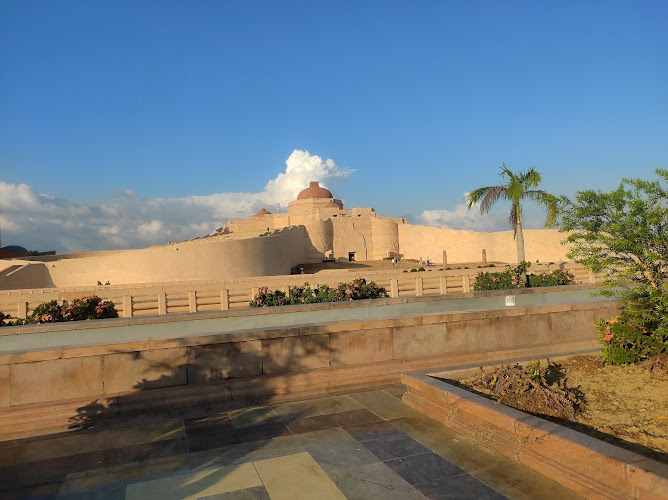
Ambedkar Park Museum

Dr. Babasaheb Ambedkar Memorial
I Love Lucknow Spot
Find Accommodations Nearby
Recommended Tours & Activities
Visitor Reviews
There are no reviews yet. Be the first one to write one.
Share Your Experience
Have you visited Bara Imambara? Help other travelers by leaving a review.