
Arco Gucumatz
About Arco Gucumatz
Key Features
More Details
Updated April 16, 2024
## Arco Gucumatz, Chichicastenango: History, Legend, and How to Visit
Location: 4a Calle (near 5a Avenida), Chichicastenango, Quiché, Guatemala
Plus Code: WVVQ+RP7
Coordinates: 14.9445396, -91.1106913
### Why this arch matters
Arco Gucumatz is one of Chichicastenango’s most recognizable monuments—both a practical waypoint in town and a symbol tied to K’iche’ Maya cosmology. Local accounts record that the original brick arch stood here in the early 20th century. In 1932, the municipality commissioned the current stone structure, designed by the Quetzaltenango architect Aniceto de León using hewn stone sourced from the Quiejelej area. The arch’s name and meaning reference Gucumatz (K’iche’ “feathered serpent”), a creator deity that appears in the Popol Vuh; the relief depicts a serpent devouring a person, a direct nod to the oral tradition behind the site.
### The legend—brief and relevant
Oral tradition says a giant serpent once blocked a stream along this street, cutting water to the town. When a man sought the cause, the serpent devoured him. The episode gave the arch its name, and later the sculpture—attributed locally to archaeologist Flavio Rodas Noriega—made the symbolism explicit (serpent + human figure).
### What you’ll actually see
– A stone archway with a relief referencing the feathered serpent mythos, set over a narrow urban street. It’s modest in size but visually distinct and photographable from either side of 4a Calle.
– The arch functions as a point of reference in Chichicastenango’s town grid (4a Calle at/near 5a Avenida).
### Where it is and how to get there
– On foot: From the central plaza (Parque Central / Iglesia de Santo Tomás), walk north via 5a Avenida and turn onto 4a Calle; the arch is a short walk along the street. The map-based listings place Arco Gucumatz on 4a Calle with Plus Code WVVQ+RP7.
– Map confirmation: Multiple mapping references (Mapcarta/OpenStreetMap-style index and Waze) list the arch at 4a Calle, Chichicastenango with the noted Plus Code.
> Accessibility note: The approach is along paved urban streets with typical highland gradients. Surfaces may be uneven; plan footwear accordingly. (General condition guidance; no official accessibility spec is published for the arch.)
### Best time to go (and pairing with market days)
Chichicastenango’s open-air market operates Thursdays and Sundays, drawing regional vendors and pilgrims. If you’re already in town for the market, Arco Gucumatz is an easy add a few minutes from the plaza. Independent and guide sources consistently note Thursday/Sunday as market days.
– Tip: If crowds are your concern, many travelers prefer Thursday over Sunday for slightly easier movement through the town core. (This pattern is commonly reported by current guides and trip reports.) Guatemala
### Photography & cultural respect
– The arch is public and commonly photographed. When composing wider frames that include people—especially vendors or ceremonial participants—ask permission first.
– Near the plaza and Iglesia de Santo Tomás, ceremonies and incense offerings (pom/copal) are part of living Maya tradition. Avoid obstructing ritual spaces and do not place tripods where people are moving with offerings. (Context: Chichicastenango is a K’iche’ Maya cultural center where ritual life is active.)
### Quick facts to deepen your visit
– Builder and date: Current stone arch erected 1932 by Aniceto de León; earlier version was pure brick.
– Material: Hewn stone (“piedra desbastada”) sourced from Cantón Quiejelej.
– Iconography: Relief with a serpent devouring a human; name and theme tied to Gucumatz, creator of the waters in K’iche’ tradition.
– Address anchor: 4a Calle near 5a Avenida; Plus Code WVVQ+RP7.
### Nearby places that make a logical loop
– Iglesia y Monasterio de Santo Tomás – focal point of market-day life and syncretic ritual practice.
– Museo Ceremonial de Máscaras – a compact collection contextualizing dance masks and highland traditions.
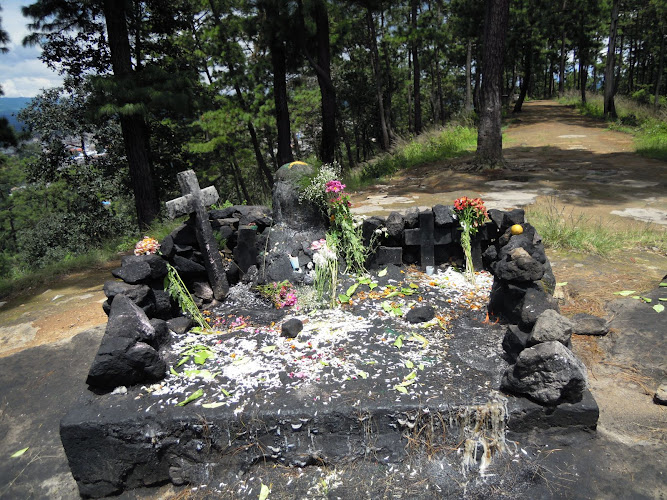
– Pascual Abaj (Cerro Pascual Abaj) – an outdoor shrine still used for Maya ceremonies on a hill overlooking town.
(These are all listed as nearby from local tourism references; distances are short but bring time for hills and traffic on market days.)
### Safety and practicalities
– Crowd dynamics: On market days, pedestrian traffic can bottleneck near the plaza streets. The arch sits on a narrower stretch of 4a Calle; step aside when locals need to pass. (General crowd-management advice consistent with market-day conditions.)
– Light & timing for photos: Morning light along 4a Calle is often softer; later morning can add bustling context if you want people in the frame. (Observational advice; no official schedule affects the arch itself.)
– No tickets, no set hours: This is a public street monument; no admission and no official opening hours are published. (Local listings describe it as accessible all day.)
### Cultural literacy, briefly
– Gucumatz corresponds to the feathered serpent deity known elsewhere as Kukulkán/Quetzalcóatl; in K’iche’ sources, Gucumatz is associated with creation—especially of waters. The arch’s narrative aligns with that cosmology and with the Popol Vuh tradition referenced in local write-ups.
– Living traditions: Chichicastenango remains predominantly K’iche’ Maya by population share, and rituals are ongoing around the town’s sacred sites. That context is why respectful behavior—especially around ceremonies—is emphasized.
—
## Summary for planners
– What it is: Historic 1932 stone arch with K’iche’ Maya symbology; earlier arch documented ca. 1930.
– Where: 4a Calle near 5a Avenida; WVVQ+RP7, 14.9445396, -91.1106913.
– When to go: Any day; easily paired with Thursday/Sunday market visits.
– Nearby: Santo Tomás Church, Museo de Máscaras, Pascual Abaj.
—
### Accuracy & currency notes
– Architectural details (1932 build; architect Aniceto de León; stone from Quiejelej; serpent relief credit to Flavio Rodas Noriega) come from a 2022 update by Aprende Guatemala, which cites the Municipalidad de Chichicastenango. If the municipality publishes a newer specification, defer to it.
– Market-day scheduling (Thursdays/Sundays) is consistent across recent travel guides and reference pages; always verify day-of if planning a same-day trip, as transportation or holiday events can affect access.
—
Sources: Core history/architecture from Aprende Guatemala (with municipal reference); location and “nearby” confirmations from GuateValley and map references; market-day context from current guides and reference pages.
Inclusivity reminder: This is a living cultural landscape. Prioritize consent for portraits, step aside for processions, and avoid handling offerings or ritual items.
Table of Contents
Key Highlights
Arco Gucumatz
Location
Places to Stay Near Arco Gucumatz
Find and Book a Tour
Explore More Travel Guides
No reviews found! Be the first to review!
Traveler Reviews for Arco Gucumatz
There are no reviews yet. Be the first one to write one.
Have you visited Arco Gucumatz? Help other travelers by sharing your review.
You Might Also Like
Chichicastenango Regional Museum
Iglesia de Santo Tomás
Pascual Abaj
Find Accommodations Nearby
Recommended Tours & Activities
Visitor Reviews
There are no reviews yet. Be the first one to write one.
Share Your Experience
Have you visited Arco Gucumatz? Help other travelers by leaving a review.