
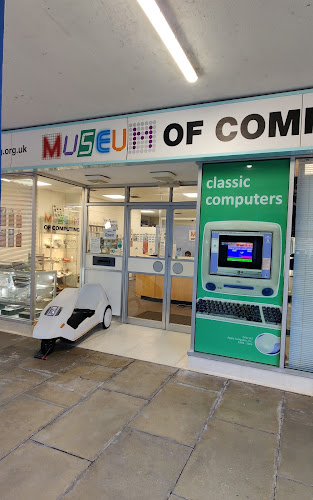
The Museum of Computing
About The Museum of Computing
Description
The Museum of Computing in Swindon is presented as a lively, hands-on chronicle of the evolution of computing, tracing a path from room-sized mechanical beasts to pocket-sized marvels. It showcases working machines and carefully preserved relics that together tell a story about technology, people and the slow, sometimes messy, progress of ideas. Visitors find more than display cabinets; they find playable consoles, vintage keyboards, dot-matrix printers that still whirr, and cabinets of historic computers that seem to hum with other people's evenings and early mornings. The museum frames computing as human history, not just circuitry.
The collection leans heavily on tactile and interactive experiences. Exhibits include early calculators and personal computers, an impressive range of retro computer games, and a selection of consoles and peripherals that chart the development of gaming culture alongside industrial and academic computing. There are working demonstrations of older systems — machines that will boot up, prompt a command, and respond — which is a rare thing. Seeing, hearing and sometimes touching these devices bridges the gap between textbook history and real-world memory: it suddenly becomes possible to understand how programming, troubleshooting and even patience shaped computing as we know it.
Swindon’s Museum of Computing has an approachable, almost homespun feel. The layout is compact but cleverly arranged, so each corner offers a new surprise: a gallery devoted to early British computing, a wall of classic game cartridges, or a table strewn with hardware from the 1970s and 1980s. The museum has a clear mission to educate, but it does so without becoming overly formal; friendly labels, volunteers with stories to tell, and small hands-on stations encourage curiosity. It’s exactly the kind of place where a child’s question about how a floppy disk works turns into a twenty-minute demonstration and a laugh about the size of storage in the old days. And yes, grown-ups often end up more intrigued than the kids. That tends to happen here.
Accessibility and visitor amenities are honest and plainly stated. The entrance is wheelchair accessible, which matters for those who need level access. However, the museum does not have an accessible restroom onsite and, in fact, lacks public restrooms and an on-site restaurant. This can be a surprise to first-time visitors who plan a long afternoon. Consequently, people often pair their visit with a quick stop at nearby facilities in the town centre before or after touring the galleries. The museum’s compact footprint means visits average one to two hours for most people, but technical fans — and nostalgists — are likely to linger much longer, tinkering with demos and chatting with volunteers.
One distinctive attribute is the balance between objects that are frozen in time and machines kept in working order. Some museums present everything behind glass, pristine and untouchable. Here, a number of items are actively demonstrated, occasionally fired up for the public, and that makes the experience immediate. For visitors who grew up with certain rigs, there is an emotional hit — the buzz of a CRT monitor, the clack of a mechanical key, the grainy colours of early graphics. For younger visitors, the exhibits are educational in a tactile way: they can see the physicality of computation before cloud services and invisible processors became the norm.
Another notable strength is the emphasis on storytelling. The museum ties hardware to people and events: engineers with names, projects with deadlines, and wartime efforts that shaped algorithms and machines. Swindon’s museum references the broader British computing story and situates local pieces within that national context. Did it get deep into code theory? Not always; the focus is more on technology in use, design choices, and cultural impact, which many casual visitors find more engaging than dense technical explanations. There are occasional displays that nod to famous figures and milestones, helping to orient visitors within the larger narrative of computing history.
For travellers, the Museum of Computing serves as an unexpected, rewarding stop in a town that often surprises people with pockets of cultural and industrial history. It sits conveniently close to theatre and civic areas, making it feasible to combine a visit with other local activities. School groups and families appreciate the hands-on approach, while enthusiasts and hobbyists will find the depth of the collection satisfying. It’s especially good for those who like their museums to be a bit scruffy in the best possible way: lovingly curated, volunteer-run energy rather than a sterile corporate gloss.
Practicality is also part of the charm. Admission policies and opening hours can be limited at times, so planning ahead is advisable. The museum frequently hosts themed events, demonstrations and small workshops; these often sell out or fill quickly because of the museum’s size and popularity among niche communities. A group might catch a live demonstration of a restored machine, a talk about conservation techniques, or a retro gaming night where visitors play original titles on preserved consoles. These events give an added dimension to a standard visit because they invite participation, not passive observation.
Educationally, the museum punches above its weight. Exhibits are designed to be accessible to non-specialists while still offering enough detail to be valuable for learners. Interpretive panels, volunteer talks and interactive displays make complex ideas — like how early computing handled storage and memory, or why certain architectures dominated a decade — digestible. For those interested in the development of games there is a clear through-line: from early text-based adventures to arcade ports and home console adaptations. That history is presented not as a dry timeline but as a cultural shift, examining how games changed expectations about interactivity and social play.
There are small touches that reward repeat visits. Rotating displays, guest-curated mini-exhibitions and items on loan occasionally appear, keeping the museum fresh. Hidden gems — a rare peripheral, a prototype unit, or a locally rescued machine with an interesting backstory — pop up now and then, and they delight both newcomers and repeat visitors. Volunteers and staff are often collectors, engineers, or educators who share personal anecdotes about the machines, and these stories add texture to the physical exhibits.
Many visitors report leaving the museum with a new appreciation for the material constraints early engineers worked under: limited memory, slow processors and the need to design efficient, elegant solutions. The museum translates abstract concepts into tangible examples: punch cards, magnetic drums, early algorithmic calculators and their mechanical cousins. It also highlights continuity — how principles of logic and algorithm design echo from historic machines into modern systems.
From a travel perspective, the Museum of Computing is compact, dense, and satisfying. It performs best for those who arrive curious and ready to engage, rather than visitors expecting a large-scale national centre. Its intimate scale is part of the appeal; exhibits can be viewed at leisure, and long conversations with volunteers are possible in ways they aren’t at larger institutions. People who have visited the larger national computing museums often appreciate the Museum of Computing for its personal atmosphere and for the chance to see working machines in a less formal environment.
There are a few practical caveats to note. Because the museum does not have an on-site restroom or café, visitors planning longer stays should build in breaks or combine the visit with dining in the town centre. Also, while the entrance is wheelchair friendly, some parts of the older displays or demonstration areas may be cramped, and staff are usually honest about that. For visitors dependent on fully accessible facilities, a quick phone call before arrival can clarify what is feasible on the day.
Overall, the Museum of Computing in Swindon presents a thoughtful, lively and hands-on portrait of computing history. It offers a mix of nostalgia for older visitors, approachable education for younger audiences, and technical curiosity for hobbyists and historians. It’s a place that rewards slow observation and conversation, and it quietly insists that technology is best understood when seen, touched and explained by people who love it.
Key Features
More Details
Updated August 30, 2025
Table of Contents
Description
The Museum of Computing in Swindon is presented as a lively, hands-on chronicle of the evolution of computing, tracing a path from room-sized mechanical beasts to pocket-sized marvels. It showcases working machines and carefully preserved relics that together tell a story about technology, people and the slow, sometimes messy, progress of ideas. Visitors find more than display cabinets; they find playable consoles, vintage keyboards, dot-matrix printers that still whirr, and cabinets of historic computers that seem to hum with other people’s evenings and early mornings. The museum frames computing as human history, not just circuitry.
The collection leans heavily on tactile and interactive experiences. Exhibits include early calculators and personal computers, an impressive range of retro computer games, and a selection of consoles and peripherals that chart the development of gaming culture alongside industrial and academic computing. There are working demonstrations of older systems — machines that will boot up, prompt a command, and respond — which is a rare thing. Seeing, hearing and sometimes touching these devices bridges the gap between textbook history and real-world memory: it suddenly becomes possible to understand how programming, troubleshooting and even patience shaped computing as we know it.
Swindon’s Museum of Computing has an approachable, almost homespun feel. The layout is compact but cleverly arranged, so each corner offers a new surprise: a gallery devoted to early British computing, a wall of classic game cartridges, or a table strewn with hardware from the 1970s and 1980s. The museum has a clear mission to educate, but it does so without becoming overly formal; friendly labels, volunteers with stories to tell, and small hands-on stations encourage curiosity. It’s exactly the kind of place where a child’s question about how a floppy disk works turns into a twenty-minute demonstration and a laugh about the size of storage in the old days. And yes, grown-ups often end up more intrigued than the kids. That tends to happen here.
Accessibility and visitor amenities are honest and plainly stated. The entrance is wheelchair accessible, which matters for those who need level access. However, the museum does not have an accessible restroom onsite and, in fact, lacks public restrooms and an on-site restaurant. This can be a surprise to first-time visitors who plan a long afternoon. Consequently, people often pair their visit with a quick stop at nearby facilities in the town centre before or after touring the galleries. The museum’s compact footprint means visits average one to two hours for most people, but technical fans — and nostalgists — are likely to linger much longer, tinkering with demos and chatting with volunteers.
One distinctive attribute is the balance between objects that are frozen in time and machines kept in working order. Some museums present everything behind glass, pristine and untouchable. Here, a number of items are actively demonstrated, occasionally fired up for the public, and that makes the experience immediate. For visitors who grew up with certain rigs, there is an emotional hit — the buzz of a CRT monitor, the clack of a mechanical key, the grainy colours of early graphics. For younger visitors, the exhibits are educational in a tactile way: they can see the physicality of computation before cloud services and invisible processors became the norm.
Another notable strength is the emphasis on storytelling. The museum ties hardware to people and events: engineers with names, projects with deadlines, and wartime efforts that shaped algorithms and machines. Swindon’s museum references the broader British computing story and situates local pieces within that national context. Did it get deep into code theory? Not always; the focus is more on technology in use, design choices, and cultural impact, which many casual visitors find more engaging than dense technical explanations. There are occasional displays that nod to famous figures and milestones, helping to orient visitors within the larger narrative of computing history.
For travellers, the Museum of Computing serves as an unexpected, rewarding stop in a town that often surprises people with pockets of cultural and industrial history. It sits conveniently close to theatre and civic areas, making it feasible to combine a visit with other local activities. School groups and families appreciate the hands-on approach, while enthusiasts and hobbyists will find the depth of the collection satisfying. It’s especially good for those who like their museums to be a bit scruffy in the best possible way: lovingly curated, volunteer-run energy rather than a sterile corporate gloss.
Practicality is also part of the charm. Admission policies and opening hours can be limited at times, so planning ahead is advisable. The museum frequently hosts themed events, demonstrations and small workshops; these often sell out or fill quickly because of the museum’s size and popularity among niche communities. A group might catch a live demonstration of a restored machine, a talk about conservation techniques, or a retro gaming night where visitors play original titles on preserved consoles. These events give an added dimension to a standard visit because they invite participation, not passive observation.
Educationally, the museum punches above its weight. Exhibits are designed to be accessible to non-specialists while still offering enough detail to be valuable for learners. Interpretive panels, volunteer talks and interactive displays make complex ideas — like how early computing handled storage and memory, or why certain architectures dominated a decade — digestible. For those interested in the development of games there is a clear through-line: from early text-based adventures to arcade ports and home console adaptations. That history is presented not as a dry timeline but as a cultural shift, examining how games changed expectations about interactivity and social play.
There are small touches that reward repeat visits. Rotating displays, guest-curated mini-exhibitions and items on loan occasionally appear, keeping the museum fresh. Hidden gems — a rare peripheral, a prototype unit, or a locally rescued machine with an interesting backstory — pop up now and then, and they delight both newcomers and repeat visitors. Volunteers and staff are often collectors, engineers, or educators who share personal anecdotes about the machines, and these stories add texture to the physical exhibits.
Many visitors report leaving the museum with a new appreciation for the material constraints early engineers worked under: limited memory, slow processors and the need to design efficient, elegant solutions. The museum translates abstract concepts into tangible examples: punch cards, magnetic drums, early algorithmic calculators and their mechanical cousins. It also highlights continuity — how principles of logic and algorithm design echo from historic machines into modern systems.
From a travel perspective, the Museum of Computing is compact, dense, and satisfying. It performs best for those who arrive curious and ready to engage, rather than visitors expecting a large-scale national centre. Its intimate scale is part of the appeal; exhibits can be viewed at leisure, and long conversations with volunteers are possible in ways they aren’t at larger institutions. People who have visited the larger national computing museums often appreciate the Museum of Computing for its personal atmosphere and for the chance to see working machines in a less formal environment.
There are a few practical caveats to note. Because the museum does not have an on-site restroom or café, visitors planning longer stays should build in breaks or combine the visit with dining in the town centre. Also, while the entrance is wheelchair friendly, some parts of the older displays or demonstration areas may be cramped, and staff are usually honest about that. For visitors dependent on fully accessible facilities, a quick phone call before arrival can clarify what is feasible on the day.
Overall, the Museum of Computing in Swindon presents a thoughtful, lively and hands-on portrait of computing history. It offers a mix of nostalgia for older visitors, approachable education for younger audiences, and technical curiosity for hobbyists and historians. It’s a place that rewards slow observation and conversation, and it quietly insists that technology is best understood when seen, touched and explained by people who love it.
Key Highlights
The Museum of Computing
Location
Places to Stay Near The Museum of Computing
Find and Book a Tour
Explore More Travel Guides
No reviews found! Be the first to review!
Traveler Reviews for The Museum of Computing
There are no reviews yet. Be the first one to write one.
Have you visited The Museum of Computing? Help other travelers by sharing your review.
You Might Also Like
Liddington Hillfort
Co-Decode Live Escape Games

Stanton Country Park
Find Accommodations Nearby
Recommended Tours & Activities
Visitor Reviews
There are no reviews yet. Be the first one to write one.
Share Your Experience
Have you visited The Museum of Computing? Help other travelers by leaving a review.