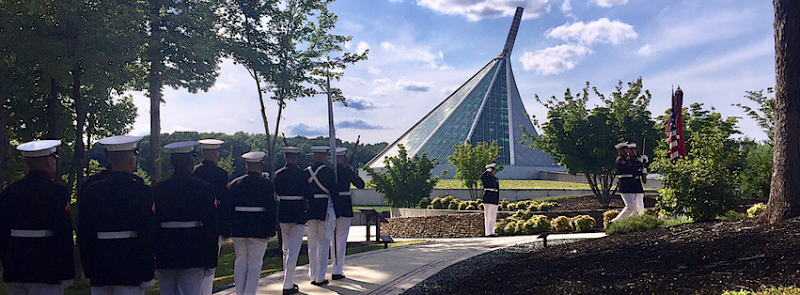
Located near the Marine Corps base at Quantico in Virginia, the museum functions as both a serious historical repository and a public-facing experience center. It balances sprawling galleries of artifacts and dioramas with immersive, often hands-on displays and short theatrical programs. The overall effect is educational without being dry, reflective without being dour. The architecture itself makes a statement; people remark on the soaring, angled roof that echoes the spirit of Iwo Jima imagery while the plaza and Fidelis Memorial Park outside give the visit a contemplative punctuation.
The museum’s exhibition strategy is straightforward and effective: combine artifacts, multimedia, oral histories and tactical storytelling so that the visitor can see individual items and then step back to understand the bigger picture. Large artifacts — uniforms, vehicles, copies of historic flags, and personal items from Marines who served in conflicts across centuries — sit alongside interactive kiosks and short films played in the museum theater. Some galleries are chronological, leading the guest through formative moments of American military history; others are thematic, taking on subjects like amphibious operations, aviation, combat art and the social history of Marines at home and abroad.
One thing that often catches visitors off-guard is the emotional weight of several exhibits. The museum does not shy away from hard truths; it highlights both valor and sacrifice. There are spaces that honor the fallen and memorialize major battles, and those spaces tend to be quiet, even hushed. But there are also lively components: an engaging Leatherneck Gallery, occasional live performances that dramatize moments from Marine Corps history, and a theater that shows short documentaries produced with high-quality sound and visuals. A visitor who expects only static displays might leave surprised at how many elements use sound, lighting and scale to create a sort of micro-theater experience.
Practical offerings are solid and sensible. There is a cafe and a restaurant on site for those who want a full meal or a quick coffee between galleries, and a well-stocked gift shop that sells books, replicas and family-friendly souvenirs. The museum operates guided tours and educational programs, which many families and school groups praise for being both accessible and informative. Several exhibits are explicitly designed to be kid-friendly, including hands-on stations and simplified interpretive panels, and changing tables and family restrooms make it practical for visitors with young children.
Accessibility gets attention here. Wheelchair-accessible entrances, parking and restrooms are in place, and the circulation routes through the galleries are broad and navigable. That matters to many visitors and is part of why the museum has become a reliably approachable place for people from many backgrounds. At the same time, the visitor experience can vary depending on how much time one spends: a quick walk-through takes maybe 60–90 minutes; a more curious guest who stops for theater pieces, tours, and to read many of the labels should plan on three or more hours. It’s not a one-size-fits-all visit — it rewards the person who lingers.
The interpretive voice of the museum leans toward honor and education rather than polemic. The displays emphasize commitment, heritage and military history while framing those elements within broader American history and global context. Visitors will encounter references to major conflicts — including World War II and the iconic Iwo Jima moment — as well as explorations of how technology, training and culture changed over time. But the museum also steps back to highlight everyday stories: letters home, civilian support networks, and the less glamorous logistics that make military operations possible. Those smaller objects often spark a stronger connection than the big hardware does.
For travelers, there are a few practical notes worth keeping in mind. Free parking is available in the lot, which is a relief compared with many tourist sites near major cities. There is an admission fee, though many find the price reasonable relative to the depth of the collections and the cost of operating a museum of this scale. Live performances and special programs are scheduled at intervals, especially on weekends and around Veterans Day and Memorial Day, so checking the museum’s schedule before planning a trip (yes, call or check online; this is the one time the author recommends a quick pre-visit check) will help avoid disappointment. Also, while many parts of the complex are indoors, the Fidelis Memorial Park is outdoors and can be quite striking on clear days; it’s a good complement to a museum visit and offers photo opportunities and quiet spaces for reflection.
What the museum does exceptionally well is present a human scale within a large story. The exhibits are packed with individual names, faces and stories, and those micro-histories give texture to big-picture themes. One visitor’s anecdote — about finding a loved one’s name among a wall of honors after an otherwise aimless museum stroll — is the kind of moment that sticks with people. The museum facilitates that sort of personal connection without being sentimental; it places the artifacts in context that allows visitors to form their own impressions and come away with a clearer understanding of what it means to serve as a Marine and why that service is a significant thread in American history.
There are, inevitably, a few curatorial choices that divide opinions. Some visitors wish for more in-depth analysis of controversial episodes or for a fuller treatment of social issues such as race, gender and politics in the Corps’ history. Others appreciate the museum’s emphasis on heritage and coherence. Both impulses are understandable. The museum’s leadership has been active in updating galleries and adding new exhibits over the years, so what a visitor sees today is part of an evolving narrative. That evolving nature is actually a plus: new galleries and rotating exhibits mean repeat visits can reveal different things.
From a traveler’s perspective, the museum also works well as part of a regional itinerary. It pairs naturally with a drive through Prince William County, a stop at Quantico’s perimeter areas (public areas only), or a broader tour of military-related sites in the Washington-Baltimore corridor. But the National Museum of the Marine Corps is not merely a regional footnote; many guests travel specifically to see it and plan multi-hour visits. The museum is designed to be memorable: the plazas, the memorial park, the galleries, and the theatrical elements all combine to create a trip that registers visually and emotionally.
Lastly, perhaps a small, quirky suggestion: visitors who like to take photos should bring a little patience and a flexible plan. Certain galleries and outdoor spots are popular for family photos and quiet contemplation alike, and those areas can fill up at peak times. And if a visitor wants to catch a live performance or a special film in the theater — which are often short but well-done — it’s worth timing the visit around those offerings. The museum rewards curiosity, and those who go with an open mind often leave with more than historical facts: they leave with a sense of the human cost and commitment behind the artifacts. It doesn’t try to tell visitors what to feel, but it reliably provides the raw material for a meaningful visit.
 Real Journey Travels