
Moesgaard Museum
About Moesgaard Museum
Description
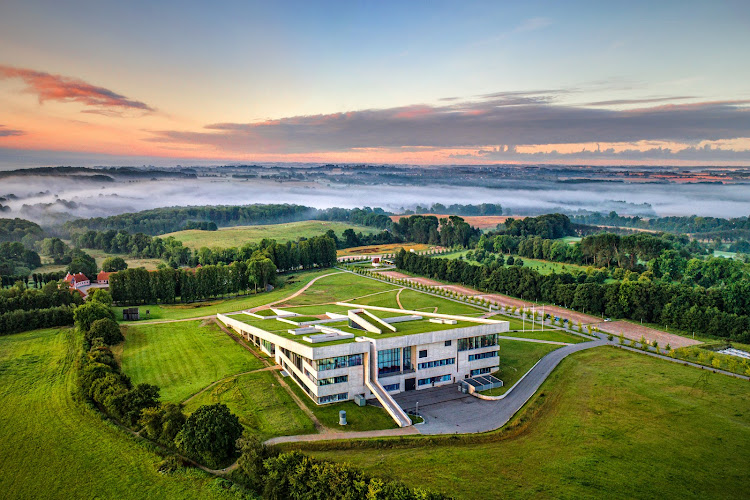
The Moesgaard Museum is a modernist museum that tilts out of the earth like a deliberate misstep in the landscape and then smiles at the sea. Located just south of Aarhus, Denmark, it presents a curious, sometimes intense story of people — from the earliest stone age visitors to the complexities of modern human life. The building itself is part of the attraction: a gently sloping green roof that invites views across the bay, wide glass facades that frame the trees, and a design that feels like architecture and archaeology had a long, slightly awkward conversation and decided to live together. The architecture deserves as much attention as the cases inside, honestly — it’s not often a museum’s roof becomes a trail.
Inside, Moesgaard balances scholarly weight with playful, hands-on interpretation. Exhibitions range from deep-time prehistory to vivid reconstructions of Viking Age life, coupled with ethnographic displays that remind visitors that human stories are global and wonderfully messy. The curators here do not hide the grey bits of history. Instead they illuminate them: preserved bog bodies are shown with sensitivity, ancient tools are displayed alongside the scientific explanations of how they were used, and immersive audio-visual sequences let visitors hear, briefly, what an Iron Age settlement might have sounded like. It is both museum and research center; the tone is authoritative, yet approachable.
One of the things most people remember after a visit is the Grauballe Man — one of the best preserved bog bodies in the world. He’s not presented as a curiosity behind glass but rather as a person with a difficult story, contextualized through forensic study, environmental science, and historical interpretation. That approach is typical across the museum: objects are rarely isolated. They arrive with place, date, method of discovery, and a little interpretative humility. This is a museum that wants visitors to think, not just to tick a travel box.
Interactive displays are plentiful. Touchscreens with 3D scans of artifacts let visitors rotate objects that would otherwise be too fragile to handle in real life. There are reconstructions of houses from different ages, and occasionally staff run demonstrations or workshops that let visitors see, for instance, how iron tools were made or how ancient textiles were woven. Families tend to enjoy this; there’s a clear push toward making archaeology tactile without being trivial. Schools and children’s groups come here a lot, and the kid-friendly elements are well thought out: clear signage, dedicated activity zones, and sometimes scavenger-hunt style prompts that actually make small explorers excited.
Because Moesgaard is also a center for research, some exhibits shift and change. Temporary exhibitions often explore international archaeology or new scientific findings and these can be unexpectedly brilliant. The permanent displays, meanwhile, give a sweeping narrative of Danish and northern European prehistory — think Stone Age hunter-gatherers, Bronze Age changes, Iron Age settlements, and the Viking Age — but they also don’t forget the wider world. Don’t be surprised to find ethnographic objects and comparative displays that place northern finds in a global context. And that global frame is refreshing; it avoids the trap of making local history feel isolated or parochial.
Practicalities are part of the experience here in a very consumer-friendly way. The museum offers restaurant seating with meals that are decent for museum food, restrooms that are easy to find, Wi-Fi, and accessible facilities including wheelchair-accessible entrances and restrooms, along with wheelchair rental. There’s free on-site parking and electric vehicle charging options, which is a small detail that, for many visitors, turns a good visit into a convenient one. Staff are generally helpful, though like any busy site, the level of attention can vary depending on how crowded the galleries are.
Visitors should expect emotional contrasts. Casual curiosity sits next to forensic analysis; family-friendly interactives sit beside exhibits that confront death, ritual, and climate change. The museum doesn’t shy away from larger themes: human adaptability, the impact of rising sea levels on settlements, and how culture transforms raw material into meaning. For people who love design, the interplay of light, concrete, grass, and glass is a treat; for history buffs, the depth of archaeological interpretation is satisfying; for families, the mix of active learning and straightforward storytelling works well.
Moesgaard is not flawless. The very ambition that makes it special can sometimes overwhelm. Some visitors report that the most interesting sections are packed, signage can be dense if someone isn’t fluent in museum-speak, and the audio-visual elements — while impressive — occasionally demand more attention than a casual pace allows. On busy days the sloping roof path and the restaurant can get crowded, and timed-entry policies during special exhibitions sometimes create lines that test patience. Yet for many, those small frustrations are outweighed by the quality of the content and the originality of the setting.
A short, slightly personal aside: the writer remembers arriving on a grey afternoon when the wind off the bay made the grass on the roof shimmer like a living thing. Staff were setting up a small talk on Viking ship burial rites and a child nearby kept whispering as if she were on the brink of discovering a treasure. Moments like that make Moesgaard feel alive — and not just a repository of things. Museums can be dusty and distant; this one breathes, literally and figuratively, with the landscape around it.
For photographers and casual sightseers, Moesgaard delivers unexpected compositions. The angles of the building, the light coming through the treetops, and the way exhibits are staged make for strong pictures — but a gentle caution: flash tends to be restricted, and some exhibits are intentionally dim to preserve artifacts, so bring a camera that copes well with low light. Also, the green roof is best taken in stride; it’s walkable but not a manicured garden. It’s designed to connect the museum with the surrounding archaeological landscape, and that sometimes includes rough patches, steps, and windy viewpoints.
Many repeat visitors compliment the balance between permanent and temporary exhibitions; there’s a sense of fresh ideas arriving year to year. And because the museum is tied to active archaeological projects, visitors sometimes glimpse real-time research results in the displays. That immediacy — seeing the latest scientific take on an Iron Age find, for instance — is a powerful reminder that history is not just recovered, it is constantly debated and re-interpreted.
In short, Moesgaard Museum is an architectural statement and a narrative engine. It appeals to people who like their history lined with science and their architecture cut with landscape. It will challenge visitors at times; it will also reward curiosity. Whether someone is drawn by the famous bog bodies, an interest in the Viking Age, or simply the chance to step onto a grassy roof and look out toward the bay, the museum offers an experience that lingers. Expect to leave with new questions, a couple of surprising images in the mind, and the sort of museum fatigue that, oddly, feels like a good thing.
Key Features
More Details
Updated August 29, 2025
Table of Contents
Description
The Moesgaard Museum is a modernist museum that tilts out of the earth like a deliberate misstep in the landscape and then smiles at the sea. Located just south of Aarhus, Denmark, it presents a curious, sometimes intense story of people — from the earliest stone age visitors to the complexities of modern human life. The building itself is part of the attraction: a gently sloping green roof that invites views across the bay, wide glass facades that frame the trees, and a design that feels like architecture and archaeology had a long, slightly awkward conversation and decided to live together. The architecture deserves as much attention as the cases inside, honestly — it’s not often a museum’s roof becomes a trail.
Inside, Moesgaard balances scholarly weight with playful, hands-on interpretation. Exhibitions range from deep-time prehistory to vivid reconstructions of Viking Age life, coupled with ethnographic displays that remind visitors that human stories are global and wonderfully messy. The curators here do not hide the grey bits of history. Instead they illuminate them: preserved bog bodies are shown with sensitivity, ancient tools are displayed alongside the scientific explanations of how they were used, and immersive audio-visual sequences let visitors hear, briefly, what an Iron Age settlement might have sounded like. It is both museum and research center; the tone is authoritative, yet approachable.
One of the things most people remember after a visit is the Grauballe Man — one of the best preserved bog bodies in the world. He’s not presented as a curiosity behind glass but rather as a person with a difficult story, contextualized through forensic study, environmental science, and historical interpretation. That approach is typical across the museum: objects are rarely isolated. They arrive with place, date, method of discovery, and a little interpretative humility. This is a museum that wants visitors to think, not just to tick a travel box.
Interactive displays are plentiful. Touchscreens with 3D scans of artifacts let visitors rotate objects that would otherwise be too fragile to handle in real life. There are reconstructions of houses from different ages, and occasionally staff run demonstrations or workshops that let visitors see, for instance, how iron tools were made or how ancient textiles were woven. Families tend to enjoy this; there’s a clear push toward making archaeology tactile without being trivial. Schools and children’s groups come here a lot, and the kid-friendly elements are well thought out: clear signage, dedicated activity zones, and sometimes scavenger-hunt style prompts that actually make small explorers excited.
Because Moesgaard is also a center for research, some exhibits shift and change. Temporary exhibitions often explore international archaeology or new scientific findings and these can be unexpectedly brilliant. The permanent displays, meanwhile, give a sweeping narrative of Danish and northern European prehistory — think Stone Age hunter-gatherers, Bronze Age changes, Iron Age settlements, and the Viking Age — but they also don’t forget the wider world. Don’t be surprised to find ethnographic objects and comparative displays that place northern finds in a global context. And that global frame is refreshing; it avoids the trap of making local history feel isolated or parochial.
Practicalities are part of the experience here in a very consumer-friendly way. The museum offers restaurant seating with meals that are decent for museum food, restrooms that are easy to find, Wi-Fi, and accessible facilities including wheelchair-accessible entrances and restrooms, along with wheelchair rental. There’s free on-site parking and electric vehicle charging options, which is a small detail that, for many visitors, turns a good visit into a convenient one. Staff are generally helpful, though like any busy site, the level of attention can vary depending on how crowded the galleries are.
Visitors should expect emotional contrasts. Casual curiosity sits next to forensic analysis; family-friendly interactives sit beside exhibits that confront death, ritual, and climate change. The museum doesn’t shy away from larger themes: human adaptability, the impact of rising sea levels on settlements, and how culture transforms raw material into meaning. For people who love design, the interplay of light, concrete, grass, and glass is a treat; for history buffs, the depth of archaeological interpretation is satisfying; for families, the mix of active learning and straightforward storytelling works well.
Moesgaard is not flawless. The very ambition that makes it special can sometimes overwhelm. Some visitors report that the most interesting sections are packed, signage can be dense if someone isn’t fluent in museum-speak, and the audio-visual elements — while impressive — occasionally demand more attention than a casual pace allows. On busy days the sloping roof path and the restaurant can get crowded, and timed-entry policies during special exhibitions sometimes create lines that test patience. Yet for many, those small frustrations are outweighed by the quality of the content and the originality of the setting.
A short, slightly personal aside: the writer remembers arriving on a grey afternoon when the wind off the bay made the grass on the roof shimmer like a living thing. Staff were setting up a small talk on Viking ship burial rites and a child nearby kept whispering as if she were on the brink of discovering a treasure. Moments like that make Moesgaard feel alive — and not just a repository of things. Museums can be dusty and distant; this one breathes, literally and figuratively, with the landscape around it.
For photographers and casual sightseers, Moesgaard delivers unexpected compositions. The angles of the building, the light coming through the treetops, and the way exhibits are staged make for strong pictures — but a gentle caution: flash tends to be restricted, and some exhibits are intentionally dim to preserve artifacts, so bring a camera that copes well with low light. Also, the green roof is best taken in stride; it’s walkable but not a manicured garden. It’s designed to connect the museum with the surrounding archaeological landscape, and that sometimes includes rough patches, steps, and windy viewpoints.
Many repeat visitors compliment the balance between permanent and temporary exhibitions; there’s a sense of fresh ideas arriving year to year. And because the museum is tied to active archaeological projects, visitors sometimes glimpse real-time research results in the displays. That immediacy — seeing the latest scientific take on an Iron Age find, for instance — is a powerful reminder that history is not just recovered, it is constantly debated and re-interpreted.
In short, Moesgaard Museum is an architectural statement and a narrative engine. It appeals to people who like their history lined with science and their architecture cut with landscape. It will challenge visitors at times; it will also reward curiosity. Whether someone is drawn by the famous bog bodies, an interest in the Viking Age, or simply the chance to step onto a grassy roof and look out toward the bay, the museum offers an experience that lingers. Expect to leave with new questions, a couple of surprising images in the mind, and the sort of museum fatigue that, oddly, feels like a good thing.
Key Highlights
Moesgaard Museum
Location
Places to Stay Near Moesgaard Museum
Find and Book a Tour
Explore More Travel Guides
No reviews found! Be the first to review!
Traveler Reviews for Moesgaard Museum
There are no reviews yet. Be the first one to write one.
Have you visited Moesgaard Museum? Help other travelers by sharing your review.
You Might Also Like

Marselisborg Deer Park

Rush Trampoline Park
Find Accommodations Nearby
Recommended Tours & Activities
Visitor Reviews
There are no reviews yet. Be the first one to write one.
Share Your Experience
Have you visited Moesgaard Museum? Help other travelers by leaving a review.