
Episcopal palace, Oradea
About Episcopal palace, Oradea
Key Features
More Details
Updated April 15, 2024
Episcopal Palace in Oradea – Photo 05 | Romania In Our Hearts
# Episcopal Palace, Oradea (Baroque Palace): what to know before you go
If you’re mapping out Oradea’s architectural “greatest hits,” the Roman Catholic Episcopal Palace of Oradea—often called the Baroque Palace of Oradea—is one of the city’s anchor sights, both for its scale and for how much of Oradea’s ecclesiastical and cultural story is tied to the surrounding Baroque ensemble. Ladislaus
Below is what’s worth knowing, what to look for once you’re inside, and how to pair it with nearby sites without wasting time.
—
## Quick facts for planning
– Name(s) you’ll see: Baroque Palace of Oradea / Roman Catholic Episcopal Palace of Oradea
– City: Oradea, Bihor County, Romania
– Address (museum collection listing): Șirul Canonicilor nr. 2/a, Oradea, postal code 410161 Muzeelor
– Getting there by public transport (per museum database): Tram lines 1, 3; Bus lines 11, 17 Muzeelor
– Coordinates (provided): 47.068006, 21.9313462
### Tickets (verified pricing on the bishopric site)
The bishopric’s visitor info for its exhibitions lists:
– Total ticket: 40 lei/person
– Discounted ticket (students 6–20, pensioners 65+): 25 lei/person
– The combined ticket package covers multiple exhibitions at the “Patachich Center” (including church art, temporary exhibitions, and a pharmacy-history museum). Ladislaus
—
## A short, reliable history (and why the dates matter)
The palace was commissioned by Bishop Ádám Patachich and designed by Franz Anton Hillebrandt. The bishopric’s official write-up places the start of work in 1761 and notes completion of construction by 1777, describing the building as an example of Austrian Baroque. Ladislaus
That timeline matters because it explains why the palace feels less like a single “room highlight” attraction and more like a complex: it was built to function as a seat of a diocese and as a representative residence, not as a purpose-built museum.
A later layer that’s easy to miss: the bishopric site notes that the ceremonial hall paintings depicting scenes from the life of Saint Ladislaus (László) were completed in 1879 and attributed to Ferenc Storno. In other words, not everything you see belongs to the initial 1760s–1770s phase. Ladislaus
—
## What to look for inside (beyond “it’s Baroque”)
Different sources describe the palace under slightly different visitor frames (palace vs. museum vs. exhibition hub). The cleanest, verifiable way to understand what’s on offer is to think of it as a site hosting multiple exhibitions under the bishopric’s umbrella.
The bishopric’s English visitor page for the ecclesiastical art collection lists exhibition components that may be included in combined access, such as: Ladislaus
– “The cult and work of Saint Ladislaus in Oradea”
– “Cardinal Lőrinc Schlauch Memorial Room”
– Church art exhibition
– Temporary exhibitions
– “Pomegranate Pharmacy” History Museum
Separately, Romania’s museum/collections database characterizes the Oradea Roman Catholic Bishopric Museum Collection as religious art, noting exhibits that include rare books, decorative art, and fine arts items. Muzeelor
Practical lens while touring:
– If you’re primarily here for sacred art objects and devotional material culture, bias your time toward the church art–focused sections (and give yourself extra time to actually read labels—this is where the “why” tends to live). Ladislaus
– If you’re here for Oradea’s Baroque identity, treat the building itself—layout, halls, and decorative programs—as part of the “collection.” The ceremonial hall paintings are a good example: they’re not just decoration; they’re a narrative statement about local religious heritage. Ladislaus
—
## How the palace fits into the bigger Baroque complex
The Romanian-language Oradea tourism site frames the palace together with nearby Baroque landmarks (notably the cathedral/basilica and the Canon Row area), describing it as part of the city’s key Baroque ensemble and giving a brief note about reconstruction and finalization in 1777 after an 1773 fire.
This is useful for itinerary design: you don’t need to “save” the palace for a separate day. It pairs naturally with adjacent religious and architectural sites in the same zone.
Suggested internal links (contextual):
– Read next: Oradea’s Baroque Complex itinerary → /romania/oradea/baroque-complex
– Nearby walk: Șirul Canonicilor (Canon Row) quick guide → /romania/oradea/sirul-canonicilor
(Use your site’s existing URL structure if different.)
—
## Getting there smoothly (and avoiding small friction)
If you’re arriving by public transport, the museum database explicitly lists:
– Trams: 1 and 3
– Buses: 11 and 17 Muzeelor
That matters because Oradea is compact enough that people often default to walking everywhere; public transport is still the better choice if you’re stitching together multiple points in one day or visiting in poor weather.
—
## Accessibility and respectful visiting (simple, not preachy)
Because this is an ecclesiastical site with religious-art collections, behavior norms can be stricter than in a purely civic museum:
– Keep your voice low in exhibition rooms; avoid phone audio.
– Be cautious with flash photography around paintings and textiles (even when it’s not explicitly prohibited, it’s usually a preservation issue).
– If any part of your visit overlaps with liturgical activity nearby, assume access routes and noise expectations may change.
These are general best practices; always follow on-site signage and staff guidance.
—
## Outdated-data flags (read this before you plan around a single screenshot)
Some practical details found online can go stale quickly—especially opening hours, temporary closures, and which exhibitions are included in a combined ticket.
– The Romanian museum database lists a timetable (Tue–Sat 9:00–16:00, Monday closed, Sunday closed during liturgies) and contact details. That’s a useful planning hint, but treat it as potentially outdated unless it matches current bishopric/venue postings. Muzeelor
– Ticket pricing and exhibition bundle details cited above come from the bishopric’s site, which is more likely to be current—still, verify shortly before you go if your schedule is tight. Ladislaus
—
## A smart way to spend your time here
If you have 45–75 minutes, focus on:
– The most distinct exhibition rooms (church art + any highlighted narrative sections like Saint Ladislaus content). Ladislaus
If you have 90–120 minutes, add:
– Slower looking in the rooms with rare books/decorative arts (they’re easy to rush, and that’s where the “unexpected” objects tend to be). Muzeelor
If you’re doing a broader Oradea architecture day, treat the palace as one anchor stop in a Baroque-focused walking circuit rather than a standalone museum mission.
Table of Contents
Key Highlights
Episcopal palace, Oradea
Location
Places to Stay Near Episcopal palace, Oradea
Find and Book a Tour
Explore More Travel Guides
No reviews found! Be the first to review!
Traveler Reviews for Episcopal palace, Oradea
There are no reviews yet. Be the first one to write one.
Have you visited Episcopal palace, Oradea? Help other travelers by sharing your review.
You Might Also Like

Parcul Libertății - Liberty Park
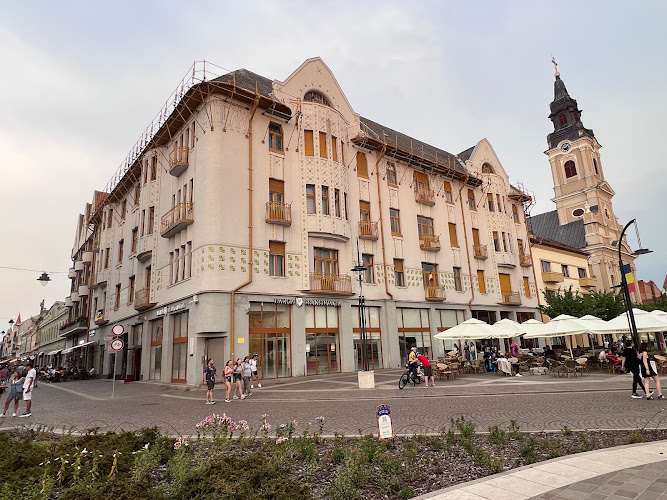
Palatul Moskovits Adolf și Fii

Parcul Petőfi Sándor
Find Accommodations Nearby
Recommended Tours & Activities
Visitor Reviews
There are no reviews yet. Be the first one to write one.
Share Your Experience
Have you visited Episcopal palace, Oradea? Help other travelers by leaving a review.