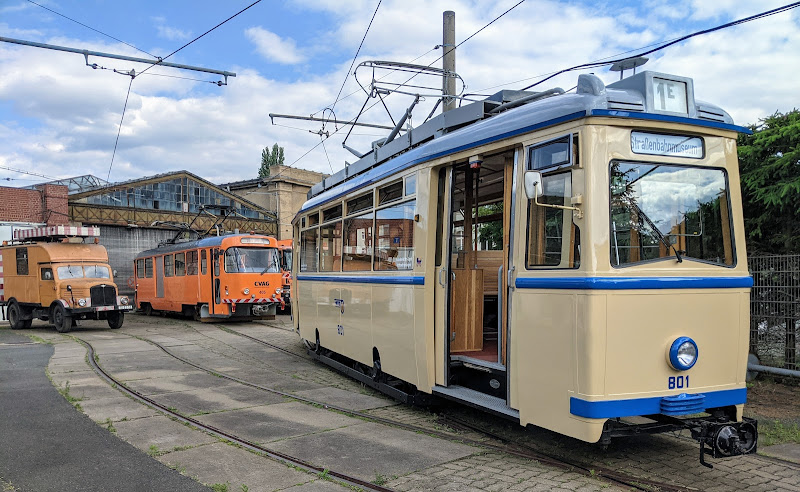
Housed in former depot buildings on Zwickauer Straße, the museum presents a timeline of the region’s streetcar story: early steam and horse-drawn beginnings, elegant pre-war cars, sturdy mid-century vehicles from the Karl-Marx-Stadt era, and the Tatra workhorses that ran across Eastern Europe for decades. It is the sort of place where the past smells faintly of oil and old leather seats, and where a creak in the stairwell or the rattle of a vintage motor feels less like decay and more like character.
Unlike many sterile technocratic collections, this museum lives in its objects. Cars stand in rows in a large depot and in workshop bays where restorations are visible to the public. That means visitors do not only look at trams; they glimpse the processes that keep them alive. Mechanics and volunteers often tinker nearby, polishing brass, replacing wooden slats, or tuning accents that make each vehicle a small, rolling time capsule. On certain days, restored trams run on short heritage routes—an experience that turns the museum visit into a moving history lesson. The sensation of climbing into one of these older cars is unexpectedly intimate: narrow corridors, heavy doors, crank windows, and original signage carry more narrative than most placards ever could.
For travelers who think they know museums, this one offers a refreshingly different rhythm. It mixes technical detail with social history. Panels and displays explain wiring, braking systems, and the evolution of track gauges, but they also tell stories about daily life in Chemnitz: the commute to factories, the morning markets, wartime disruptions, and the later GDR-era adaptations when mass transit had to be practical above all. The collection includes several dozen trams and utility vehicles, plus related artifacts—tools, conductor’s uniforms, signal equipment and archival photos—so the overall impression is comprehensive without being overwhelming.
There is a relaxed, slightly scrappy atmosphere here. It is maintained by a community of volunteers and enthusiasts who impulsively pop up to chat with visitors. Those conversations often turn revealing—someone might point out a particular seat that still bears the burn marks of a long-ago cigarette, or tell a short, wry story about how a tram once broke down during a festival and became an impromptu stage. Such small human details lift the museum from a static exhibit into an ongoing conversation with the city’s past. It’s easy to see why repeat visitors come back; every restoration project or special-run tram changes the place a little, and the museum wears those changes proudly.
Practical note for the mildly obsessive: while much of the signage is in German, many displays are pictorial and intuitive; staff and volunteers are often happy to help in English, especially on busier days. Photography is permitted for personal use, and the light inside the depot—long skylights and high windows—makes for great shots. Visitors with a taste for unusual, tactile history—families, design students, transport fans, and photographers—will find a soothing kind of treasure trove. And if someone happens to enjoy thinking about how cities move, this museum will prompt a dozen interesting thoughts that linger after the visit.
Key Features
- Special events and themed days—often announced seasonally—featuring tram parades, driver demonstrations, and restoration showcases
- Volunteer-run model offers a personable, down-to-earth visitor experience—expect warmth and occasional quirks
Best Time to Visit
The best time to visit depends on what one wants from the experience. Spring through early autumn tends to be the liveliest season: longer daylight hours, more restoration work visible through open doors, and a higher chance of heritage tram operations. If a visitor wants to ride a restored tram, spring and summer offer the best odds because special runs and events are more common then. Weekend mornings are often calm and pleasant, and they let people stroll the depot before guided tours start.
Weekdays can be surprisingly rewarding for people who prefer quieter, reflective visits. With fewer families around, a visitor can spend longer examining the technical displays or photographing details without feeling rushed. Midweek also sometimes coincides with active workshop work, so there’s a chance to see a mechanic or volunteer at a restoration bench—those moments can be like finding a little slice of industrial theater.
For travelers on a tight schedule, it pays to check the museum’s event calendar before planning. Special themed days, restoration reveals, or anniversary parades attract crowds but deliver unique value. Conversely, if someone dislikes crowds, they should avoid announced event weekends and arrive early on any other day. As an aside, the light inside the depot is particularly lovely in late afternoon. Photographers take note: the slanted sun and long shadows show off textures in a way that flat midday light does not.
How to Get There
The museum is located within the urban fabric of Chemnitz and is well connected to public transport. From the city center and the main railway station, local trams and buses provide straightforward connections. Travelers who prefer to use the tram network will find services that run along Zwickauer Straße and nearby corridors; a short walk from the nearest stop brings visitors to the depot buildings housing the museum. Those coming by car will find limited on-site parking and additional street parking in adjacent neighborhoods—arriving early on busy days helps avoid the parking scramble.
For international visitors arriving by train, the route is easy: luggage-friendly tram services and buses from the Hauptbahnhof link to stops close to the museum. Taxis and ride-sharing options are also available and are a convenient choice if someone is traveling in a small group or has mobility needs. Cyclists will appreciate that parts of the neighborhood are bike-friendly; locking up outside the depot is common, and the trip provides a pleasant way to see more of the city en route.
One practical travel tip: because the museum sits in former industrial buildings, the immediate streetscape is authentic but utilitarian. Travelers should allow a few extra minutes to orient themselves upon arrival: the main hall is large and visible from the street, but the entrance can be modest compared with the size of the collection inside. If the weather is poor, short covered walkways help, but wearing weather-appropriate shoes is a good idea—there can be cobbles and tram tracks underfoot.
Tips for Visiting
Plan for at least two hours to explore properly. The museum’s layout encourages slow, curious wandering: it is worth lingering in the restoration bays and revisiting a particular tram that caught one’s eye. For enthusiasts, a half-day is better; there’s always a deeper layer of technical or social detail to discover.
- Bring comfortable shoes. The site is spread across depot halls and workshop areas with uneven surfaces at places.
- Carry a lightweight jacket. Depot spaces can be cool even on warm days because of high ceilings and drafty doors.
- Photography is encouraged. Pack a small tripod if low light photography matters to you, but be mindful of other visitors and restoration work.
- Ask volunteers questions. They love to tell stories—those anecdotes about a tram’s odd paint job or an unexpected parts scavenging mission are gold for understanding the place.
- Families: children often adore the tactile elements, but it’s wise to keep little ones close near the workshops and tracks for safety.
- If a heritage tram run is desired, check event schedules and arrive early. Popular runs can fill up, and some are timed to coincide with guided tours or demonstrations.
- Accessibility: the museum makes an effort, but not every tram is wheelchair-accessible. Phone or message ahead to clarify specific needs before a visit.
- Combine the visit with nearby attractions. The museum sits in a neighborhood with industrial history; a short walk will reveal more of the city’s working-class past and contemporary reinventions.
- Souvenirs and small purchases often support restoration projects. If a visitor appreciates the work, buying a postcard or booklet helps keep the trams rolling.
- Bring patience and curiosity. The museum rewards slow attention. Those who rush through will miss the best bits—the personal stories, the small repairs, the look of a seat that has been sat in for decades.
In short, the Straßenbahnmuseum Chemnitz offers an appealing mix of mechanical detail, social history, and human storytelling. It is practical to reach, rich with texture, and run with a kind of grassroots dedication that makes each visit feel personal. Travelers who enjoy hidden layers of urban history, odd technical brilliance, or simply the pleasure of stepping into a moving past will find this museum a memorable stop in Chemnitz.
 Real Journey Travels