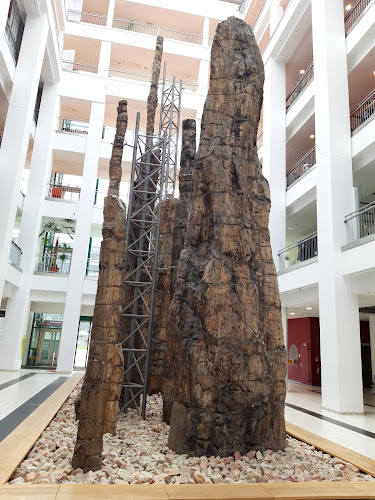
It is not a blockbuster, and that’s part of its charm — the museum feels like a well-loved cabinet of wonders rather than an overdesigned theme-park space. Visitors will find a concentrated, thoughtfully arranged collection that leans heavily into regional geology and paleontology, with special emphasis on the famous Chemnitz petrified forest and plant fossils from the Permian era. Those long-dead landscapes — turned to stone over roughly 290 million years — are the museum’s headline act, and they still manage to feel a little uncanny when seen up close.
Exhibits are arranged so that learning creeps up on you. Large display cases of petrified wood and fossilized plants sit beside explanatory panels that combine basic science with local history: how these fossils were discovered, why Chemnitz is important in the story of central German paleontology, and what the stones can tell us about ancient climates and ecosystems. The museum mixes specimen-focused displays with occasional dioramas and explanatory maps, so it works for folks who want slow, close-up study as well as those who prefer a quicker tour. And yes, kids are welcome — the layout and the tactile way many specimens are presented make it a surprisingly good day out for families. Expect interactive elements aimed at children that simplify complex ideas without talking down to them.
Accessibility is taken seriously here in a practical way. The building offers a wheelchair accessible entrance, accessible restrooms, and accessible parking, which makes it easier for many visitors to relax and spend time with the exhibits. Practical note: there is no on-site restaurant, so plan snacks or a nearby café stop into the day. Public signage is generally clear, although a few of the older panels are in German only; visitors with limited German might find that a little frustrating, but the specimen labels and visual displays often do most of the communicating anyway.
One of the memorable things about the museum is its scale. This is not an enormous, overwhelming institution. It is compact enough that a focused visit takes a couple of hours, but deep enough that a curious person can happily linger for much longer. The collection includes not only petrified trees and plant fossils but also paleontological finds, geological samples, and educational exhibits on evolution and the history of life in Saxony and central Germany. There is a modest but solid sense of research behind what is shown: notes about ongoing investigations, mentions of scientific methods, and displays that hint at the museum’s role beyond exhibition — in research and preservation.
Atmosphere-wise, the place has character rather than gloss. Lighting is functional rather than theatrical, which suits the subject matter (stone and bone don’t need neon), and the staff tend to be engaged and helpful. People who are into natural history will appreciate the care given to the specimens; casual visitors will likely be surprised at how quickly the subject draws them in. A frequent visitor once remarked that the museum is the sort of place where a single fossil slab can stop a whole family in their tracks — and it’s true. The petrified forest displays, in particular, offer that small-moment awe that museums seek to create without trying too hard.
For travelers planning a museum-rich day in Chemnitz, the Museum für Naturkunde serves as both a destination and a complement to the city’s other cultural offerings. It gives context to the local landscape and deep time in a way that many larger institutions don’t: by focusing on the local story, the museum connects visitors to a surprising prehistoric past that unfolded right where they are standing. It’s educational, yes, but also quietly evocative — and if the weather’s not ideal for wandering the city, it’s a perfectly sensible indoor choice that won’t eat up the whole day.
Some practical caveats: the small size means popular weekend hours can feel a bit busier, and the signage language mix means that those seeking exhaustive English labels might be slightly disappointed. But most visitors find the trade-off acceptable; the specimens themselves are the main event, and the museum delivers on that promise. Overall, the Museum für Naturkunde in Chemnitz comes across as authentic, focused, and pleasantly low-friction for families and accessibility-minded travelers. Visitors who like to leave a museum feeling they’ve actually learned something specific — not just grazed a lot of highlights — will probably come away satisfied.
 Real Journey Travels