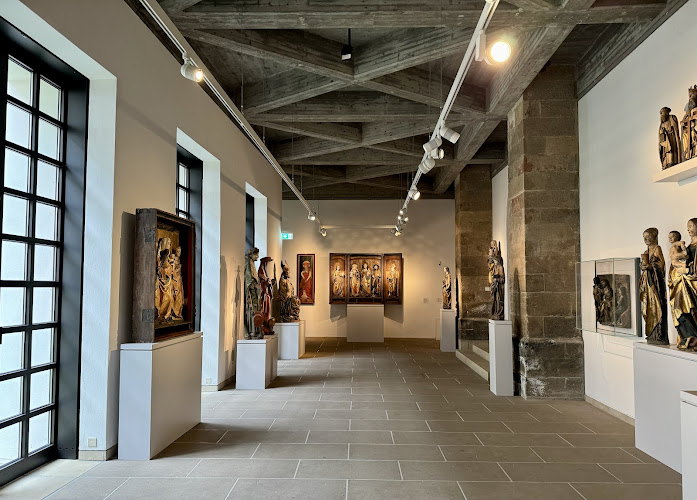
Housed in a former Benedictine monastery founded around 1135 by Emperor Lothar, the museum is both a history museum and a local history museum—an institution devoted to Chemnitz, to Saxony, and to the slow, patient work of buildings that outlast empires.
Architecturally, the site is a patchwork of eras that actually makes sense when one stops trying to see everything at once. The roman south apse dates back to roughly 1150, a quiet, rounded remnant from the founding phase; the early Gothic east wing is from about 1275, more severe, more vertical; and the south wing with the church is a late Gothic statement associated with the last abbots, Heinrich von Schleinitz and Hilarius von Rehburg, whose building activity ran between 1483 and 1539. Those dates matter because they give the Schloßbergmuseum Chemnitz a layered personality—medieval foundations, gothic gravitas, and a modern museum heartbeat all in one.
Inside, the museum focuses on city history and cultural heritage—exhibits that map Chemnitz from its medieval origins through industrialization and into the 20th century. The display strategy often relies on tangible, tactile objects: models of the town, municipal artifacts, photographs, and everyday items that somehow say more about people’s lives than a thousand flowery phrases. Visitors will find collections that address art and urban development, as well as thematic rooms that make city life feel immediate rather than distant. The Schloßbergmuseum does not pretend to be an enormous national institution; instead it aims for depth about place, showing how a regional history ties into the broader story of Saxony and Germany.
One of the more charming and lesser-known aspects is the inclusion of Burg Rabenstein, described locally as Saxony’s smallest castle. That little stronghold belongs to the museum complex and adds a castle-y flourish to an already interesting historic site—think of it as an unexpected bonus: medieval masonry with a tiny, proud silhouette that begs to be photographed. For anyone who likes castles but is tired of the same postcard images, Burg Rabenstein offers a pleasantly intimate alternative.
The physical experience of visiting the museum is part of the story too. Cloistered arcades, thick stone walls, and corridors that once echoed with monastic life are now re-purposed to hold glass cases and interpretive panels. The contrasts are interesting: one side of a courtyard might hint at silence and prayer, while the other hosts hands-on displays aimed at younger visitors. The Schloßbergmuseum Chemnitz manages to feel reverent without being dusty. And yes, there are moments where the old mortar gives off that musty-but-comforting smell that people who love old buildings instantly adore.
Accessibility has been taken seriously. The museum offers a wheelchair accessible entrance and parking, along with accessible restrooms—details that often make or break a visit for many travelers. Amenities include a small restaurant space where visitors can pause for coffee and cake; nothing pretentious, but practical, welcome. Families are welcomed with kid-friendly exhibits and discounts for children, which makes the museum a reliable option for parents exploring Chemnitz. The combination of historic architecture and family-oriented content gives it a slightly unexpected family-friendly vibe—parents can indulge their own curiosity and still keep kids engaged.
For the historically inclined, the site is a compact seminar in medieval monastic architecture. There is a real educational advantage to seeing building phases side by side: the roman south apse, the early Gothic east wing, and the late Gothic additions create a timeline one can trace with fingers on stone. The Schloßbergmuseum Chemnitz is not just about display cases; it’s about reading a building. Guidebooks will tell you the same facts, but standing beneath a ribbed vault or beside a buttressed wall—those are the moments that make history feel like a lived thing.
Curatorial choices tend to favor clarity over spectacle. Exhibitions are curated to highlight city development, industrial heritage, and local cultural identity, often with a careful hand when presenting difficult 20th century topics. The museum includes interpretive material that helps place Chemnitz within larger historical currents—industrial booms, political changes, cultural developments. Visitors who enjoy piecing together narrative threads will leave satisfied: the Schloßbergmuseum Chemnitz rewards slow attention, curiosity, and a willingness to read labels closely.
There are also quieter pleasures: small carved details in the cloister, the play of light against old stone in late afternoon, and the occasional temporary exhibition that brings contemporary questions into dialogue with the long span of the site’s history. The museum staff are generally helpful; on a rainy January afternoon this writer remembers getting a recommendation for a local pastry that turned an otherwise gray day into an unexpectedly pleasant stop between museums. Little human touches like that matter. They turn a museum visit from a passive viewing into a short-lived relationship with a place.
For photographers and Instagram folks who like atmospheric shots, the Schloßbergmuseum Chemnitz presents numerous framing opportunities. The inner courtyard framed by arched walkways makes for a moody shot, while details like aged wooden doors, stone carvings, and the compact silhouette of Burg Rabenstein are perfect for closeups. That said, the museum is mindful of preservation. Flash photography and large tripods are often discouraged because the place cares not only about looks but longevity.
Practical-minded travelers should note that the museum sits above the Chemnitz river on a hill—the elevation means views toward parts of the city are possible from the complex, adding a landscape dimension to a history-focused visit. Those who enjoy combining indoor and outdoor exploration can easily pair a museum visit with a short stroll along adjacent streets or a quick detour to nearby civic landmarks. In that sense the Schloßbergmuseum Chemnitz is an anchor for a compact, walkable exploration of the surrounding district.
Visitors interested in thematic depth—say medieval ecclesiastical life, urban growth, or Saxony’s architectural transitions—will find ample material to dig into. The museum often serves as a starting point for students, researchers, and curious travelers who want texture and specificity rather than sweeping generalities. And for those who just like to be in neat old stones, the place offers that special calm that only centuries of careful maintenance can provide.
Lastly: the experience here is quietly local. This is not a glossy, international blockbuster museum; it’s a city museum with character. That sometimes means signage is more useful in German than in other languages, though key panels and staff assistance usually bridge the gap. The Schloßbergmuseum Chemnitz is a recommendation for travelers who like their history rooted in place, who enjoy architectural detail, and who appreciate museums that respect both the past and the practical needs of present-day visitors. It is a museum that invites you to slow down, to read stone and object alike, and to leave with a clearer sense of how Chemnitz came to be.
 Real Journey Travels