History and Significance

Behind an unassuming doorway in Lahore’s bustling Bhati Gate quarter lies one of South Asia’s best-kept secrets – the Fakir Khana Museum, a private collection so vast it makes the British Museum look understocked. Established in 1901 by the Fakir family (originally Sikh merchants who converted to Islam), this 22-room treasure house contains over 20,000 artifacts spanning 3,000 years of subcontinental history.
What makes this museum extraordinary isn’t just its contents, but its living museum concept. For six generations, the Fakir family has preserved this collection in their ancestral haveli, opening their home to visitors while continuing to live among Mughal miniatures, Sikh-era weaponry, and colonial curiosities. When UNESCO called it “the largest private museum in South Asia,” they weren’t exaggerating – this is Lahore’s attic, overflowing with stories.
Main Attractions and Activities
Collection Highlights
Mughal Miniatures: Over 10,000 paintings including rare works by court artists Mansur and Abd us-Samad
Porcelain Gallery: Chinese vases gifted to Maharaja Ranjit Singh by Emperor Qianlong
Armory: Sikh-era daggers with nephrite handles, a 17th-century cannon that fires rosewater
Textile Collection: Shawls so fine they could pass through a finger ring (and do, during demonstrations)
Carpet Room: A 16th-century Persian carpet with silver and gold thread that took three generations to complete
Interactive Experiences
Family Guided Tours: Current curator Fakir Syed Saifuddin or his cousins personally escort visitors
Calligraphy Demonstrations: Watch masters recreate Mughal scripts with traditional tools
Miniature Painting Workshops: Monthly sessions teaching this dying art
Object Handling: Carefully selected artifacts guests can touch (with cotton gloves)
Special Exhibits
“Gifts Between Kings”: Diplomatic presents exchanged between the Sikh and British rulers
“The Fakir Family Story”: How merchants became custodians of history
“Hidden Lahore”: Rare cityscapes showing lost architectural gems
Visitor Experience
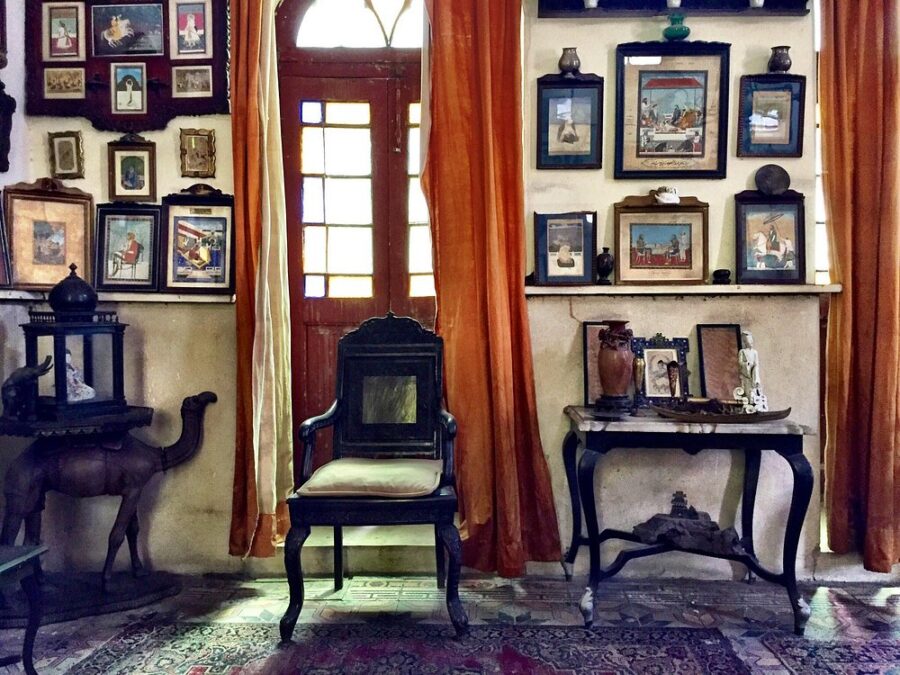
Entering Fakir Khana feels like stepping into a time capsule. The air carries the comforting scent of aged paper, sandalwood storage chests, and the occasional whiff of chai brewing in the family kitchen. Each room overflows with artifacts – not clinically displayed behind glass, but living alongside the family’s modern belongings. A 17th-century jade cup might sit beside today’s newspaper; a Mughal miniature hangs above a child’s school backpack.
The experience is intensely personal:
Family members recount ancestor Fakir Nooruddin’s friendship with Maharaja Ranjit Singh
Grandmother Fakir occasionally emerges to tell stories of pre-Partition Lahore
Younger generations explain conservation challenges with a 21st-century perspective
Tours often end in the family courtyard with Kashmiri chai and homemade baklava, turning a museum visit into something resembling a visit to wise, art-obsessed relatives.
Tips for Visitors
Book in Advance: Tours are by appointment only (call +92 300 849 6740)
Timing: Morning visits catch the best light for viewing miniatures
Footwear: Remove shoes at the entrance (socks recommended in winter)
Photography: Permitted but no flash (extra fee for professional cameras)
Cash Only: Entry fee (around PKR 500) includes guided tour
Combine Your Visit: The Nearby Wazir Khan Mosque makes a perfect pairing
Gifts: Consider bringing a small present for the family – British visitors often bring Fortnum & Mason teas
Accessibility and Facilities
As a centuries-old haveli, accessibility has limitations:
Narrow staircases to upper floors
No wheelchair access to most galleries
Limited seating during tours
Basic restroom facilities
That said, the family makes exceptional accommodations:
Portable stools for elderly visitors
Magnifying glasses for examining details
English/Hindi/Urdu tours available
First-floor exhibits can be shown to mobility-impaired guests
Unique Features
What makes Fakir Khana incomparable:
Living Museum Concept: The Family still uses some historic items daily
Oral Histories: Stories passed down six generations
Conservation Lab: Where family members repair artifacts using traditional methods
The “Forgery Wall”: Showing how to spot fake miniatures
Time Capsule Room: Left exactly as in 1947 Partition days
Overall Impressions
Fakir Khana redefines what a museum can be – not a sterile gallery but a vibrant, breathing archive of lived history. The collection’s sheer breadth overwhelms (in the best way), from the world’s smallest Quran (written on a single grain of rice) to Ranjit Singh’s whisky set (yes, the “Lion of Punjab” enjoyed Scotch).
You’ll leave with your senses full – the glint of gold leaf in miniatures, the smoothness of jade weapon handles, the warmth of the family’s hospitality. More than artifacts, this museum preserves the human connections behind history – the gifts between rulers, the craftsmen’s signatures hidden in paintings, the stories whispered through generations.
Pros and Cons
Pros
Unparalleled collection of subcontinental art and history
Personal guided tours by passionate family members
Intimate access to normally restricted artifacts
Living history experience unlike any museum
Affordable entry for world-class collection
Cons
Limited accessibility in a historic building
No formal climate control (concerns for conservation)
It can feel overwhelming due to the collection density
No proper cataloging system (charmingly chaotic)
Limited visitor facilities (no proper cafe/shop)
Fakir Khana is Lahore’s best-kept cultural secret – a place where history feels alive, personal, and deliciously chaotic. Whether you’re an art historian, a Partition buff, or simply someone who appreciates extraordinary passion projects, this museum-home offers an experience no institution can replicate.
As current curator Saifuddin often says: “These objects aren’t ours – we’re just their temporary caretakers.” After visiting, you’ll understand why this family has devoted generations to preserving Pakistan’s multilayered heritage. Just don’t be surprised if you find yourself booking a return visit before you’ve even left the haveli’s enchanted confines.