
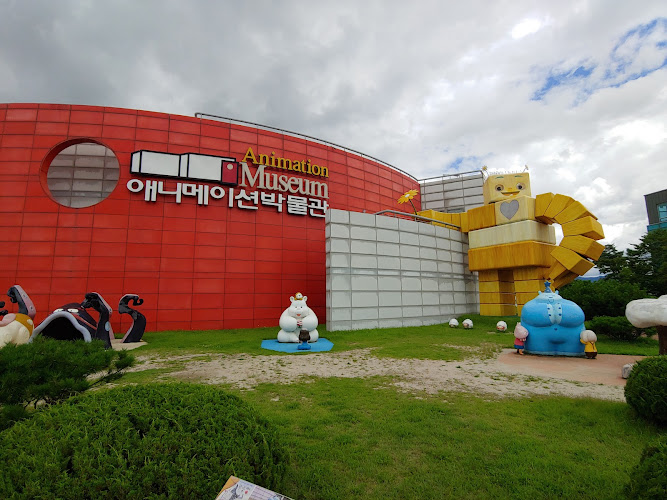
Animation Museum
About Animation Museum
Description
The Animation Museum in Chuncheon is an immersive, slightly quirky celebration of moving pictures and mechanical play that sits in Gangwon-do with a personality all its own. It presents a colorful collection of displays tracing the history and art of animation in Korea and beyond, with an emphasis on hands-on experiences that actually make people laugh out loud or lean in and say, ah — I get it now. The museum mixes traditional exhibits—original cels, storyboards, archival sketches—with interactive installations, a working Robot Studio where visitors can see small robots perform or even try simple programming, and periodic live performances that give the whole place a lively pulse. Visitors come for the animation history and stay because the place invites tinkering and curiosity.
Unlike a sterile gallery where one tiptoes around, this museum encourages touch, play, and questions. The Robot Studio is the kind of attraction that sparks repeat visits: a compact workshop-like space with demo robots, motion-sensor displays, and workshops for kids. It’s not Disneyland elaborate, but it’s delightfully earnest — the sort of place where a small mechanical arm trying to wave will convince even the most jaded adult to clap. And to be honest, the live performances are a highlight; short shows combine puppetry, projection, and simple robotics to tell stories that are surprisingly sophisticated for their runtime. They are curated to appeal to families and animation aficionados alike.
From a design perspective, the museum uses vivid color palettes, large-scale still frames, and friendly signage to guide visitors through themes such as character design, frame-by-frame techniques, and the evolution of Korean animation. Exhibits periodically rotate, so returning visitors often find new material. There is a thoughtful nod to local artistry: the museum features Korean animation milestones alongside international examples, placing the regional scene within a global context. This balance of local and global helps visitors appreciate how Korean animation developed, and why Chuncheon now hosts such an animation-focused attraction within Gangwon province.
Practical amenities are well-covered here, which matters when someone’s planning a family day out. The museum provides accessible entrances, accessible parking, and wheelchair accessible restrooms — not a token mention but evident in the facility layout. There’s a small restaurant for refueling, clean restrooms with changing tables for families with infants, and plenty of places to sit and watch demo reels or recharge a phone. These sorts of considerate touches are easy to take for granted until they’re not available at other spots — and good on the museum for getting the basics right.
That said, the place isn’t without its charm-related compromises. Some visitors note that parts of the collection feel compact or that certain exhibits aim more for playful interaction than deep academic coverage. Which is fair; the museum’s goal is to ignite interest and present accessible, hands-on learning rather than to compete with a large national archive. The curatorial voice leans toward storytelling and discovery rather than exhaustive scholarship, so expect narrative panels and playful displays more than long, dense treatises on technique. For many, that’s precisely the point: it’s a museum that wants you to leave inspired to make something, not weighed down by footnotes.
When the writer first wandered into the Robot Studio, he remembers watching a shy child step up to a small robot and then beam when the machine returned a tiny bow. That memory is telling: the museum works best when approached with curiosity and a willingness to interact. Workshops and short demo sessions are scheduled regularly; these are often run by enthusiastic staff who explain complex ideas—like interpolation or onion-skinning—in plain language. If one wants a more structured experience, looking into workshop times ahead of a visit can be helpful, because those moments are when the museum’s educational side shines brightest.
For travelers planning an itinerary around Chuncheon, the museum is a nice cultural counterpoint to outdoor attractions like nearby lakes and parks. It’s small enough to visit as a half-day stop but layered enough that animation buffs could easily spend a few hours exploring. The exhibition flow tends to be linear and easy to follow: visitors typically progress from historical timelines and production tools to contemporary screens and the hands-on Robot Studio. Along the way, there are photo-op corners with stylized characters and projection walls that encourage playful snapshots—so bring a camera, even if just to capture a moment of a tiny robot handing over a paper prop like it’s the most important thing in the world.
Language accessibility is decent. Exhibit text is mostly in Korean, but many panels include English summaries, and staff often have basic English skills. For non-Korean speakers, the visual and hands-on components are particularly friendly — the museum’s strength is showing rather than telling. Visitors who want more depth can sometimes request brief guided introductions or pick up bilingual leaflets when available. Still, if someone is hoping for full multilingual audio guides, that might be a stretch; expect the museum to cater primarily to a domestic audience while being welcoming to international travelers.
There is a slightly uneven mixture of old-school charm and modern tech here, and that dichotomy is actually a strength. One might find vintage animation tools displayed near a touchscreen demonstrating modern frame sequencing, and the juxtaposition invites reflection on how far animation techniques have come. The museum frames animation as both an art form and a technical craft. It doesn’t shy away from showing the messy sketches and discarded ideas that lead to beloved characters; seeing those rough drafts humanizes the creative process, making the final polished works feel all the more miraculous.
Families tend to find the museum particularly rewarding. The children’s areas are designed with safety and playfulness in mind: low displays, interactive stations, and staff-led activities that appeal to younger visitors. Changing tables and family-friendly restrooms make long days less of a logistical headache. If someone’s traveling with very young kids, planning for a mix of structured demos and free play will usually keep everyone happy. The museum’s energy is upbeat and unpretentious, and parents often comment that kids leave inspired to draw, make little flipbooks, or even tinker with simple robotics at home.
For solo travelers or animation students, the museum offers moments of quiet discovery: tucked display cases with original art, timeline panels that trace Korean animation’s development, and short curated film loops that highlight key works. These are the sections that reward slower, focused visits. It’s the kind of place where lingering pays off — watch one short film twice, read the production notes, and then step into the Robot Studio to see theory become practice. Students of animation often leave with fresh ideas for projects, and occasionally the museum hosts small talks or screenings that bring local creators to the fore.
Practical travel notes worth keeping in mind: the museum gets busier during school holidays and weekends, particularly because of its family-friendly offerings and live performances. If someone prefers a quieter visit, weekday afternoons or morning openings are usually calmer. The facility is compact, so arrival timing matters for catching scheduled performances without feeling rushed. Tickets are affordable relative to the experience, and the overall vibe is approachable rather than formal: people tend to stay a relaxed hour or two, sometimes longer if a workshop aligns with their visit.
Finally, the Animation Museum in Chuncheon is one of those places that rewards visitors who come with curiosity and an appetite for play. It may not be the largest museum in Korea, but it makes efficient, thoughtful use of space and programming to celebrate animation as both an art and a technology. Whether someone is a family looking for a fun educational outing, a student hunting for inspiration, or a traveler wanting a local cultural experience in Gangwon province, the museum offers an honest, engaging slice of animation culture that often surprises and delights. And if one leaves humming a short theme tune or plotting a tiny flipbook project, well, that’s the sign of a good visit.
Key Features
Animation Museum
Tours & Activities
GetYourGuide provides this tour inventory. We may earn a commission if you book through it; verify current availability, prices, and terms with the provider.
Visitor Reviews
There are no reviews yet. Be the first one to write one.
Share Your Experience
Have you visited Animation Museum? Help other travelers by leaving a review.