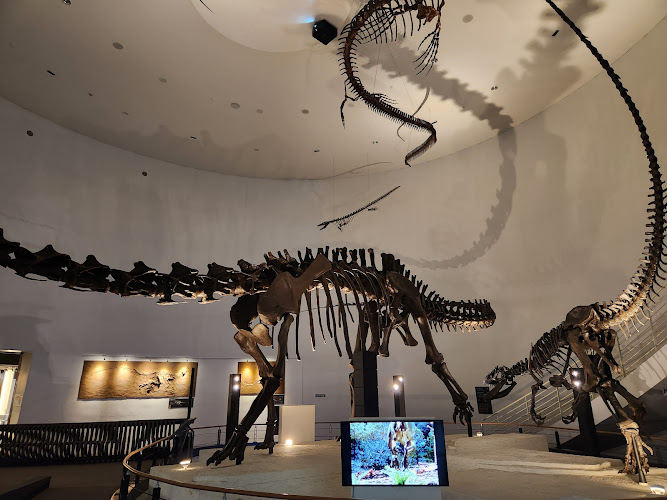
It sits within the cultural fabric of the port city and acts as a kind of neighborhood classroom for curious kids, amateur paleontologists, and travelers who want something a bit different from the usual seafood-and-harbor itinerary. Visitors will find a mix of permanent exhibits and rotating displays, interpretive signage in Korean (and often some English), and child-friendly layouts that make the museum both approachable and educational.
What stands out first is the approachable scale. This is not an enormous national museum that swallows a day; it’s a mid-sized museum with galleries arranged so that someone can comfortably explore the highlights in an hour or two while still finding plenty of surprises if they linger. The dinosaur displays—models, skeletal casts, and explanatory panels about regional paleontology—are the obvious crowd-pleasers, especially for families. But the museum also houses exhibits on local ecosystems, fossils, and specimens that tie Mokpo to the wider patterns of life in the Southwest of the Korean peninsula. It offers a snapshot of natural history that connects global themes (evolution, fossilization, marine biodiversity) with local geology and ecology.
Practical accessibility is a real strength here. The museum provides a wheelchair-accessible entrance and parking, and restrooms are designed to be accessible as well. That accessibility quietly signals that the place intends to be welcoming — not performative, but practical. Caregivers and visitors with mobility needs generally report fewer logistical headaches than in many smaller museums. There is no on-site restaurant, so plan accordingly. Restrooms are available inside, and the layout is kid-friendly: wide corridors, clear sightlines, and exhibits at a range of heights for little hands and shorter visitors.
Education is clearly a priority. School groups turn up regularly, and the museum’s programming often includes guided tours or brief talks aimed at younger audiences. If one is traveling with children, the museum is a solid stop. Children can point, touch (in designated areas), and try simple interactive stations that explain complex processes—like how fossils form or how marine food webs work—without dumbing anything down. Adults who enjoy a calmer, more reflective museum experience will appreciate the balance: enough detail for history and science buffs, enough simplicity to make the visit feel effortless.
Atmosphere-wise, the place strikes a friendly mid-tone. It is clean and well-signposted, though not slick; think municipal-museum professionalism, not super-polished corporate gloss. That has its charms. Exhibits feel curated by people who care about natural history and local context rather than by designers chasing headlines. The lighting and display cases are practical. Labels are informative. And yes, sometimes signage assumes some Korean literacy; non-Korean speakers may need to lean on an app or a patient guide. That said, many labels include short English summaries and there are often English-language materials available for popular exhibits—just don’t expect everything to be fully bilingual.
For travelers who like to stitch together small cultural stops into a full day, the museum fits neatly into a Mokpo itinerary. It pairs well with a harbor stroll, a coffee stop near the port, or a visit to local cultural sites. Those who come from farther afield—say from Gwangju or even Seoul as a day trip to explore the southwestern coast—will find the museum offers an educational pause from the usual tourist rhythm. Locals appreciate it too; the museum hosts occasional community events and surveys that show a steady stream of repeat visitors, so it’s more than just a tourist stop. It functions as a local institution.
There are a few caveats worth mentioning, honestly. Because it’s modest in size, the museum can feel a bit compact on busy weekend afternoons when school groups are in residence. And while many exhibits are engaging, the most specialized natural-history nerds might find the scope narrower than that of larger metropolitan museums in Seoul or Daejeon. But those apparent limitations are also benefits: the smaller scale makes the content digestible, and the focused approach means exhibits are often deeper in the subjects they do cover, particularly regional paleontology and marine ecosystems.
Unique features that travelers often mention—without being corny about it—include a small paleontology corner that highlights fossils found in the region, and thoughtful displays that connect Mokpo’s maritime identity with marine biodiversity. The dinosaur presentations are staged to excite (models, impressive casts) while also providing context about Korea’s place in the paleontological record. And for those who like to geek out a little: the museum sometimes hosts temporary exhibitions or community science events that reveal unexpected things about local geology and environmental history. If you get lucky, you might catch a short lecture or a fossil-cleaning demo—low-fi but charming.
From a traveler’s planning perspective, the museum is easy to slot into a day in Mokpo. Parking and access are straightforward, the layout makes efficient use of time, and the experience tends to be relaxing rather than rushed. It is especially attractive to families: it’s well-suited for children, and provides a calmer, educational alternative to the more crowded tourist sights. And hey, for anyone who has spent too much time in noisy markets and crowded piers, this museum offers quiet, informative refuge—a place to sit, look, and digest a bit of natural history.
One little anecdote, because those tiny human moments stick with travelers: a local guide once pointed out how a group of schoolchildren clustered around a single fossil cast, voices hushed in that concentrated way kids do when they suddenly notice something enormous and ancient. The guide said the museum’s quiet power is exactly this—how it turns moments of wonder into small, teachable pauses. That memory is helpful to picture the place: not a spectacle, but a series of moments that, together, make for a satisfying visit.
SEO-wise, the Mokpo Natural History Museum is often searched by travelers using terms like Mokpo museum, natural history museum in Mokpo, Mokpo dinosaur exhibits, and things along those lines. Writers and content managers should emphasize practical details (accessibility, family-friendly, no on-site restaurant) alongside the thematic draws (dinosaur displays, regional fossils, marine life exhibits). Doing that makes the museum findable and appealing to trip planners looking for educational stops in Jeollanam-do and the broader Southwest Korea region.
In short: the Mokpo Natural History Museum is a well-run, accessible, and quietly engaging natural history museum in Mokpo that appeals especially to families and anyone curious about dinosaurs, fossils, and marine life. It’s not the biggest or flashiest, but it is thoughtful, local in focus, and consistently useful for travelers who want to deepen their understanding of the region’s natural past. Worth a stop? Very much so—especially if you like museums that respect your time and reward curiosity.
 Real Journey Travels