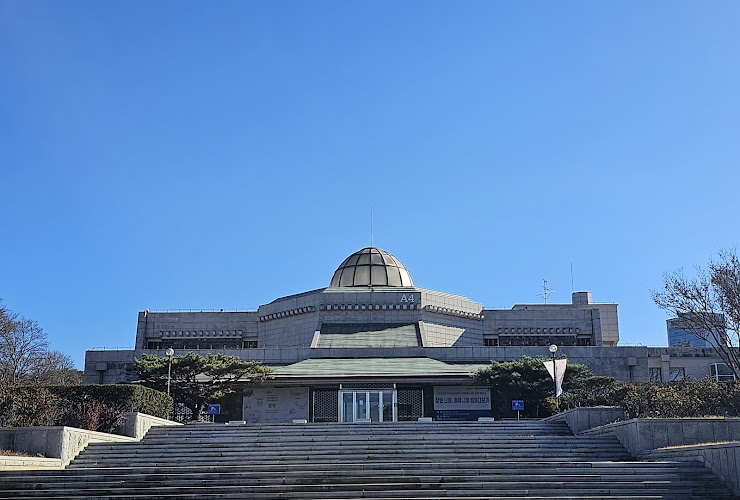
It is a university museum in the truest sense: part teaching collection, part public gallery, and part research repository. Visitors who wander in expecting a massive metropolitan institution will find instead a focused, carefully curated experience that often rewards patience and curiosity.
Exhibits range from archaeological finds and historical objects tied to the Gyeongsangbuk region to rotating displays that highlight student research, faculty projects, and local cultural traditions. The museum balances the academic with the accessible, so that a history student, an art lover, and a family with curious kids can all find something of interest. The layout is compact enough to explore in an hour, but rich enough that those who linger can discover unexpected details — pottery shards with delicate brushwork, old maps that show how the landscape changed, or a collection of vernacular tools that reveal daily life in previous centuries.
Accessibility is straightforward here. The building provides a wheelchair accessible entrance, accessible restroom facilities, and a parking lot designed for visitors with mobility needs. Visitors with strollers or small children report that it’s easy to navigate, which helps when one wants to combine a museum stop with a stroll around the leafy campus. Restroom facilities are available on-site, though visitors should note there is no dedicated restaurant inside the museum; light snacks and cafés can be found elsewhere on campus or in nearby Gyeongsan-si neighborhoods.
What sets this museum apart is its position at the crossroads of higher education and local culture. Unlike larger city museums that often prioritize blockbuster shows, the Yeungnam University Museum has the freedom to showcase academic depth: student-curated exhibitions, faculty-led interpretations, and artifacts tied directly to ongoing research. That academic slant can be unexpectedly charming. A visitor might stumble upon a display built by archaeology students, complete with handwritten notes and a palpable sense of discovery. It feels honest. And yes, sometimes a label is a bit more technical than a tourist might want — but that technicality is also the point: the museum is a place of learning.
Families with children tend to rate the museum highly because many exhibits are presented in a clear, tangible way. There are hands-on learning moments, or at least objects close enough to examine that a child’s imagination can run wild. If a family is traveling through Gyeongsan-si and wants a cultural stop that won’t exhaust little legs, this is a sensible pick. The museum’s scale makes it a gentle, manageable outing rather than an all-day commitment.
For visitors who care about photographic opportunities, the museum offers several visually interesting corners. Traditional artifacts, folk objects, and carefully lit cases provide good shots for social media or personal travel logs. But the museum is primarily an educational space, and photography etiquette matters: flash is generally discouraged and some pieces may be off-limits for photos. Still, the spaces themselves — a quiet gallery, a study room with display cabinets — create a restful mood that translates well onto a camera, when permitted.
One often-overlooked advantage of visiting the Yeungnam University Museum is the chance to experience campus life at a mid-sized Korean university. During term time, the museum hums lightly with student traffic: classes doing projects, professors leading groups, international students translating labels aloud. It’s an authentic slice of everyday academic culture. On quieter days, the galleries feel almost private, like a study nook for history lovers. That ebb and flow gives the museum character; it’s never exactly the same from one visit to the next.
It’s fair to say the museum isn’t trying to compete with Seoul’s big-name institutions. Instead, it leverages local strengths: a strong academic network, regional artifacts, and community-oriented programming. Visitors interested in Korean history and culture will appreciate the focus on Gyeongsangbuk-do context and the way exhibits connect to broader narratives in Korean archaeology and social history. For travelers who want to add depth to a trip to Daegu or to explore beyond typical tourist hubs, this museum is a revealing detour.
And yet, there are small caveats to keep in mind. The museum’s interpretive signage can be mixed — some labels are excellent, with bilingual explanations and clear timelines; others lean toward academic brevity and may assume background knowledge. But for those curious enough to ask staff or who bring a translation app, the gaps rarely spoil the visit. The museum also periodically reshuffles exhibits as part of educational programming, which means the most popular pieces may not always be on display. That can be disappointing, but it also encourages repeat visits. There’s a modest charm to knowing a display is part of a living curriculum rather than a permanent spectacle.
Practical features matter. Admission policies occasionally favor students and local residents, and educational programs for children and school groups are common. The museum’s staff, often university-affiliated, are usually receptive to questions. Short guided explanations — sometimes delivered by students — can turn an ordinary visit into a memorable exchange. Visitors who enjoy conversations about provenance, conservation, or the story behind an object will find staff and student guides eager to chat and share their knowledge.
For travel planners, the Yeungnam University Museum is effective as a half-day stop. It pairs well with a walk around campus, a visit to nearby cultural sites in Gyeongsan-si, or a short trip into Daegu. Because the museum sits on campus, it’s also an easy inclusion when attending university events like public lectures, cultural festivals, or student exhibitions. Those serendipitous overlaps — hitting a museum opening on the same day as a campus festival — are the kinds of travel memories that stick.
From an experiential standpoint, the museum rewards slow observation. Rather than rushing through every case, sitting with a single artifact and reading the accompanying research note yields a deeper appreciation. The museum’s tone is quietly scholarly; visitors who enjoy piecing together context, exploring regional history, or understanding how academic collections are used in teaching will feel at home.
In short, the Yeungnam University Museum in Gyeongsan-si is a thoughtfully curated, accessible, and academically minded museum that brings regional history and university scholarship into public view. It won’t overwhelm with pretension or bluster. Instead, it invites exploration, conversation, and the occasional delightful surprise — like discovering a student-curated exhibit that reveals a new way to look at everyday objects. For travelers seeking meaningful cultural stops in South Korea outside the usual tourist corridors, this museum is a rewarding choice.
 Real Journey Travels