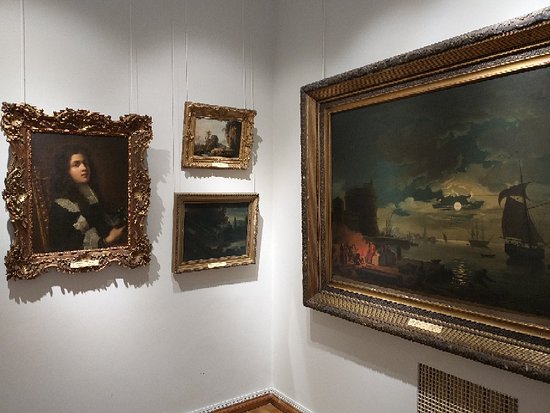
The museum’s collection leans toward paintings and works on paper, alongside decorative arts and smaller sculptural pieces that reveal crafts, tastes, and techniques from the 19th century through the 20th century and into contemporary practice. For travelers who love museums that reward curiosity rather than merely impress with spectacle, this regional art museum offers a kind of intimacy that often gets missed in big-city institutions.
Visitors will notice, right away, the emphasis on Ukrainian art. There are both familiar national themes and distinct local voices: portraits, landscapes that show the flat expanses and river bends of the northeast, and genre scenes that feature everyday life in villages and towns. Several galleries focus on regional artists whose names may not appear in guidebooks but whose works supply a narrative thread through Sumy’s cultural history. Those threads are valuable. They give a sense of continuity and context, connecting the city’s present with the people who shaped its aesthetic identity.
One thing that stands out about the museum — and this is not always advertised loudly — is its collection of smaller, lesser-known paintings that reveal technical experimentation. A traveler who slows down and reads labels will find steps in style between realism and early modern experiments, visual evidence of how Ukrainian artists navigated large political and cultural changes across the centuries. And yes, there are some surprisingly bold color choices in places; a few canvases practically insist that visitors stop and stare.
The building itself is modest, not designed to astonish. That can be a relief. Without overpowering architecture, the art gets to be the focal point. The circulation is straightforward and easy to follow, which is especially nice for people who prefer linear visits or for families who need to keep track of children in galleries. Speaking of families: the museum advertises itself as good for kids. There are accessible display heights in some rooms and a few interactive or visually engaging pieces that children tend to gravitate toward. Parents should bring snacks and a quiet bag of activities though, because the museum does not operate like a family entertainment center — it’s a calm, contemplative space with pockets of wonder.
Practical realities are part of the picture here. The museum provides restrooms for visitors, which is always appreciated when touring several sites in town. There is no on-site restaurant, and parking facilities adjacent to the entrance are limited. In fact, the main entrance and parking are not wheelchair accessible in the traditional sense, so visitors with mobility needs should plan ahead and contact local visitor services or the museum to discuss accommodations. The museum staff are often helpful and willing to assist when they can, but the building’s older layout means that full accessibility is imperfect.
Atmospherically, the museum has a lived-in feel — a little like a well-kept attic of culture, only more organized. There’s a faint scent of old varnish and paper that lingers in some rooms, a smell that many collectors and long-time museumgoers will find oddly comforting. It’s one of those sensory details that makes a visit feel real, like being let into a private conversation about heritage and craft. And yes, it may be that on a rainy afternoon the lighting and narrow corridors create a slightly introspective mood; perfect for reflective viewing, less perfect for large groups with lots of chatter.
Curators here have a clear focus on regional art, but they also situate that local story within broader movements in Ukrainian and Eastern European art. Exhibitions rotate periodically, and while some shows are strictly historical, others introduce contemporary artists who are tackling modern Ukrainian identity in surprising ways. Travelers with a broad interest in art history will appreciate this balance; it makes the museum more than a local ledger — it becomes a place where past and present meet, often in small but meaningful ways.
For the traveler who keeps a mental checklist of must-see objects, the museum offers a few highlights that tend to attract attention: a selection of 19th-century portraits with lush brushwork, landscape paintings that capture the Sumy region’s light and fields, and several mid-20th-century works showing the stylistic shifts across epochs. There are also decorative arts and folk-influenced pieces that provide context for artist training and popular aesthetic tastes. Those who enjoy tracing an artist’s development will be happy; the displays are curated to show relationships between works rather than isolating masterpieces for spectacle.
One important, slightly awkward truth about smaller regional museums — and this one is no exception — is that infrastructure sometimes lags behind ambition. Lighting in a couple of galleries can be uneven, and a few frames show the signs of age. But that does not diminish the value of the works; rather, it adds to the sense of authenticity. Many travelers come away saying that they preferred this kind of museum to more polished, tourist-focused spaces. They liked the honest, unvarnished presentation, even the occasional label that felt handwritten in spirit if not in actual print.
There is a local pride to the museum that is tangible. Museum staff, when present, often speak about works with affection and a surprising depth of knowledge. That human connection matters. Travelers who pause to ask a question or linger by a painting may find themselves learning more than the label conveys — a personal anecdote about an artist, a note on provenance, or a local gossip that makes the art feel connected to everyday life. Those small exchanges are, for many visitors, the memorable part of the trip.
Accessibility for researchers and more serious collectors is reasonable. The museum keeps a catalogued collection and will sometimes facilitate deeper inquiries for those who request them in advance. This makes it a useful stop for students of Ukrainian art history or anyone working on regional artistic networks. And for casual visitors, the galleries provide just enough textual information to build understanding without overwhelming with academic jargon.
Travelers should also be aware of timing and rhythms: the museum tends to be busiest on weekend afternoons when locals visit, and quieter in the mornings or weekday hours. That makes it ideal for anyone who likes peace and wants extended time to study specific works. And while many visitors come specifically for the art, the museum also functions as an informal cultural hub — a place where local art events, lectures, or small exhibitions happen from time to time. If the calendar aligns, a traveler might catch a lecture or a temporary exhibition that provides a fresh perspective on the permanent collection.
From an SEO and traveler-planning perspective, the Regional Museum of Art in Sumy is worth bookmarking. It helps to know the essentials before a visit: it focuses on Ukrainian and regional paintings and decorative arts; it is family-friendly though not a full-service family center; restrooms are available but there is no restaurant on-site; and physical accessibility has limits. Those details save time and set expectations. For photographers, many rooms are photo-friendly but varying light conditions mean a camera with good low-light performance helps. For sketchers and artists, the museum’s calm is a boon; a quick permission check with staff for sketching sessions is recommended, as policies can vary.
Finally, the museum rewards curiosity. It is not a place to rush through; the best visits are the ones where visitors allow themselves to be drawn into the smaller stories. Whether it’s a little-known local artist whose brushwork suddenly feels modern, or a decorative object that opens a window onto domestic life in times past, the Regional Museum of Art gives travelers a sense of place through images and objects. There’s a modesty to the museum that many people, looking for authentic cultural experiences off the beaten path, will appreciate. In short, it’s a quiet gem for those who care about Ukrainian art, Sumy’s local history, and the small, telling works that together form a meaningful collection.
 Real Journey Travels