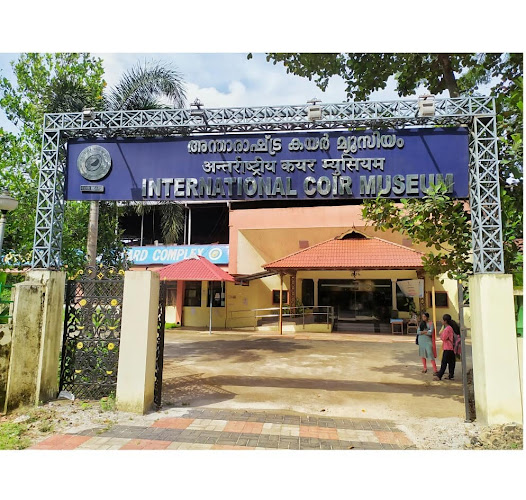
Focused on the history and technology of the coir industry, the museum displays traditional tools, archival photographs, and a variety of coir-made objects that range from everyday mats and ropes to inventive modern uses of coir fiber. It is the kind of place where layers of local craft and global trade intersect — a small institution with a big story to tell about coconut husks, hand skill, and community livelihoods.
Visitors will find exhibits that trace the entire lifecycle of coir: harvesting of husks, retting and fiber extraction, spinning and twisting, and the manufacturing processes that turn raw fiber into finished products. Interpretive panels explain traditional techniques alongside mechanized advances introduced over the 20th century. The museum highlights not only the technical evolution but also the social fabric — how families, cooperative societies, and government initiatives shaped the trade. The presentation is practical and straightforward, not overly academic, which suits the hands-on nature of the subject.
What sets this museum apart is its emphasis on real objects. There are items that rarely appear in tourist brochures: hand-twisted rope samples, early twentieth-century spinning wheels, and coirboard prototypes that show how industrial design engaged with a natural fiber. Live demonstrations and performances — often by local artisans — bring those objects to life. Watching a skilled hand pull fiber and twist it into rope is unexpectedly meditative; hearing the rhythm of the work and smelling the faint, earthy scent of processed husk somehow makes the story stick.
Accessibility and family-friendliness are practical strengths. The museum provides wheelchair-accessible entrances, parking, and restrooms, which is worth noting because heritage sites don’t always prioritize that. The layout is compact, making it manageable for families with children and older visitors. For younger visitors, the tactile dimension of coir production—textures, tools, and demonstration areas—turns history into a sensory experience rather than a series of glass cases.
On the services side, onsite demonstrations and occasional workshops offer hands-on activity, and museum staff are generally ready to explain processes in plain language. There is no in-house restaurant, so visitors should plan accordingly, but free street parking nearby makes a quick stop convenient for travelers crisscrossing the Panvel–Kochi–Kanyakumari highway or exploring Alappuzha’s coastal attractions.
The tone of the museum is earnest and rooted: it doesn’t try to be flashy. That can be a pleasant change from larger museums that overwhelm with scale. Instead, this place invites curiosity — a curious traveler will come away with a thorough primer on coir and a new appreciation for an industry that quietly underpins many livelihoods in Kerala. It also underscores a broader point: sustainable, natural fibers have long been part of circular economies here, long before such terms became fashionable in design circles.
Practical details that often get missed in quick reviews are emphasized in the displays: the environmental profile of coir as a biodegradable fiber, the role of women’s cooperatives in spinning and finishing, and the ways small-scale innovation has kept coir relevant in international markets. The museum doesn’t shy from economic realities: some panels address mechanization’s impact on jobs, the challenges of global competition, and how institutions like the Coir Board have attempted to support artisans and industry modernization. These candid notes give the visit an honest, lived-in quality — not simply celebratory nostalgia, but a nuanced look at continuity and change.
Anecdotes make the place memorable. A local guide once pointed out a faded receipt pasted inside a display case, dated decades ago, from a coir trader who shipped mats overseas. The tiny ephemera humanizes the trade; it reminds visitors that each bale of fiber represents relationships, contracts, and daily routines stretched across generations. Another frequent comment from repeat visitors is the charm of small, unexpected objects: a coir-wrapped lamp, a prototype mattress panel, or an artist’s experimental sculpture made from dyed coir fiber. Those little surprises often spark the best conversations after the tour.
Visitors should note the museum’s international outlook. While the focus is on Kerala’s craft traditions, the exhibitions place those traditions within global flows of trade and design. There’s a quiet pride in showing how local ingenuity traveled beyond the region to influence textiles, horticulture (coir pith and coir-based potting mixes), and sustainable product design worldwide. The “International” in its name is more than a label; it reflects both export history and ongoing collaborations between craft practitioners and designers overseas.
For photographers and curious minds, the museum offers rich texture and detail — the rough braids, the neat coils, the patina on wooden tools. Light is generally decent in exhibition areas, and displays are arranged for close-up viewing, though some items are behind glass. Staff are typically accommodating if a visitor wants to take time to photograph small objects or examine a tool up close during demonstrations.
Because the museum is compact, a typical visit lasts around 45 minutes to an hour if one takes in the demonstrations. Those who linger in conversation with guides or attend a workshop can easily spend longer. It’s well-suited to be part of a broader day: tissue-thin plans might pair it with Alappuzha’s backwater sights or a longer exploration of Kerala’s coir-related industries along the coast.
In short, the International Coir Museum is a focused, informative stop for travelers who appreciate craft, industrial history, and regional economies. It’s not a blockbuster attraction; rather, it rewards patience and curiosity. Those willing to slow down and listen will leave with a clearer picture of how a humble natural fiber shaped lives and landscapes — and how it still finds inventive uses today.
 Real Journey Travels