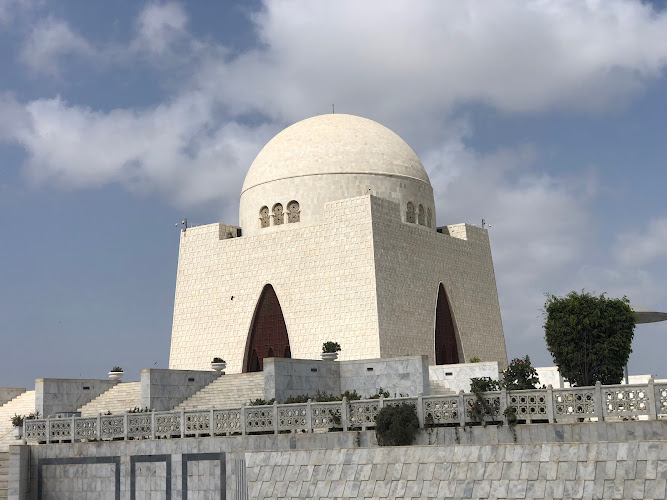
Mazar-e-Quaid-e-Azam is Karachi’s most resonant national monument: the mausoleum of Muhammad Ali Jinnah, the Quaid-e-Azam and founding father of Pakistan. Completed in 1971, it is both a place of commemoration and an enduring civic symbol, where the story of independence is expressed through a strikingly restrained architectural form. The monument’s white-marble presence stands apart from the movement and density of the surrounding city, making the approach feel ceremonial even before visitors reach the central structure.
The design is modernist rather than ornate, relying on balanced proportions, crisp geometry and a powerful contrast between pale stone, open sky and landscaped grounds. This simplicity is central to the experience. A visit is less about moving through a large collection of exhibits than about taking time to observe a landmark built for reflection, national memory and public gathering. For first-time visitors to Karachi, it offers a useful starting point for understanding how the city holds Pakistan’s political history alongside its everyday urban energy.
Standout Highlights & Experience
Give yourself time to take in the monument from several distances. Its visual impact changes as you move from the gardens toward the marble exterior and then into the more solemn interior spaces. The atmosphere is generally respectful, so this is best approached as a memorial rather than a quick photo stop.
- The white-marble monument: Notice the clean, geometric massing and the way its uncluttered surfaces create a memorable silhouette against Karachi’s light.
- The central commemorative chamber: The interior focuses attention on Jinnah’s final resting place and invites a quieter, more reflective pace.
- Modernist civic architecture: Look for the disciplined symmetry and minimal decoration that distinguish the mausoleum from more traditional South Asian tomb architecture.
- Gardens and formal grounds: The landscaped setting provides breathing room around the building and frames some of the best overall views.
- A national symbol in daily life: Watch how families, students and local visitors engage with the site as a place of remembrance, photography and civic pride.
- Changing light: Morning or late-afternoon light can bring out the texture and brightness of the marble, while a clear sky heightens the monument’s graphic form.
Practical Visitor Strategy
| Factor | What to Know |
|---|
| Best Time to Go | Choose a cooler part of the day when possible, especially in Karachi’s warmer months. Softer morning or late-afternoon light also suits exterior viewing and photography. |
| Suggested Duration | Allow around 45 to 90 minutes for the grounds, exterior details and a measured visit to the memorial spaces. Stay longer if you enjoy architecture or want unhurried photographs. |
| Crowd & Entry Tips | Expect a respectful public atmosphere and possible security or entry procedures. Carry only what you need, dress modestly, and follow instructions on photography and access when you arrive. |
| Getting Oriented | Begin with a full view from the grounds, then approach slowly to appreciate the scale. The building’s symmetry makes it easy to navigate, but pause to look back at the gardens and city context. |
This is a landmark where a little planning improves the experience. Build in time for heat, walking across open ground and any arrival checks, rather than scheduling it as a rushed stop between distant parts of Karachi. Photography is most rewarding when it includes both close studies of the marble geometry and wider compositions showing the monument within its landscaped setting. Keep voices low near commemorative areas, and treat the site’s formal character with the same consideration you would give a working memorial.
Honest Fit: Who Will Love It (and Trade-Offs)
Mazar-e-Quaid-e-Azam is especially rewarding for travelers interested in Pakistan’s independence history, modern architecture, urban landmarks and meaningful public spaces. It also works well for families, students and photographers seeking an instantly recognizable Karachi image. Travelers hoping for a museum-style visit with extensive interpretive displays may find the experience more architectural and contemplative than explanatory; reading about Jinnah and the independence movement beforehand adds useful context. The open setting can mean sun exposure and some walking, so bring water and plan for the weather; visitors with mobility concerns should confirm current access arrangements on arrival. Pair it with other central Karachi plans, a heritage-focused outing or time set aside to explore the city’s broader cultural life, while allowing this memorial its own quieter pace.
 Real Journey Travels