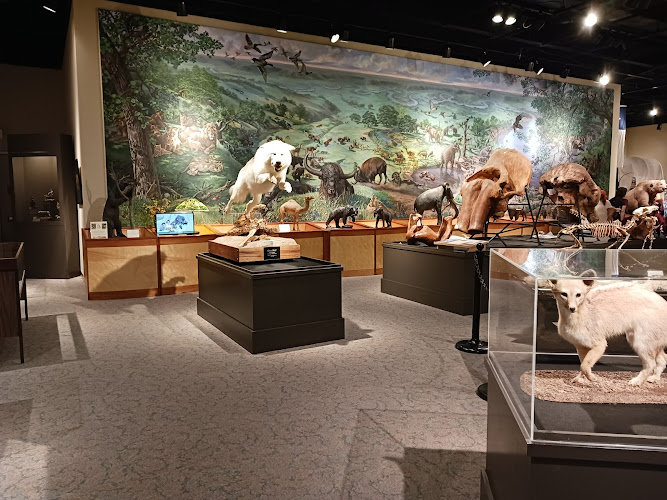
The Brazos Valley Museum of Natural History presents a focused, hands-on look at the natural and cultural story of the Brazos Valley and nearby regions of Texas. Visitors encounter a mix of scientific displays and local heritage artifacts — fossils pulled from ancient sediments, hand-hewn stone tools, historic wagons that speak to early transportation, and striking murals that stitch together geology, paleontology and human history. The museum aims to educate without being pretentious; it puts material evidence front and center so people of all ages can make sense of deep time and local life in an immediate way.
Travelers often expect a sprawling, impersonal institution when they hear the phrase natural history museum, but the Brazos Valley experience is pleasantly different. Galleries feel curated by folks who know the community and care about teaching. The interpretive panels are clear, the fossils are real and visible, and the wagons and tools are displayed so visitors can appreciate scale, workmanship and the quirks of objects that were used every day. And, yes, the murals are worth a slow walk — they pull in regional stories that aren’t plastered across generic museum labels.
In practice, the museum functions like a neighborhood learning center with museum-grade collections. It hosts school groups, families, and travelers curious about Texas natural history. Most exhibits emphasize local relevance: how prehistoric life left traces in local rocks, how early inhabitants adapted to the landscape, and how the Brazos region developed through centuries. For a traveler who wants a compact, informative stop on a Bryan–College Station itinerary, the museum is an efficient and memorable choice.
Not everything is polished to a corporate gloss, and that’s part of the charm. The atmosphere leans toward low-key dedication rather than spectacle. Staff and volunteers — many of whom are local educators, students or enthusiasts — often share context that brings exhibits to life. A docent might point out a small detail on a stone tool that opens a bigger conversation about trade networks or local geology. That kind of on-the-ground storytelling is what sets the place apart from larger institutions where interpretation can be more generalized.
Accessibility and visitor convenience are taken seriously. The site offers a wheelchair accessible entrance, accessible parking, and restrooms designed for mobility needs. Free onsite parking makes arrival easy for families traveling by car, and Wi-Fi is available for visitors who want to look up related materials on the spot or check event schedules. Practical amenities — restrooms, a gift shop and scheduled tours — mean one can plan a short visit or linger for longer without scrambling for basics.
Families with kids will find the museum particularly approachable. Exhibits are designed to spark curiosity rather than overwhelm: fossils and artifacts within reach of a child’s gaze, clear labels, and occasional hands-on programming. While it is educational at heart, the place preserves a light, playful energy during family-focused hours and events. Travelers who bring children report that a couple of hours here often turns into happy learning time rather than a chore.
For visitors who like a little behind-the-scenes flavor, the museum frequently offers guided tours or staff-led talks that go beyond static labels. These tours highlight local research, the story of artifact acquisition, and sometimes even the conservation work that keeps fragile fossils and textiles safe. Those who appreciate deeper context will want to check for scheduled programs or ask at the front desk about pre-booked group tours.
Realistically, it’s not a place built to dazzle with blockbuster skeletons or giant immersive theaters. Instead, it does steady work: it interprets the natural history and cultural heritage of the Brazos Valley with clarity, local knowledge and a dose of personality. Travelers who prefer thoughtful, local-centered museums — the kind where interpreters visit with you in the galleries and point out a favorite specimen — will walk away satisfied. For those who want Instagram-ready spectacle, temper expectations; the value here is substance, not flash.
One memorable little anecdote often mentioned by repeat visitors: during a summer visit, a volunteer quietly pulled a fossil fragment from storage and showed a family how sediment layers told a story about ancient rivers. The family left talking about geology for the rest of the day. That informal, human-scale moment is emblematic of what many visitors value — an encounter with authentic objects, guided by people who care enough to share stories beyond the placards.
Finally, the museum plays a quiet role in the regional cultural network. It connects to local schools, universities and heritage efforts, which means exhibits sometimes reflect ongoing research, recent finds or community-driven projects. Travelers who are curious about the broader Brazos Valley context will find that a stop here often leads to other discoveries in Bryan and the surrounding area.
Key Features
- Focused local collections: fossils, stone tools, wagons and regional artifacts that tell the story of the Brazos Valley
- Interpretive murals that contextualize natural history with cultural narratives
- Educational programming and tours offered onsite for families, school groups and adult learners
- Wheelchair accessible entrance, accessible parking and accessible restrooms
- Family-friendly layout and exhibits suitable for children and curious travelers
- Gift shop with locally themed items and educational souvenirs
- Free onsite parking and convenient on-site amenities like restrooms and Wi-Fi
- Admission fee supports the museum’s operations and educational outreach
- Staff and volunteers provide personable, knowledgeable interpretation
Best Time to Visit
The Brazos Valley Museum of Natural History works well as an almost-all-seasons stop because most of the experience is indoors and climate-controlled. However, timing can make a difference for comfort and crowd levels. Late morning on weekdays tends to be quieter; visitors can enjoy exhibits at their own pace without the school-group energy that often arrives later in the day. If a traveler wants a docent-led experience, checking the schedule ahead and aiming for advertised tour times is wise.
Spring and fall in Texas offer pleasant outdoor weather for pairing a museum visit with a stroll around the area or nearby attractions. Summer brings hotter temperatures, so the museum’s indoor coolness can be an attractive respite, though families often come in greater numbers during school vacations. Winter visits are fine too; the museum’s focused galleries are not weather-dependent, and holiday-time programming occasionally adds festive educational activities.
For those who prefer quieter visits and a touch of exclusivity, weekday mornings right after opening are the sweet spot. For families chasing programming, check local school calendars and museum event listings — special events and family days are often scheduled when school-age visitors can participate, which is great for kids but busier overall. Ultimately, the “best” time depends on whether the traveler prioritizes quiet study or participatory events.
How to Get There
The museum sits within the Bryan–College Station area, which is easily reached by car from surrounding towns and by travelers visiting Texas A&M University. Most visitors arrive by private vehicle; the property provides free onsite parking and straightforward access from the local road network. For visitors staying in the area, it is a short drive from a variety of hotels and local accommodations.
Public transportation options in the immediate region are limited compared with larger metro areas, so planning a car trip is the simplest approach. Rideshare and taxi services operate in Bryan–College Station and can drop off at the curb for those who prefer not to drive. The museum’s parking and accessible drop-off points make arrival convenient regardless of travel mode.
Those combining a visit with other attractions in Bryan or College Station will find the location practical for a half-day itinerary. It’s easy to pair the museum with a lunch stop in town or nearby historical sites, making it a useful component of a relaxed regional exploration rather than a single-destination day trip.
Tips for Visiting
Plan for 60–90 minutes on a typical visit. That’s enough time to read key panels, admire the fossils and artifacts, and perhaps catch a short tour. If the traveler wants to join a guided tour or attend a special program, calling ahead or checking the museum’s event calendar is recommended.
Buy admission upon arrival and ask about docent-led tours or special demonstrations. Those short tours often add context that makes exhibits far more interesting, especially for adults who want stories behind the objects and for kids who enjoy interactive moments.
Bring a camera for personal photos, but be mindful of any signage that restricts flash or tripod use. Photography is generally fine for sharing memories, yet the museum prefers that visitors respect exhibit rules so fragile items stay protected.
If traveling with mobility needs, the accessible entrance, parking and restroom facilities simplify logistics. Families with strollers will also find the layout manageable, though some exhibit areas benefit from a slower pace to appreciate small details.
Visit the gift shop before leaving. It offers a range of educational items and locally themed mementos that make nice souvenirs or gifts — useful for travelers who like to take home something directly tied to the place they visited.
Finally, ask staff about current or rotating exhibits. The museum’s connections to local research and community projects mean new material appears periodically. For travelers who love the feeling of discovering something new, a quick question at the front desk can reveal recent finds or upcoming talks that align well with a visit.
 Real Journey Travels