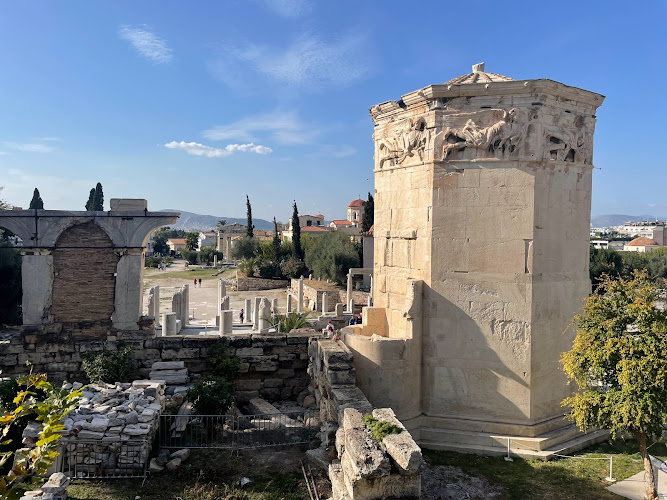
But don’t let the fancy name fool ya, this ancient octagonal tower is one of Athens’ coolest hidden gems. Tucked away in the Roman Agora, it’s like stepping into a time machine that whisks you back to the 1st century BC.
Now, I’m no expert on ancient Greek architecture, but even I can appreciate the ingenuity of this bad boy. It’s not just a pretty face – this tower was the Swiss Army knife of its day, serving as a weather station, sundial, and water clock all rolled into one. Talk about multitasking!
The outside of the tower is adorned with eight sundials, one on each face. These aren’t your garden-variety sundials either – they’re intricately carved and surprisingly accurate. And perched atop the tower? A bronze wind vane in the shape of Triton, the sea god. Fancy, huh?
But the real magic happens inside. The Horologion housed a water clock, an ancient timekeeping device that used the steady drip of water to measure the hours. It’s like the great-great-great-grandfather of our modern clocks.
Now, I gotta be honest – it’s not the Parthenon. It’s not gonna knock your socks off with its grandeur. But what it lacks in size, it makes up for in charm and historical significance. It’s a testament to the ingenuity and scientific prowess of the ancient Greeks. Plus, it’s way less crowded than some of Athens’ more famous spots, so you can really take your time exploring without feeling like you’re in a sardine can.
So, if you’re a history buff, a science nerd, or just someone who appreciates cool old stuff, the Horologion of Andronikos Cyrrhestes should definitely be on your Athens itinerary. Trust me, your Instagram followers will thank you for the unique shots!
Best Time to Visit
Alright, let’s talk timing. When’s the best time to check out this ancient marvel? Well, it really depends on what you’re after.
If you’re like me and can’t stand sweltering heat, avoid the peak summer months of July and August. Athens in summer is hotter than a sauna, and trust me, you don’t want to be trudging around ancient ruins when it feels like you’re walking on the surface of the sun.
Spring (April to mid-June) and fall (September to November) are your best bets. The weather’s mild, the crowds are thinner, and you can explore without feeling like you’re melting. Plus, in spring, you might catch some wildflowers blooming around the ruins. How’s that for a photo op?
Winter isn’t a bad choice either, especially if you’re a fan of moody skies and atmospheric ruins. Just pack a jacket and be prepared for some rain. The upside? You’ll practically have the place to yourself.
Now, here’s a pro tip: try to visit early in the morning or late in the afternoon. Not only will you avoid the midday heat (your sunburn-prone skin will thank you), but you’ll also catch some gorgeous lighting for photos. The way the sunlight hits the marble at these times… *chef’s kiss* … it’s just magical.
And hey, if you’re a real history geek (no judgment here, I’m one too), consider visiting on the spring or fall equinox. The sundials are at their most accurate on these days, and it’s pretty cool to see this ancient timekeeper in action.
How to Get There
Getting to the Horologion of Andronikos Cyrrhestes is easier than pronouncing its name, I promise!
First things first, you’ll want to head to the Roman Agora in Athens. It’s smack dab in the middle of the city’s historic center, so you can’t miss it. Now, I’m not gonna lie, Athens can be a bit of a maze, but that’s part of its charm, right?
If you’re a fan of public transport (and let’s face it, who isn’t when you’re trying to save those euros for more important things… like gyros), the metro is your best friend. Hop on the red line and get off at either Monastiraki or Acropoli station. From there, it’s just a short walk to the Roman Agora.
Now, if you’re staying in the Plaka or Monastiraki areas (smart choice, by the way), you’re in luck. The Horologion is just a stone’s throw away. You can easily walk there while soaking in the atmosphere of Athens’ old town. Just follow the signs to the Roman Agora, or better yet, get lost in the narrow streets and stumble upon it by accident. Some of my best travel memories have come from getting gloriously lost!
For those of you who prefer to be chauffeured around (no judgment here, sometimes my feet need a break too), taxis are readily available. Just make sure the meter is running to avoid any, ahem, “tourist pricing”.
And if you’re feeling adventurous, why not rent a bike? Athens has been working on becoming more bike-friendly, and it’s a great way to explore the city. Plus, you’ll feel less guilty about that extra baklava you had for dessert.
Remember, half the fun is in the journey. So don’t stress if you take a wrong turn or two. Who knows? You might discover your new favorite taverna along the way!
Tips for Visiting
Alright, fellow travelers, listen up! I’ve got some insider tips to make your visit to the Horologion of Andronikos Cyrrhestes absolutely top-notch.
First off, wear comfy shoes. I know, I know, it sounds obvious, but you’d be surprised how many people I’ve seen hobbling around in flip-flops or fancy sandals. The ground around the Roman Agora can be uneven, and you’ll want to be able to explore every nook and cranny without worrying about twisting an ankle.
Bring water. Lots of it. Athens can get hot, and there’s not much shade around the Horologion. Trust me, you don’t want to end up looking like a sundried tomato by the end of your visit.
Now, here’s a pro tip: bring a small notebook or sketchpad. Why, you ask? Well, the Horologion is a fantastic place to sit and sketch or jot down some thoughts. It’s peaceful, inspiring, and you’ll have a unique souvenir to take home.
Don’t forget your camera! The Horologion is super photogenic, especially in the early morning or late afternoon light. But here’s the thing – try to look beyond just snapping a picture of the tower. Get creative! Zoom in on the intricate carvings, or try to capture the play of light and shadow on the marble.
If you’re a history buff (high five!), consider hiring a guide or joining a tour. There’s so much fascinating info about this place that’s not immediately obvious. Did you know the tower was originally clad in bronze? Mind-blowing, right?
Oh, and don’t rush! I know it’s tempting to quickly tick it off your list and move on to the next attraction, but take your time. Sit on a nearby bench, soak in the atmosphere, and try to imagine what it was like 2000 years ago when this was a bustling center of Roman Athens.
Lastly, combine your visit with other nearby attractions. The Roman Agora is right there, and the Ancient Agora and Acropolis are just a short walk away. Make a day of it!
And remember, the best tip I can give you is to approach it with curiosity and wonder. This isn’t just an old building – it’s a window into the ingenuity and scientific knowledge of our ancestors. How cool is that?
 Real Journey Travels