## Colossal Monument of Antiquity in the Heart of Athens
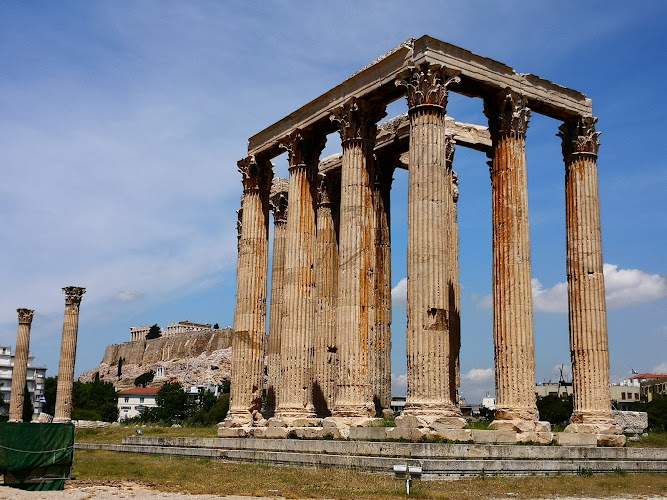
The **Temple of Olympian Zeus** (known in Greek as the *Naos tou Olympiou Dios* or simply the **Olympieion**) is one of the most monumental archaeological treasures of classical antiquity. Situated on a broad, sun-drenched plain just 500 meters southeast of the Acropolis and a short walk from Syntagma Square in central Athens, Greece, this awe-inspiring sanctuary was dedicated to Zeus, the supreme king of the Olympian gods.
During the Roman imperial period, the Olympieion was universally celebrated as the largest temple in all of Greece and one of the largest religious structures in the ancient Mediterranean world. Although centuries of earthquakes, pillaging for building stone, and atmospheric weathering have reduced its structure, the remaining sixteen colossal Corinthian columns stand as a breathtaking testament to ancient architectural ambition and craftsmanship.
## The Epic 638-Year Construction Saga
The building of the Temple of Olympian Zeus is legendary for having spanned over six centuries across multiple civilizations:
– **Tyrants and the 6th Century BC Origins:** Construction was first initiated around 520 BC by the Athenian tyrant **Peisistratus the Younger** (alongside his sons Hippias and Hipparchus), who sought to surpass the great Greek temples of Ephesus and Samos. When the Peisistratid tyranny was overthrown in 510 BC and Athenian democracy was established under Cleisthenes, work halted for over three centuries because democratic citizens viewed the colossal temple as a symbol of aristocratic hubris.
– **The Hellenistic Resumption under Antiochus IV:** In 174 BC, the Seleucid monarch **Antiochus IV Epiphanes** revived construction, hiring the renowned Roman architect Decimus Cossutius. Cossutius made the pivotal design decision to change the architectural order from Doric to the elaborate **Corinthian order**, making the temple the earliest grand building to feature Corinthian columns on its exterior perimeter. When Antiochus died in 164 BC, work once again ground to a halt.
– **The Sacking by Sulla (86 BC):** When the Roman general Sulla besieged and sacked Athens in 86 BC, he dismantled several unfinished carved capitals and columns from the Olympieion, transporting them to Rome to adorn the Temple of Jupiter Optimus Maximus on the Capitoline Hill, which helped popularize the Corinthian order across the Roman Empire.
– **Hadrian’s Triumphant Completion (131 AD):** Construction was finally completed in 131 AD by the Philhellene Roman Emperor **Hadrian**, who held deep reverence for classical Athenian culture. Hadrian officially consecrated the colossal temple during the Panhellenic festival, dedicating it to Zeus and himself.
## Colossal Corinthian Architecture and Pentelic Marble
The dimensions of the Temple of Olympian Zeus were extraordinary:
– **Colossal Proportions:** The temple stood upon a three-stepped limestone platform (*crepidoma*) measuring 110.35 meters (362 feet) in length and 43.68 meters (143 feet) in width, covering an area nearly double that of the Parthenon.
– **104 Soaring Corinthian Columns:** The temple was dipteral (octastyle dipteral), surrounded by a double colonnade of 20 columns along each flank and triple colonnades of 8 columns across the front and rear facades, totaling 104 colossal columns.
– **Carved Pentelic Marble:** Each column was sculpted from brilliant white Pentelic marble quarried from Mount Pentelicus. Standing 17.25 meters (56.6 feet) high with a base diameter of 1.7 meters (5.5 feet), each column was fluted with 24 grooves and crowned with an exquisitely hand-carved Corinthian capital featuring double rows of curling acanthus leaves and spiraling volutes.
– **Colossal Chryselephantine Cult Statues:** Inside the central cella stood a colossal gold-and-ivory (*chryselephantine*) cult statue of Zeus, rivaling the famous statue at Olympia, alongside an equally massive statue of Emperor Hadrian.
## The Fallen Column and the Surviving Pillars
Following the barbarian sack of Athens by the Heruli in 267 AD, the temple fell into decline, and over subsequent Byzantine and Ottoman centuries, its stones were quarried for lime and building material:
– **The Surviving 15 Standing Columns:** Today, a dramatic group of fifteen columns remains standing in their original positions, their weathered golden-ochre marble glowing warmly against the bright Mediterranean sky.
– **The 16th Fallen Column:** On October 26, 1852, a ferocious gale storm struck Athens, toppling one of the standing columns. Rather than re-erecting it, archaeologists preserved the column exactly where it fell, lying across the ground like fallen giant dominoes. Its separated drum segments allow visitors to inspect the ancient fluting and wooden dowel alignment holes up close.
## Hadrian’s Arch (Hadrian’s Gate)
Immediately northwest of the temple precinct, along modern Vasilissis Amalias Avenue, stands the historic **Arch of Hadrian** (*Pyli tou Adrianou*):
– Built in 131–132 AD by the Athenians to honor Emperor Hadrian for his patronage, this 18-meter-tall monumental gateway was constructed entirely of Pentelic marble without mortar or cement, joined solely with iron clamps leaded into the stone.
– The arch marked the symbolic boundary between classical Greek Athens and the new Roman quarter, bearing famous contrasting inscriptions: facing the Acropolis, it reads *”This is Athens, the ancient city of Theseus”*, while the side facing the temple reads *”This is the city of Hadrian, and not of Theseus”*.
## Practical Visitor Information and Travel Tips
– **Address:** Vasilissis Olgas Avenue, Athens, Greece, 105 57.
– **Coordinates:** 37.9693° N, 23.7331° E.
– **Operating Hours:**
– *Summer (April to October):* Daily 08:00 AM – 20:00 PM (Last entry at 19:30 PM).
– *Winter (November to March):* Daily 08:00 AM – 17:00 PM (Last entry at 16:30 PM).
– **Ticketing and Admission:**
– *Single Site Ticket:* Approximately €8 (Standard) / €4 (Reduced, winter months and eligible EU citizens).
– *Athens Combined Archaeological Ticket:* Approximately €30, valid for 5 days and providing admission to the Acropolis, Ancient Agora, Roman Agora, Temple of Olympian Zeus, Kerameikos, and Aristotle’s Lyceum.
– **Photography Tip:** The southern corner of the sanctuary offers one of Athens’ finest photographic vistas, allowing you to frame the towering Corinthian columns in the foreground with the Parthenon and the Acropolis rock rising majestically in the background.
– **Getting There:**
– *By Metro:* Take the Athens Metro Red Line (Line 2) to **Acropoli station**, exiting onto Makrigianni Street and walking two minutes east.
– *By Tram / Bus:* Take tram lines 4 or 5, or buses 1, 5, 9, or 230 to the Makrigianni or Leoforos Vouliagmenis stops.