Description
What sets this museum apart isn’t just the breadth; it’s the very local way it tells Aragón’s story. The archaeology section pulls visitors straight into the Roman city of Caesaraugusta with mosaics, sculptures, inscriptions, and everyday objects that make Roman life feel tangible rather than textbook. Then it pivots to the region’s Islamic period—delicate plasterwork, ceramics, and artifacts that trace the city’s medieval heartbeat. Zaragoza’s layers stack up quickly, and the museum does the stacking for you.
Across the courtyard, the fine arts galleries deliver an equally grounded arc: Gothic altarpieces that glow with gold leaf, Renaissance portraits, and a solid 19th–20th century run of paintings and sculpture. And yes, there are Goya works—one of the chief draws for most art lovers. Seeing Francisco Goya in Zaragoza just hits differently. He was born not far from here, shaped by the city and its contradictions, and the museum’s selection (often including paintings and print series) gives a sharp window into his restless mind. It’s not a monographic Goya museum—there’s a separate one in town—but what’s on show here rounds out the picture without overwhelming everything else.
Travelers consistently praise the museum’s elegant layout, generous space, and (let’s be honest) the excellent value. It’s a smart stop when the summer sun is high or the cierzo wind whips through the streets. Some guests do wish for more detailed English labels in every gallery. That’s a fair point, though there are bilingual sections and rotating exhibitions where translations appear. Either way, modern travelers adapt fast: a quick photo on a translation app usually clears things up. And in person, the pieces truly do the talking—those Roman mosaics and Islamic ceramics don’t need much hand-holding to impress.
Not everyone realizes that the museum also stewards ethnology and ceramics collections beyond the main site, including seasonal heritage houses like the Casa Pirenaica and Casa de Albarracín in Parque José Antonio Labordeta. If the timing works, add them to the itinerary for a deeper dive into traditional life in Aragón (they’re low‑key gems). Within the main building, the ceramics section alone can surprise people—Aragonese pottery has both rustic charm and serious craftsmanship, and it’s displayed with enough context to appreciate the evolution of style and technique.
Location-wise, the museum is an easy stroll from the city’s main axis around Paseo de la Independencia. Many visitors pair it with La Seo or a wander across the Ebro to the Basílica del Pilar, or tack on a Roman Route stop like the Caesaraugusta Forum Museum or Theater. If the goal is to understand Zaragoza beyond the postcards, this museum acts like a compass. It points to what came before, where the city stands now, and why so much of Aragón’s culture feels proudly distinct.
Allow 90 minutes for a stress‑free highlights tour, two hours if Goya and archaeology are non‑negotiables, and longer if temporary exhibitions catch the eye. The flow is forgiving: one can dip into a gallery or two and still leave with the essentials. And while it’s rarely crammed like the big national museums, weekends and late mornings draw a healthy crowd—proof that the place earns its reputation rather than coasting on it.
In short, for travelers weighing the best museums in Zaragoza, this one consistently punches above its weight. It’s beautiful, digestible, and anchored in a sense of place. Even visitors who “aren’t museum people” end up charmed, often because the Roman and Islamic sections pull them in before they realize they’ve spent half an afternoon enthralled.
Key Features
- Neo‑Renaissance building from 1908
- Designed for the Hispano‑French Exposition by Ricardo Magdalena and Julio Bravo
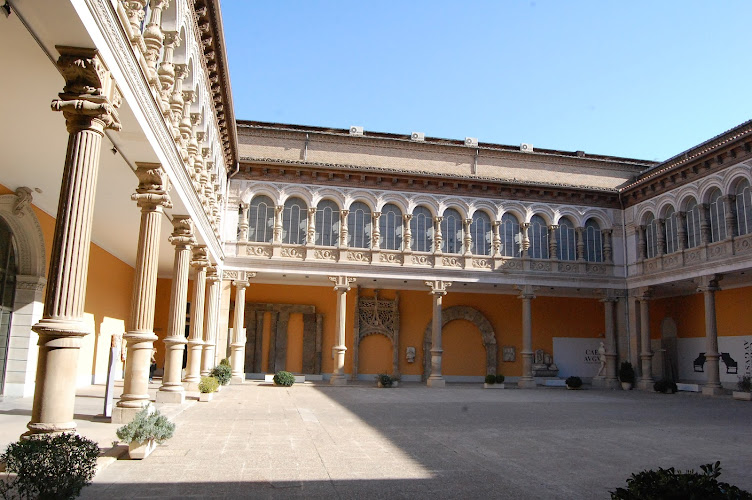
- Graceful courtyard and period details that make architecture part of the visit
- Archaeology and fine art under one roof
- Prehistory, Celtiberian, Roman Caesaraugusta, Visigothic, and Islamic collections
- Roman mosaics, inscriptions, coins, domestic objects, and statuary
- Islamic art of Aragón, including ceramics and carved stucco
- Goya presence where it matters
- Paintings and often print series that showcase Francisco Goya’s range
- Context for Goya within Aragonese art, not just as a standalone superstar
- Strong fine arts galleries
- Gothic and Renaissance altarpieces, portraits, sculpture, and 19th–20th century works
- Thoughtful curation that suits a highlights visit or a deep dive
- Ceramics and ethnology depth
- Aragonese pottery traditions explained with clarity and craft
- Seasonal heritage houses (Casa Pirenaica and Casa de Albarracín) managed by the museum
- Rotating temporary exhibitions
- Fresh themes that reward repeat visits and keep content current
- Central location on Plaza de los Sitios
- Easy to combine with La Seo, El Tubo, IAACC Pablo Serrano, Pablo Gargallo Museum, and the Caesaraugusta sites
- Traveler‑friendly pacing
- Comfortable galleries, clear flow, and manageable size for 60–120 minute visits
Best Time to Visit
Late morning on weekdays typically offers a relaxed experience with steady energy but little crowd pressure. If traveling in summer, aim for the cooler bookends of the day—first thing in the morning or in the early evening session. Zaragoza’s heat can be a scorcher in July and August, and the museum’s airy rooms provide a perfect retreat. Winter brings crisp air (and the occasional blast of cierzo), making the museum a cozy cultural stop between walks.
As with many museums in Spain, expect a midday closure and an evening reopening. That siesta rhythm can actually work in visitors’ favor: plan a culture‑and‑tapas loop. See archaeology and fine art in the morning, take a long lunch in El Tubo, then swing back for Goya and any temporary exhibition in the evening slot. Sundays stay pleasantly busy, while Saturdays tend to peak after 11:00. If traveling during major festivals or long weekends, consider arriving within the first hour to snag calm galleries for the biggest highlights.
How to Get There
The Zaragoza Museum sits on Plaza de los Sitios, a short walk from the city’s main downtown spine.
- On foot
- About 8–10 minutes from Plaza de España via Paseo de la Independencia
- Roughly 15–20 minutes from the Basílica del Pilar and La Seo
- By tram (Tranvía)
- Ride Line 1 and alight at Plaza de España or Gran Vía, then walk 7–12 minutes
- By bus
- Numerous city lines serve Paseo de la Independencia and Plaza de Aragón; from there it’s an easy stroll
- By car
- Paid garages and underground parking can be found around Plaza de los Sitios and nearby avenues
- Street parking zones change by time and day; allow extra minutes to park and walk in
- By bike/scooter
- Central streets are bike‑friendly; look for docking stations and designated parking areas near the plaza
Tips for Visiting
- Admission and tickets
- General admission is frequently free or very low‑cost; temporary exhibitions may carry a small fee
- No need to book weeks in advance; walk‑in visits are the norm outside peak moments
- Opening hours
- Expect a midday closure with an evening session reopening; Mondays are commonly closed
- Arrive early for uncrowded rooms, especially on weekends and holidays
- Photography
- Photography without flash is typically allowed in the permanent collection; restrictions may apply in temporary shows
- Always check signage in each gallery; staff will clarify if needed
- Language and signage
- Some labels are Spanish‑only; bilingual panels appear in key sections
- Use a live translation app to decode labels on the fly; it’s quick and surprisingly accurate
- How long to spend
- 60–90 minutes for highlights; 2–3 hours if combining archaeology, fine arts, Goya, and ceramics
- Plan a break in the plaza or a nearby café and return for the evening session if energy dips
- What to see first
- Start with Roman Caesaraugusta to anchor the city’s origin story
- Cross to the fine arts galleries for Goya and the Gothic/Renaissance altarpieces
- Loop through ceramics if craftsmanship and design catch your eye
- Families with kids
- Roman mosaics and artifacts captivate younger visitors; consider turning it into a “treasure hunt” for symbols and animals
- Breaks in the courtyard help keep the pace fun rather than rushed
- Accessibility and comfort
- Elevators and ramps serve key areas; the layout is generally gentle on the legs
- Pack a light layer; gallery temperatures can feel cool compared with the street in summer
- Pairing the visit
- Before or after the museum, stroll to La Seo and the Basílica del Pilar for contrasting styles of sacred art
- Consider the Caesaraugusta Forum Museum or Theater to deepen the Roman arc
- Art lovers also enjoy the Pablo Gargallo Museum and the IAACC Pablo Serrano for sculpture and contemporary angles
- Savvy planning
- If traveling during a heat wave or winter wind, use the museum as your midday anchor—it’s calm, cool, and culture‑rich
- Check for temporary exhibitions; a special show can reshape the route and is often worth the detour
- Good to know
- Some sections rotate for conservation; if a particular piece is a must‑see, verify on arrival
- A small shop or desk area may offer guides and leaflets; ask about English materials at entry
For a museum in Zaragoza that truly connects the dots—from prehistory and Caesaraugusta to Islamic artistry and Goya’s genius—this one is hard to beat. It’s central, smartly curated, and quietly beautiful. Visitors leave with a sharper sense of Aragón’s identity and a mental map that makes every step in the old streets around it feel richer. And that’s the whole point of a great city museum: it doesn’t just show objects; it tunes your eye to see the city differently the moment you step back outside onto the plaza.
 Real Journey Travels